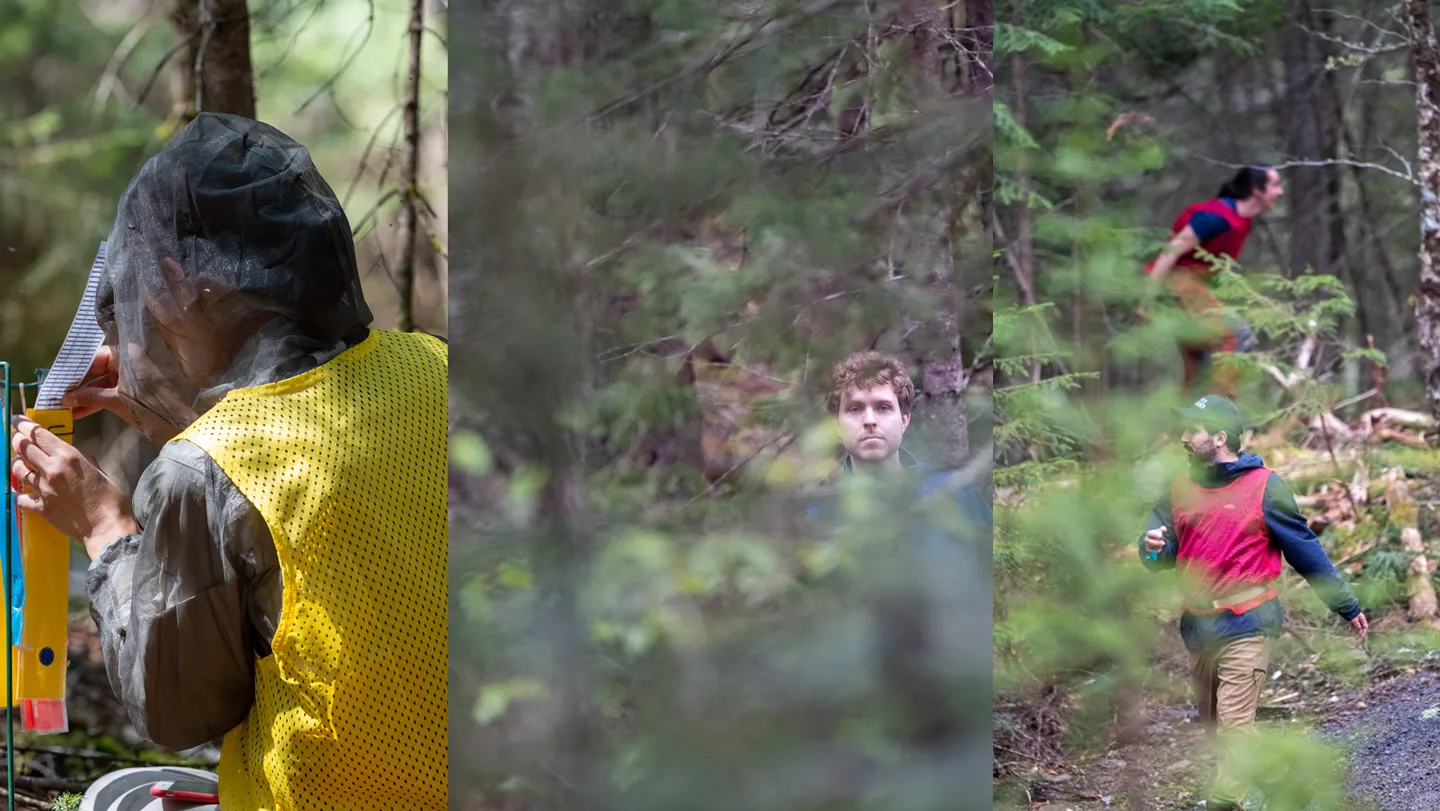
the predator was closing in, and the prey had to make a perhaps life-altering choice: find food or flee?
That prey was ecologist David bolduc. And he was one of many other researchers in a forest in Canada’s Quebec province just trying to stay alive.
“It’s so fun,” he says.
Bolduc, of Université Laval in Quebec City was one player in a game designed to explore predator-prey behaviors in the wild, but with people in place of animals. And following some basic rules, the players did indeed make decisions similar to animals, Bolduc and colleagues report November 17 in Methods in Ecology and Evolution.
Alluding to animals’ position on a food chain, the Trophic Interactions Experiment, or TrophIE, game began as a summer school project in 2023 to teach advanced techniques for analyzing big data sets.
“the game became kind of an intermediate” between mathematical models of ecosystems and field studies, says biologist Frédéric Dulude-de Broin, also at Université Laval. “We could have a lot of realism, having real players evolving in a real landscape, but still control a lot of the parameters and being able to measure everything.”
The researchers hosted nine 30-minute games,each with between 23 and 31 players in a park about 2 hours north of Montreal. Players took on roles of prey, mesopredator (an animal that preys on smaller animals) and apex predator, each identified by the color of their shirt. The goals of the prey players were to find food and mates — and not “die.” The mesopredators had to hunt but not be caught by apex predators, and apex predators had to hunt both prey and mesopredators. The team tracked each player with GPS.
“To do this with animals requires capturing both predators and prey and hoping that they interact,” Bolduc says. With the game, however, “you have the whole population [of animals], which is something quite challenging to do in the field, if not impossible.”
The players were also able to describe what they felt, saw and heard — like the sounds of footsteps on leaves — which can’t be gotten from an animal. Just like wild animals, players preferred areas they already knew, prey players avoided the more exposed and riskier main trails, and safety and competition dictated what they chose to do.
And while the players kept to the rules, there were some captivating interpretations the researchers hadn’t thought of, like prey players staying in a designated safe refuge and calling for mates.
The authors note that playing for fun and research isn’t the same as a wild animal surviving in nature, something picked up on by Liana Zanette, a wildlife ecologist at western University in London, Canada.But, she says, TrophIE seems like a great learning tool for students.
“That is really quite brilliant for that purpose,” Zanette says. It can’t get any more concrete than choosing some criteria and getting students to act them out,she adds.but, she cautions, any findings that come from a trophie game should be backed up with an experiment that manipulates different factors using real wild animals in nature.
At games’ end, the players’ excitement was obvious, with frantic discussions between the prey and the predators about what they experienced, Bolduc says. “These are things we read about, but feeling them really kind of unlocks another part of your brain.”
- Malaysia Registers 26 Rare Disease Medicines as Budget for Treatment Hits RM42 Million
- Argentina’s Childhood Vaccination Crisis: Low Rates and Vaccine Shortages Spark Health Alerts
- Szpilman Musical Comes to Park Theatre (archynewsy.com)
- Why Do Hurricanes Stall Over Land? The Science, Explained (daybreakwire.com)