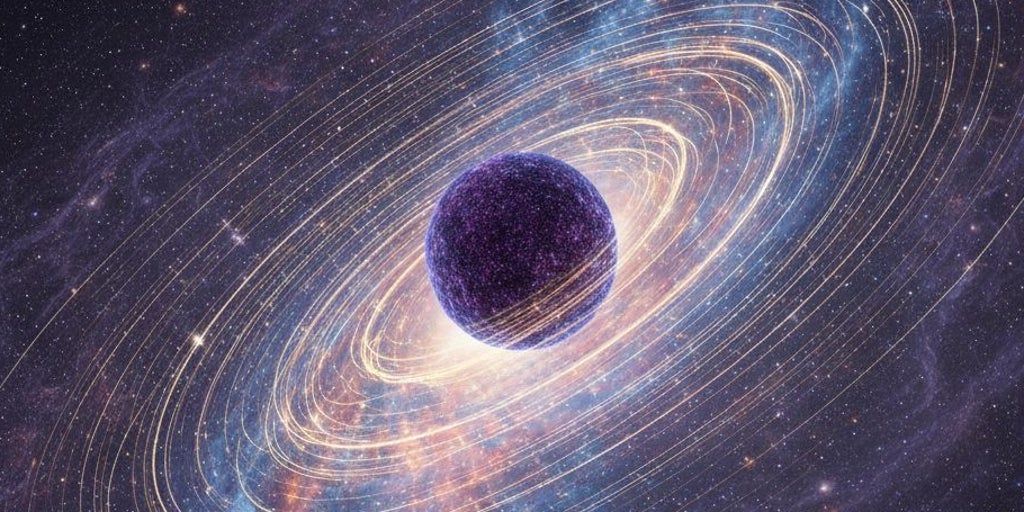
Could Dark Matter Explain the shadow at the Center of Our Galaxy?
For decades, astronomers have believed that Sagittarius A* (Sgr A), the radio source at the center of the Milky Way, is a supermassive black hole.Though, a new theoretical model proposes an option description: a dense core of dark matter could be mimicking the black hole’s observed properties, including its “shadow.”
The research, published in 2024 and building on a previous study, suggests that a sufficiently dense concentration of dark matter could create a gravitational field strong enough too bend light in a way that closely resembles the shadow observed by the Event Horizon Telescope (EHT) in 2022. This earlier work, published in *Monthly Notices of the Royal Astronomical Society, demonstrated the feasibility of such a dense dark matter core.
Unlike black holes, this proposed dark matter core wouldn’t possess an event horizon – the boundary beyond which nothing, not even light, can escape. However, its immense gravity would still warp spacetime, bending light around it. If a disk of hot gas (an accretion disk) were to orbit and illuminate this core, the resulting image would be strikingly similar to the EHT’s image of Sgr A: a dark central region surrounded by a luminous ring.
“This is a crucial point,” explains Dr. Xavier Crespi, a researcher involved in the study. “Our model not only explains the orbits of the stars and the rotation of the galaxy, but it is indeed also consistent with the famous image of the ‘black hole shadow.’ The dense dark matter core can mimic the shadow as it bends light very strongly.”
True or False?
So, is it now a stalemate? Is it impossible to determine whether we are orbiting a black hole or a ball of dark matter? While currently impossible to definitively say, the researchers point to a key difference that future telescopes may be able to detect. A genuine black hole, due to its event horizon, should exhibit a “photon ring” – a very specific and thin luminous signature. A dark matter core, lacking an event horizon, would not produce this feature.
Instruments like the GRAVITY interferometer at the Very Large Telescope (VLT) in Chile, and planned upgrades to the EHT, are expected to provide the necessary resolution to search for this distinguishing characteristic.
If confirmed, this discovery would represent a paradigm shift in modern astrophysics. Sgr A might not be the fearsome cosmic destroyer previously imagined, but instead the largest known concentration of dark matter – a substance that remains largely mysterious.
Sources:
* Crespi, X.,et al. (2024).Monthly Notices of the Royal Astronomical Society. https://academic.oup.com/mnras/article/522/3/5138/6783199
* Event Horizon Telescope Collaboration. (2022). First Image of the Supermassive Black Hole at the Center of Our Galaxy. https://eventhorizontelescope.org/
* Various news reports summarizing the research (used for context and clarity, but primary information sourced from the academic paper).
Related reading