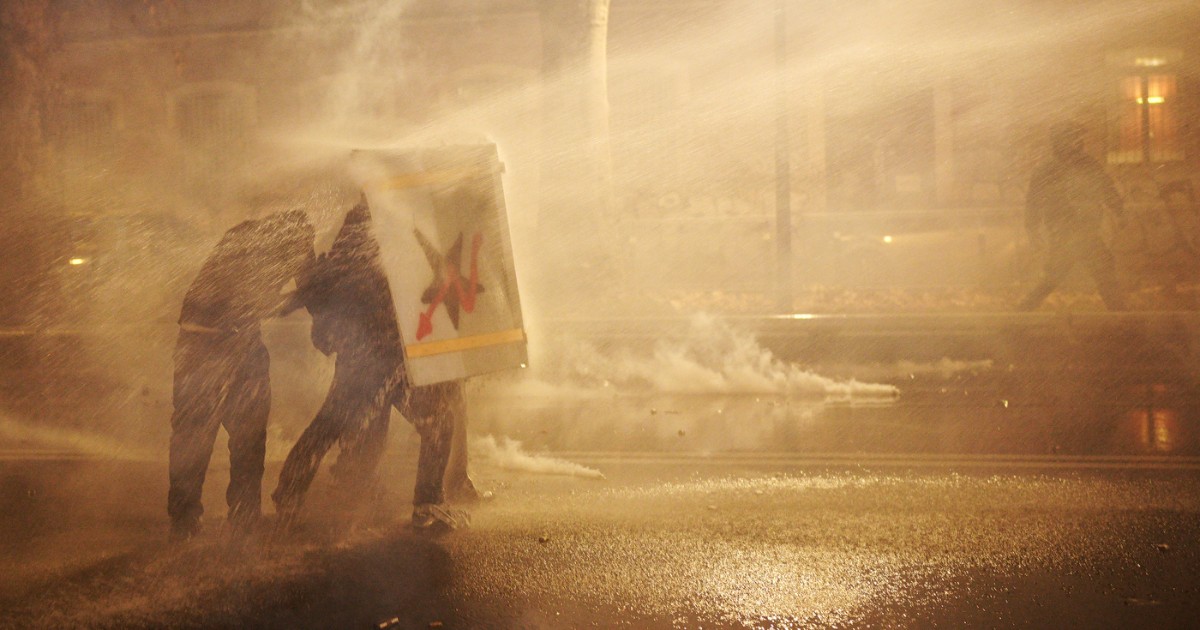
Concerns are mounting over the deployment of inadequately trained police officers during a protest in Turin, Italy, on January 31st, 2026. Reports indicate that officers with as little as two days of training were utilized during a demonstration supporting Askatasuna, a Basque separatist group, which subsequently escalated into clashes with law enforcement. The allegations, raised by Italian police unions, have sparked a debate about preparedness and risk management during public order events.
The demonstration, intended to show solidarity with the Basque independence movement, quickly devolved into what authorities described as “urban guerrilla warfare.” Videos circulating online and reported by several Italian news outlets, depict scenes of intense confrontations between protesters and police, including the use of smoke bombs, projectiles, and barricades. The situation prompted a significant police response, and it is the composition of that response that is now under scrutiny. The claims of minimal training for deployed officers raise questions about the potential for escalation and the safety of both officers, and protesters.
Askatasuna, meaning “freedom” in Basque, has historically been associated with the now-disbanded armed group ETA (Euskadi Ta Askatasuna), which waged a decades-long campaign for Basque independence from Spain and France. While ETA declared a permanent ceasefire in 2011 and formally disarmed in 2017, the organization remains a sensitive topic, and demonstrations in support of Basque self-determination often attract significant security measures. The January 31st protest in Turin, was anticipated to require a robust police presence, but the alleged lack of experience among those deployed is raising serious concerns.
Allegations of Inadequate Training
The core of the controversy lies in the assertion by Italian police unions that officers assigned to manage the Askatasuna demonstration had received only two days of training prior to deployment. This claim, initially reported by Il Fatto Quotidiano, suggests a significant gap between the level of preparation and the potential for a volatile situation. Union representatives argue that such limited training is insufficient to equip officers with the skills and judgment necessary to effectively manage large-scale protests, particularly those with a history of escalating into violence. They contend that officers require comprehensive training in crowd control techniques, de-escalation strategies, and the legal parameters governing the use of force.
The specific nature of the two-day training program has not been publicly detailed, but union officials have indicated it focused primarily on basic operational procedures and lacked sufficient emphasis on scenario-based training and risk assessment. This is particularly concerning given the known potential for demonstrations in support of Askatasuna to attract individuals with extremist views or a predisposition towards violence. The unions have called for a thorough investigation into the decision-making process that led to the deployment of these officers and a review of police training protocols to prevent similar situations from occurring in the future.
Turin’s History of Protest and Public Order
Turin, a major industrial and cultural center in northern Italy, has a long history of social and political activism, and has frequently been the site of large-scale protests and demonstrations. The city’s history of labor movements and student activism has fostered a tradition of public dissent, which often requires a significant police presence to maintain order. In recent years, Turin has as well seen an increase in protests related to immigration, economic inequality, and environmental issues. This context underscores the importance of having a well-trained and adequately equipped police force capable of responding effectively to a wide range of public order challenges.
The January 31st demonstration took place in the city center, near the Porta Nuova railway station, a major transportation hub. The location likely contributed to the potential for disruption and the need for a strong police response. The area is also home to several government buildings and commercial establishments, increasing the stakes for maintaining public safety. The choice of Turin as the location for the Askatasuna demonstration may have been strategic, intended to draw attention to the Basque cause in a city with a history of progressive activism.
The Role of WhatsApp Discover in Monitoring
Interestingly, the timing of this event coincides with increased discussion surrounding tools used for monitoring public gatherings. A tool called “Whatsapp Discover,” developed by Deepak Daswani, has gained attention for its ability to extract phone numbers from WhatsApp data. According to its GitHub repository, the tool can analyze pcap files or sniff network traffic to identify devices using WhatsApp, potentially revealing the phone numbers of individuals present at a specific location. While the real-time sniffing functionality was reportedly disabled in the initial version to prevent misuse, the tool’s capabilities raise privacy concerns and questions about the extent to which law enforcement agencies may be utilizing such technologies to monitor protests and demonstrations.
The use of such tools, even for legitimate law enforcement purposes, requires careful consideration of privacy rights and legal safeguards. The potential for mass surveillance and the targeting of individuals based on their participation in peaceful protests is a significant concern for civil liberties advocates. The availability of tools like Whatsapp Discover underscores the need for greater transparency and accountability in the use of surveillance technologies by law enforcement agencies.
Understanding WhatsApp Discover’s Capabilities
The Github page for Whatsapp Discover details its functionality, stating it can process pcap files to identify WhatsApp users. The tool was created as a proof-of-concept, and the developer explicitly notes the potential for misuse and the ease with which the real-time sniffing functionality could be re-enabled. The project’s release notes indicate it was initially released in 2015, and its continued relevance in 2026 highlights the evolving landscape of surveillance technologies.
Official Response and Ongoing Investigations
As of February 20, 2026, the Turin Police Department has not issued a comprehensive statement addressing the allegations of inadequate training. However, local officials have acknowledged the concerns raised by the police unions and have pledged to conduct a thorough internal investigation. The investigation will focus on the training records of the officers deployed to the Askatasuna demonstration, as well as the decision-making process that led to their assignment. The findings of the investigation are expected to be released within the next month.
In addition to the internal investigation, the regional prosecutor’s office has also launched a separate inquiry to determine whether any laws or regulations were violated in the deployment of the officers. The prosecutor’s office will examine the evidence gathered by the police department, as well as statements from officers, protesters, and witnesses. The outcome of the prosecutor’s investigation could potentially lead to disciplinary action against individual officers or changes in police training protocols.
The controversy surrounding the Turin demonstration has also prompted calls for greater oversight of police training programs throughout Italy. Opposition lawmakers have demanded a parliamentary inquiry into the adequacy of police training and the procedures for deploying officers to public order events. They argue that the incident in Turin is symptomatic of a broader problem of underfunding and inadequate preparation within the Italian police force.
The situation in Turin underscores the complex challenges facing law enforcement agencies in managing protests and demonstrations in an increasingly polarized political climate. Balancing the need to maintain public safety with the protection of civil liberties requires careful planning, thorough training, and a commitment to transparency and accountability. The outcome of the ongoing investigations will likely have significant implications for police training and public order management in Italy for years to come.
The next key development will be the release of the internal investigation report by the Turin Police Department, expected in March 2026. Further updates will be provided as they become available. We encourage readers to share their thoughts and perspectives on this important issue in the comments section below.
Related reading