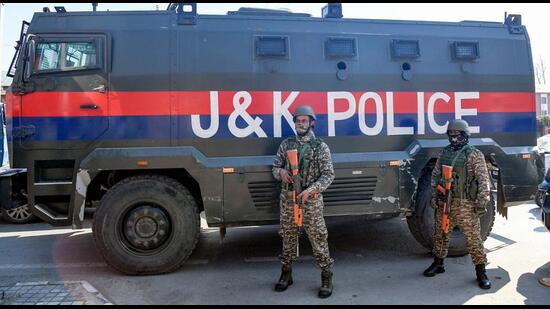
Congress Party Protest in Srinagar Met with Police Intervention
Srinagar, Jammu and Kashmir – A protest organized by the Indian Youth Congress (IYC) in Srinagar on Monday, February 23, 2026, was thwarted by local police, who prevented demonstrators from marching towards the Bharatiya Janata Party (BJP) office. The protest centered on allegations that the BJP government has compromised the sovereignty of the Prime Minister’s Office (PMO). The demonstration reflects growing opposition concerns regarding India’s foreign policy and domestic governance under Prime Minister Narendra Modi’s leadership.
The IYC activists, numbering in the scores, gathered at the Pradesh Congress Committee headquarters in Srinagar, intending to proceed towards the BJP office in Jawahar Nagar. However, police swiftly intervened, sealing the gates of the Congress office and effectively preventing the march from taking place. This action underscores the ongoing tensions between the ruling BJP and opposition parties in the region, particularly concerning issues of national sovereignty and political accountability. The incident occurred against a backdrop of increasing scrutiny of the Modi administration’s handling of international relations and domestic policy decisions.
Allegations of Compromised Sovereignty and Foreign Policy Concerns
Yasir Mandoo, president of the Srinagar Youth Congress, articulated the core grievances of the protesters, claiming that the importance and sovereignty of the PMO have been diminished since 2014, when the BJP and Narendra Modi came to power. Mandoo questioned the Modi government’s approach to international relations, specifically referencing the relationship with former U.S. President Donald Trump. He asked, “Why is Modi surrendering repeatedly in front of Donald Trump? Why is the USA framing our country’s policies? Why is Trump humiliating our country at the international level?” These questions highlight a growing narrative within the opposition that India’s foreign policy is being unduly influenced by external powers.
Mandoo further inquired about the circumstances surrounding the finalization of the US-India trade deal and the Modi administration’s silence regarding the “Epstein files,” referencing allegations involving prominent individuals and the late financier Jeffrey Epstein. These references suggest a broader concern about transparency and accountability within the government. The protest also touched upon the recent AI summit, with protesters questioning what actions tarnished the image of the country, specifically referencing the appearance of a BJP leader’s name in the Epstein files. This connection, as presented by the protesters, suggests a perceived double standard in how the government addresses allegations of misconduct.
Political Context and Regional Dynamics
The protest in Srinagar takes place within the broader political context of Jammu and Kashmir, a region with a complex history and ongoing security concerns. The region has been under direct central rule since 2019, following the revocation of Article 370 of the Indian Constitution, which granted special status to Jammu, and Kashmir. Article 370 was a constitutional provision that allowed the state of Jammu and Kashmir to have its own constitution and flag. The revocation of this article and subsequent changes to the region’s status have been met with mixed reactions, with the government asserting that the move was necessary for integration and development, whereas critics argue it undermined the region’s autonomy.
The Congress party, a major opposition force in India, has been increasingly critical of the BJP government’s policies, both domestically and internationally. The allegations leveled by Yasir Mandoo – concerning the PMO’s sovereignty and the influence of foreign powers – align with the broader opposition narrative of a weakening of India’s independent foreign policy stance. Mandoo also accused the BJP of prioritizing party interests, personal interests, and the interests of their friends, such as Adani and Ambani, over national interests. This claim reflects a common criticism leveled against the Modi administration, alleging cronyism and a lack of transparency in economic and political decision-making.
Police Response and Counter-Allegations
According to reports from Kashmir Reader, police not only sealed the Congress office gates but also allegedly “facilitated” an attack by BJP members on the Congress office. Mandoo made this claim, alleging a biased response from law enforcement. However, this counter-allegation has not been independently verified. The police have not yet issued an official statement addressing these claims. The incident raises questions about the impartiality of law enforcement in handling political protests and the potential for escalating tensions between rival political factions.
The police action reflects the authorities’ ongoing efforts to maintain law and order in the region, particularly in light of past instances of political unrest and separatist movements. Jammu and Kashmir has been a sensitive region for decades, and the government has consistently prioritized security measures to prevent any disruption to peace and stability. The sealing of the Congress office and the prevention of the march towards the BJP office can be seen as part of this broader strategy.
Broader Implications and Future Outlook
The protest in Srinagar and the subsequent police intervention highlight the growing political polarization in India and the challenges facing the opposition in voicing their concerns. The allegations made by the Congress party regarding the PMO’s sovereignty and the influence of foreign powers are likely to fuel further debate and scrutiny of the Modi administration’s policies. The incident also underscores the sensitivity of the political situation in Jammu and Kashmir and the need for careful handling of protests and demonstrations.
Looking ahead, it is likely that the opposition will continue to raise these issues in the coming weeks and months, particularly as India approaches the next general election. The government will likely defend its policies and reiterate its commitment to national sovereignty and economic development. The situation in Jammu and Kashmir remains volatile, and any further escalation of tensions could have significant implications for regional stability. The next key development to watch will be any official statement from the Jammu and Kashmir Police regarding the allegations of biased conduct during the protest.
The incident also comes amidst ongoing discussions surrounding India’s role on the global stage and its relationships with major world powers, including the United States. The questions raised by the protesters about the US-India trade deal and the influence of Donald Trump reflect a broader debate about India’s foreign policy priorities and its ability to navigate a complex geopolitical landscape. The outcome of these debates will likely shape India’s future trajectory as a major global player.
Key Takeaways:
- The Indian Youth Congress protested in Srinagar, alleging the BJP government compromised the sovereignty of the Prime Minister’s Office.
- Police intervened to prevent the protest from reaching the BJP office, leading to counter-allegations of bias.
- The protest raised concerns about India’s foreign policy, particularly its relationship with the United States and the influence of former President Donald Trump.
- The incident highlights the ongoing political tensions in Jammu and Kashmir and the challenges facing the opposition in India.
This is a developing story. We will continue to monitor the situation and provide updates as they become available. Please share your thoughts and perspectives in the comments below.
Keep reading