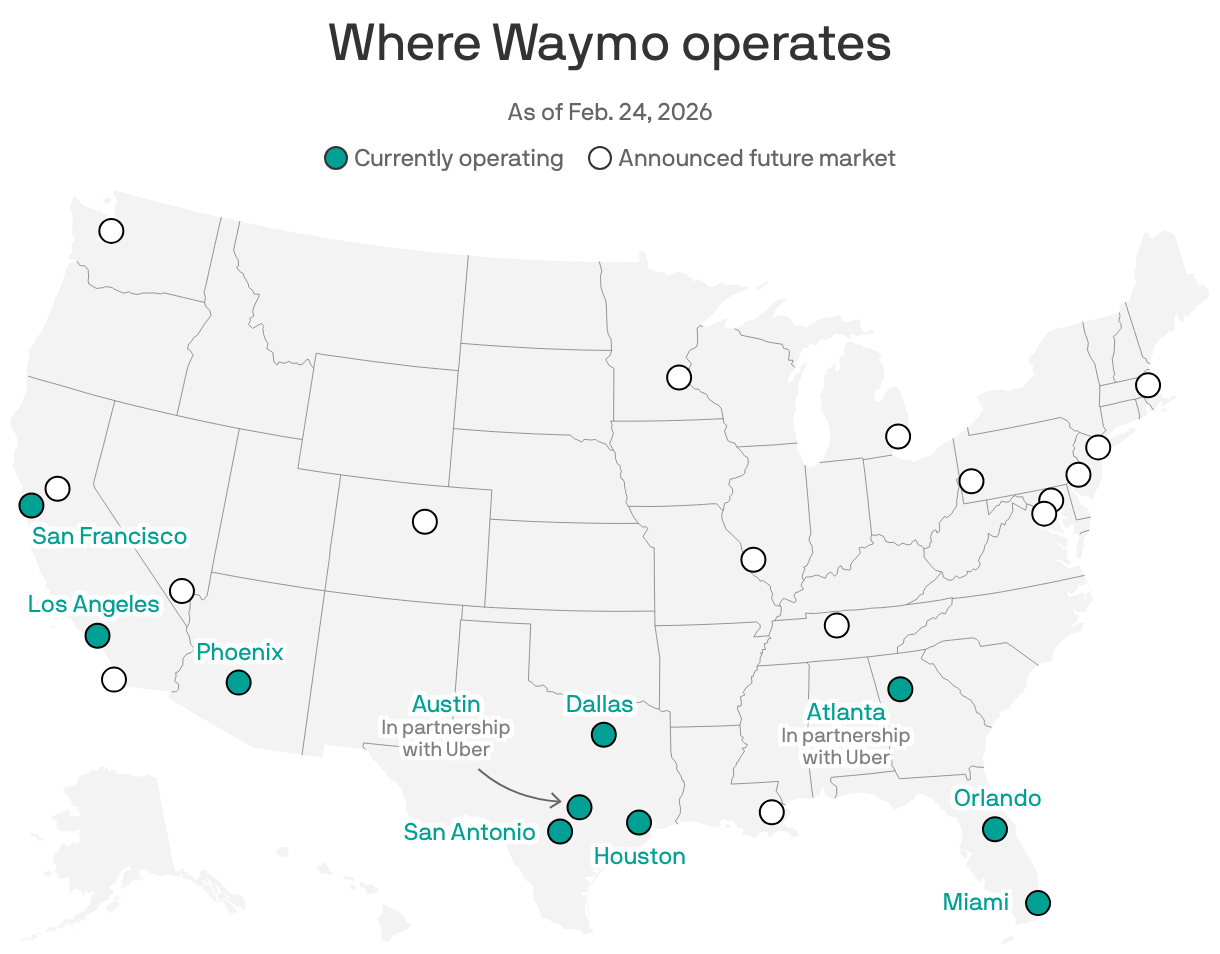
The race to deliver fully autonomous transportation is accelerating, with Waymo, Alphabet’s self-driving technology company, significantly expanding its robotaxi service across the United States. The company announced on Tuesday, February 24, 2026, that it will begin dispatching its driverless vehicles in Dallas, Houston, San Antonio, and Orlando, Florida, bringing its total operational cities to ten major U.S. Metropolitan areas. This expansion underscores Waymo’s current lead in the autonomous vehicle sector, putting pressure on competitors like Tesla and Amazon’s Zoox, who are still largely focused on testing their technologies in limited areas.
Waymo’s aggressive rollout is fueled by a recent $16 billion funding round, allowing the company to rapidly scale its operations and infrastructure. This investment is not merely about expanding geographically. it’s about building a comprehensive, nationwide network capable of handling millions of rides annually. The move into Texas and Florida represents a strategic push into large, diverse markets with varying traffic patterns and weather conditions, providing valuable data for refining Waymo’s autonomous driving system.
Waymo’s Expanding Footprint: A Nationwide Network
The addition of Dallas, Houston, San Antonio, and Orlando builds upon Waymo’s existing presence in Phoenix, the San Francisco Bay Area, Los Angeles, Miami, Atlanta, and Austin, Texas. Currently, Waymo’s robotaxis are already providing over 400,000 weekly trips across these six metropolitan areas. The company operates its own ride-hailing app in most of these cities, but in Atlanta and Austin, its robotaxis are currently accessible exclusively through the Uber ride-hailing service.
The expansion isn’t happening all at once. Waymo is employing a phased approach, initially inviting riders on a rolling basis as it builds out the necessary infrastructure – including vehicle charging stations, maintenance facilities, and remote support operations – in each new city. The company anticipates broader availability later in 2026 as it increases its fleet size and optimizes its operational capabilities. This cautious approach reflects Waymo’s commitment to safety and reliability as it introduces its technology to new environments.
A Million Rides by Year’s Complete?
Waymo has set an ambitious goal of surpassing one million weekly paid trips by the end of 2026. The company currently has approximately 3,000 robotaxis deployed nationwide, with over a third of those operating in the San Francisco Bay Area. Beyond the initial ten cities, Waymo is actively planning for expansion into at least eight additional markets, including Las Vegas, Washington D.C., Detroit, and Boston. The company is also exploring potential international opportunities, with London identified as a likely first overseas destination.
This aggressive expansion strategy is a clear signal of Waymo’s confidence in its technology and its ambition to become a dominant player in the autonomous transportation industry. However, scaling up a robotaxi service presents significant logistical challenges. Maintaining a fleet of thousands of vehicles, ensuring consistent charging and maintenance, and adapting to the unique conditions of each new city require substantial investment and operational expertise.
Challenges and Competition in the Robo-Taxi Space
Even as Waymo currently holds a significant lead, the autonomous vehicle landscape remains competitive. Tesla, despite its long-standing ambitions in the self-driving space, has been slower to deploy a fully autonomous ride-hailing service. The company continues to refine its “Full Self-Driving” (FSD) software, but widespread commercial deployment is still pending regulatory approval and further technological advancements. Amazon’s Zoox is also developing its own robotaxi, but its testing is currently limited to a few select cities.
One of the key challenges facing all autonomous vehicle companies is navigating the complex regulatory environment. State and federal regulations governing self-driving cars are still evolving, and companies must obtain permits and approvals to operate in each jurisdiction. Public perception and acceptance are also crucial factors. Building trust in the safety and reliability of autonomous vehicles is essential for widespread adoption.
Beyond regulatory hurdles and public acceptance, operational challenges such as maintaining a robust charging infrastructure and providing efficient vehicle maintenance are critical to scaling the service. Waymo’s phased rollout strategy appears designed to address these challenges proactively, allowing the company to learn and adapt as it expands into new markets. The company’s ability to overcome these obstacles will be key to achieving its goal of one million weekly rides by the end of 2026.
Key Takeaways
- Rapid Expansion: Waymo is now operating robotaxi services in ten major U.S. Metropolitan areas, doubling its reach in a matter of months.
- Significant Investment: A recent $16 billion funding round is fueling Waymo’s expansion and technological development.
- Competitive Landscape: Waymo currently leads the autonomous vehicle race, putting pressure on competitors like Tesla and Amazon’s Zoox.
- Ambitious Goals: The company aims to provide over one million driverless rides per week by the end of 2026.
Looking ahead, the next few months will be crucial for Waymo as it ramps up operations in Dallas, Houston, San Antonio, and Orlando. The company will be closely monitoring rider feedback, refining its technology, and addressing any operational challenges that arise. Waymo is also expected to announce its plans for further expansion in the coming months, potentially including the launch of pilot programs in new cities and the exploration of international markets. The company’s progress will be closely watched by industry observers and regulators alike, as it continues to shape the future of transportation.
Waymo’s next major milestone will likely be the release of data regarding the initial performance of its robotaxi service in the newly added cities, expected in the third quarter of 2026. This data will provide valuable insights into the scalability and efficiency of the company’s technology and operations. Readers interested in learning more about Waymo’s services and expansion plans can visit the company’s website at waymo.com/rides. We encourage you to share your thoughts on the future of autonomous transportation in the comments below.
Related reading
- Rappers Who Have Gone Diamond: The Ultimate List of Hip-Hop’s Biggest Hits
- Massive Wildfire in Limburg Spreads to 100 Hectares as Smoke Reaches Gelderland and Germany
- Honduras Court Rules Former President Juan Orlando Hernández Be Tried While Free (world-today-news.com)
- Houston Fire Department Statement on Fire Station 17 Incident (newsdirectory3.com)