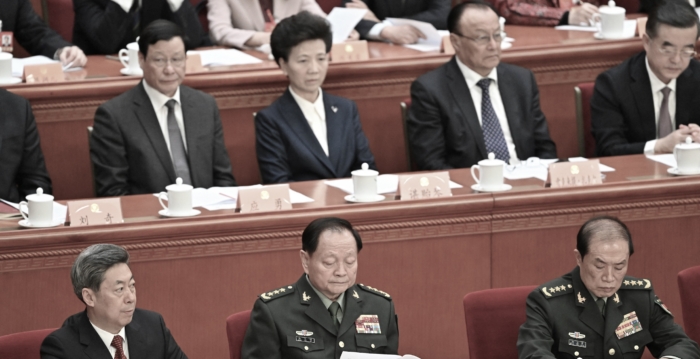
Beijing – A recent wave of dismissals within the People’s Liberation Army (PLA), culminating in the removal of nine senior military officials from the National People’s Congress (NPC), has ignited speculation about internal power dynamics within the Chinese Communist Party (CCP). The move, occurring ahead of the annual “Two Sessions” meetings, has focused attention on the position of PLA Deputy Chairman Zhang Youxia, and raised questions about potential challenges to the authority of President Xi Jinping. The unfolding situation underscores the complex interplay between the military, the legislature, and the CCP leadership, and the lengths to which the party is going to maintain control and ideological purity within the armed forces.
The removals, confirmed by state media on February 26, 2026, include high-ranking officers previously considered close allies of Zhang Youxia. The dismissals from the NPC, China’s legislature, are unusual and signal a significant escalation in the ongoing anti-corruption campaign and a broader effort to consolidate power under Xi Jinping. While officially framed as a response to corruption and maintaining discipline, analysts suggest the moves are also aimed at preempting potential opposition and ensuring unwavering loyalty within the military. The timing, just before the critical Two Sessions, amplifies the political significance of these actions.
The central figure in the current turmoil is Zhang Youxia, who has been under increased scrutiny following the investigation of former Central Military Commission (CMC) Vice Chairman He Weidong. He Weidong, along with other military leaders, is reportedly being investigated for corruption and “two-faced” behavior – a term used by the CCP to describe officials who outwardly profess loyalty while harboring dissenting views. Zhang Youxia’s own position has become precarious, with reports suggesting that attempts were made to initiate proceedings to remove him from his post. However, these attempts appear to have been met with resistance, potentially from within the NPC itself.
Zhang Youxia’s Position and Allegations of Interference
According to reports, including those cited by Yahoo News, the attempt to remove Zhang Youxia and Joint Staff Department Chief Liu Zhenli faced opposition during a hastily convened meeting of the NPC Standing Committee on February 4, 2026. Zhao Leji, Chairman of the NPC Standing Committee, is alleged to have intervened to protect Zhang Youxia, utilizing his position to halt the proceedings. This alleged intervention has fueled speculation about a power struggle within the CCP’s highest echelons. The reports suggest that Zhao Leji may share concerns about the extent of Xi Jinping’s crackdown and the potential destabilizing effects on the military and the party.
The situation is further complicated by the fact that the PLA is already operating with a reduced number of senior leaders. With the investigations of Zhang Youxia and Liu Zhenli, the CMC is now comprised of only Chairman Xi Jinping and Vice Chairman Zhang Shengmin. This creates a potential leadership vacuum and raises concerns about the PLA’s ability to effectively respond to potential crises. The removal of nine military officials from the NPC further exacerbates this situation, diminishing the representation of the armed forces within the legislature.
The allegations against He Weidong, as reported by the Central News Agency, center on “serious violations of discipline and law,” a common euphemism for corruption within the CCP. Zhang Youxia, in an article published in the People’s Daily on November 12, 2025, emphasized the need for the entire military to “consciously and thoroughly transform their thinking,” eliminate “toxic residues,” and resolutely prevent “two-faced people and false loyalty.” This article, viewed in retrospect, appears to be a preemptive attempt to address the growing concerns about disloyalty within the PLA and to reinforce the importance of ideological conformity.
The Broader Context: Xi Jinping’s Anti-Corruption Campaign and Military Reform
The current crackdown on military officials is part of a broader anti-corruption campaign launched by Xi Jinping, which has targeted officials at all levels of the CCP. While the campaign has been lauded by some as a necessary effort to combat corruption and improve governance, critics argue that it is also a tool for political purges and the consolidation of power. Xi Jinping has consistently emphasized the importance of maintaining the absolute leadership of the CCP over the military, and the recent actions appear to be aimed at ensuring that the PLA remains firmly under his control.
The ongoing military reforms, initiated under Xi Jinping, are also contributing to the current instability. These reforms, aimed at modernizing the PLA and improving its combat capabilities, have involved significant restructuring and personnel changes. The reforms have created opportunities for ambitious officers to rise through the ranks, but they have also generated resentment among those who have been sidelined or lost influence. The combination of these factors – the anti-corruption campaign, the military reforms, and the power struggle within the CCP – has created a volatile environment within the PLA.
The dismissal of nine military officials from the NPC, as reported by Yahoo Finance, underscores the extent of the purge. The individuals removed from their positions as NPC representatives are likely to face further scrutiny and potential legal action. This move sends a clear message to other military officials that any hint of disloyalty or corruption will be dealt with swiftly and decisively. The removals also highlight the CCP’s determination to maintain control over all aspects of Chinese society, including the military and the legislature.
Implications for Regional Security and International Relations
The internal turmoil within the PLA has potential implications for regional security and international relations. A weakened or divided military could be less capable of responding to potential crises, such as tensions in the South China Sea or on the Korean Peninsula. The uncertainty surrounding Zhang Youxia’s position also raises questions about the PLA’s decision-making processes and its ability to effectively coordinate with other branches of the government. The United States and other countries in the region are closely monitoring the situation and assessing the potential risks.
The CCP’s emphasis on ideological conformity and political loyalty within the military could also have negative consequences for the PLA’s professionalism and combat effectiveness. A military that is more focused on political obedience than on military competence is likely to be less innovative and less adaptable to changing circumstances. This could undermine China’s long-term military ambitions and its ability to project power in the region.
Zhao Leji’s alleged intervention to protect Zhang Youxia, as reported by various sources, suggests a degree of resistance to Xi Jinping’s policies within the CCP leadership. This resistance could further complicate the political landscape and make it more difficult for Xi Jinping to implement his agenda. The upcoming Two Sessions will be a crucial test of Xi Jinping’s authority and his ability to maintain control over the CCP and the PLA.
Key Takeaways
- The dismissal of nine PLA officials from the NPC signals a significant power struggle within the CCP.
- Zhang Youxia’s position is precarious, with allegations of corruption and disloyalty swirling around him.
- Zhao Leji is reportedly attempting to protect Zhang Youxia, potentially indicating resistance to Xi Jinping’s policies.
- The ongoing anti-corruption campaign and military reforms are contributing to the instability within the PLA.
- The situation has potential implications for regional security and international relations.
The Two Sessions, scheduled to begin in early March, will be closely watched for any further developments in this unfolding drama. The meetings will provide an opportunity for Xi Jinping to reaffirm his authority and to address the concerns about the PLA’s loyalty and combat readiness. The outcome of the Two Sessions could have a significant impact on the future of China’s military and its role in the world. Further updates on the investigations into He Weidong, Zhang Youxia, and other military officials are expected in the coming weeks.
As the situation continues to evolve, it is crucial to monitor the actions of key players within the CCP and the PLA. The stability of China’s military is essential for maintaining regional peace and security, and any disruption could have far-reaching consequences. The world will be watching closely to see how Xi Jinping navigates this challenging period and whether he can maintain his grip on power.
What are your thoughts on the recent developments within the PLA? Share your insights and perspectives in the comments below.
Keep reading