
Marathon Digital Shifts Bitcoin Strategy, Paving the Way for Potential Sales Amid AI Expansion
The cryptocurrency mining landscape is witnessing a notable shift as Marathon Digital Holdings (MARA), once a staunch proponent of holding Bitcoin as a long-term investment, has revised its strategy. The company now reserves the right to sell its Bitcoin holdings, including those not recently mined, a move that reflects a broader trend among mining firms to bolster financial flexibility and fund diversification into emerging technologies like artificial intelligence. This decision, while not entirely new – Marathon began selling Bitcoin in the latter half of 2025 – has nonetheless sparked renewed discussion about the evolving priorities within the Bitcoin mining sector and the potential impact on the market.
Marathon’s move comes as the company increasingly focuses on developing AI data centers. This strategic pivot requires significant capital investment, and liquidating some of its Bitcoin reserves provides a means to fund these ambitious projects. The company’s recent filing with the Securities and Exchange Commission (SEC) details this shift, stating that Marathon will continue to evaluate opportunities to monetize its Bitcoin holdings to enhance its financial position and support growth initiatives. This includes providing liquidity for projects and initiatives designed to increase shareholder value, contingent on market conditions and capital allocation priorities.
The decision by Marathon Digital isn’t occurring in a vacuum. It reflects a wider trend of Bitcoin miners reassessing their long-held “hodl” strategies – the practice of holding Bitcoin for the long term regardless of price fluctuations. Several prominent figures and companies within the crypto space have recently taken actions that deviate from this traditional approach, raising questions about the enduring commitment to Bitcoin as a purely long-term store of value. This has led some observers to characterize the current moment as a departure from the early ideals of the Bitcoin community, where unwavering faith in the cryptocurrency was paramount.
A Shift in Sentiment: From ‘Hodl’ to Liquidity
The narrative surrounding Marathon’s decision is complicated by a broader context of recent activity within the Bitcoin mining industry. Throughout the second half of 2025, a number of entities that previously championed Bitcoin’s long-term potential began to liquidate their holdings. This included actions attributed to individuals linked to firms like Wintermute and Jane Street, initially speculated to be part of coordinated market manipulation, though the true motivations remain complex. Marathon’s actions, while not new, add to this pattern of miners converting Bitcoin into fiat currency.
According to a 10-K filing with the SEC, Marathon historically retained the Bitcoin it produced through mining as a long-term investment. However, the company began selling Bitcoin in the latter half of 2025 to finance its operations. The filing explicitly states that Marathon anticipates continuing to monetize its Bitcoin holdings in 2026 to improve its financial flexibility, including providing liquidity to support its projects and initiatives aimed at increasing shareholder value, based on market conditions and capital allocation priorities. SEC Filing
This move isn’t necessarily a sign of waning confidence in Bitcoin itself, but rather a pragmatic response to evolving business needs. Marathon’s increasing investment in AI data centers requires substantial capital, and utilizing existing Bitcoin holdings provides a readily available funding source. The company’s strategy appears to be one of balancing its commitment to the cryptocurrency with the need to pursue new growth opportunities.
Bitcoin Holdings and Production Levels
Despite the revised sales policy, Marathon Digital has continued to accumulate Bitcoin. The company increased its holdings from 52,850 Bitcoin in September 2025 to 53,822 Bitcoin by December 2025. Throughout 2025, Marathon produced an average of 12.6 Bitcoin per day, resulting in approximately 1,134 Bitcoin mined in the final 90 days of the year. While the company now has the option to sell, it appears to have limited actual sales in the most recent quarter.
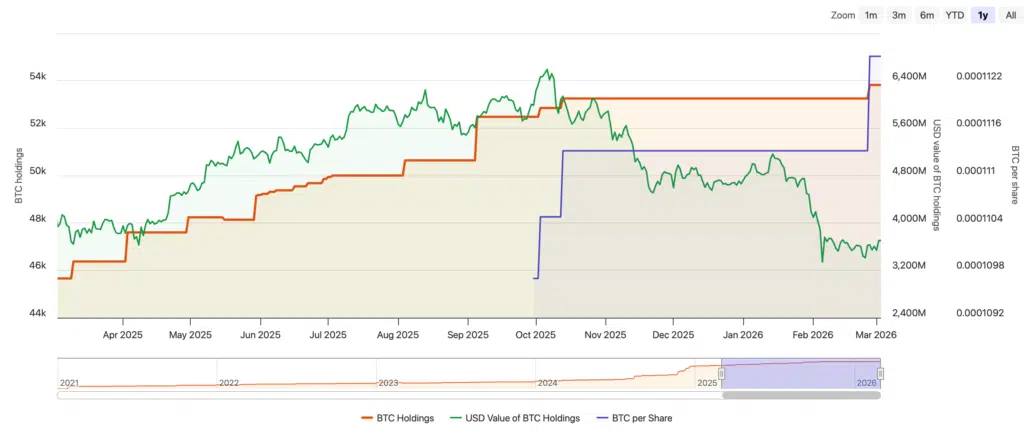
The key change lies in the company’s increased flexibility to sell not only newly mined Bitcoin but also those currently held on its balance sheet. However, Marathon has not committed to widespread sales, and the extent to which it will utilize this option remains to be seen. The company is likely to adopt a measured approach, liquidating Bitcoin strategically to fund its AI initiatives without significantly impacting the market.
Marathon Digital’s situation contrasts with that of Core Scientific, another Bitcoin mining company that has significantly reduced its Bitcoin holdings. Core Scientific has reportedly almost completely liquidated its BTC reserves, a more drastic step than Marathon’s current strategy. This divergence highlights the varied approaches being taken by different mining firms in response to changing market conditions and strategic priorities.
The broader implications of these shifts within the Bitcoin mining industry remain to be fully understood. While Marathon’s decision may not have a substantial immediate impact on the Bitcoin market, it underscores a growing trend of miners prioritizing financial flexibility and diversification. This trend could potentially lead to increased selling pressure in the future, particularly if more mining firms follow suit. However, the overall impact will likely depend on the scale and timing of these sales, as well as the broader market dynamics at play.
Investors will be closely watching Marathon Digital’s future filings and announcements for further clarity on its Bitcoin monetization strategy. The company’s next earnings call and SEC filings will provide valuable insights into its plans and the extent to which it intends to utilize its newfound flexibility to sell its Bitcoin holdings. The company is scheduled to report its first-quarter earnings in May 2026, which will likely include an update on its Bitcoin holdings and its progress in developing its AI data center infrastructure.
As the cryptocurrency landscape continues to evolve, Marathon Digital’s strategic shift serves as a reminder that even the most ardent proponents of Bitcoin are not immune to the pressures of market forces and the need to adapt to changing business conditions. The company’s decision to prioritize financial flexibility and invest in emerging technologies reflects a pragmatic approach to navigating the complexities of the digital asset space.
Related reading
- vdpResearch Identifies Trendy Neighborhoods with Above-Average Price Growth
- Zambian Kwacha and Ghanaian Cedi Forecast to Weaken
- Adidas Shares Plunge Despite Ambitious World Cup Marketing Strategy (world-today-news.com)
- Why the Blue Jays Trading Their Beloved Reliever Shouldn’t Surprise Fans (archyde.com)