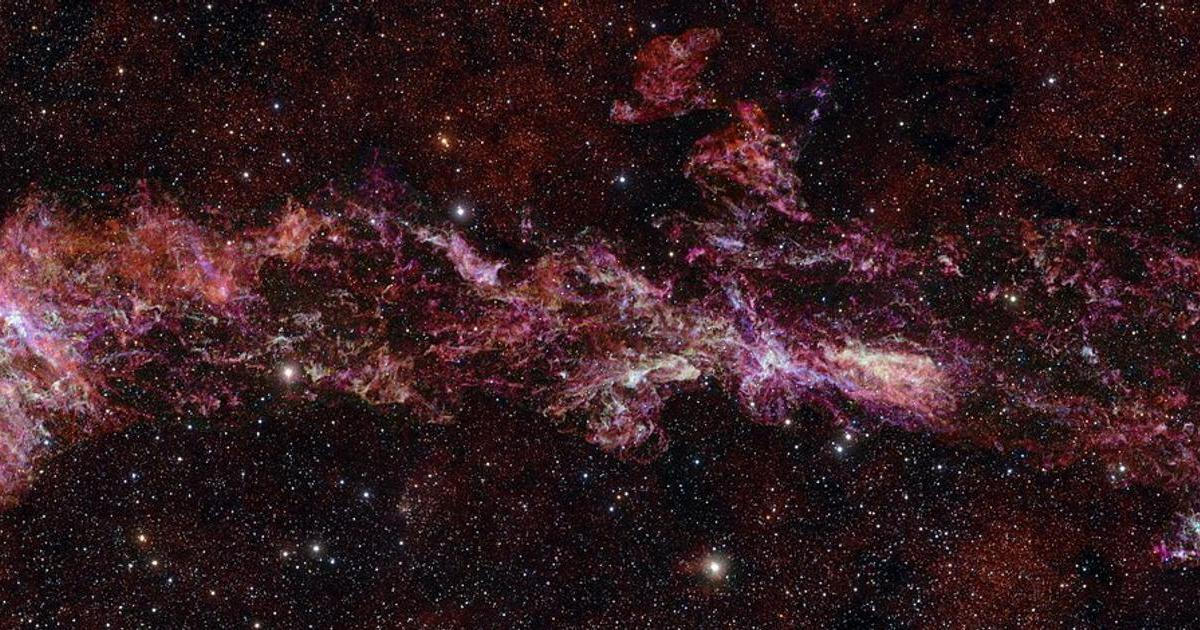
Unprecedented View of the Milky Way’s Heart Reveals Galactic Core in Stunning Detail
Astronomers have unveiled a breathtaking new image of the central region of our galaxy, the Milky Way, revealing intricate details of the supermassive black hole at its core and the surrounding environment. Captured by the Atacama Large Millimeter/submillimeter Array (ALMA) in Chile, the image provides an unprecedented look at the dense clouds of gas and dust that obscure our view of this galactic center. This region, a hotbed of star formation and intense activity, has long been a subject of fascination for scientists, and this new data promises to unlock further secrets about the evolution of galaxies. The image showcases an area spanning over 650 light-years – a distance it would grab light 650 years to traverse – offering a comprehensive view of the complex structures within the Central Molecular Zone (CMZ).
The heart of the Milky Way is a chaotic and dynamic place, teeming with gas and dust that make it difficult to observe in visible light. ALMA, though, is designed to detect millimeter and submillimeter wavelengths of light, which can penetrate these obscuring clouds, allowing astronomers to peer into the galactic core with remarkable clarity. This new observation isn’t just a pretty picture; it’s a crucial step forward in understanding how stars form in extreme environments and how supermassive black holes influence the evolution of their host galaxies. The data collected will help refine models of galactic evolution and provide insights into the processes that shaped our own cosmic neighborhood.
“It’s a place of extremes, invisible to the human eye, but now revealed in extraordinary detail,” said astronomer Ashley Barnes, who participated in the project with over 160 other researchers, according to the European Southern Observatory (ESO). The observation provides a unique view of cold gas – the raw material from which stars are born – within the CMZ. This marks the first time scientists have been able to study the cold gas in this region with such high resolution.
Unveiling the Central Molecular Zone
Previously, astronomers had only isolated images of smaller areas within the center of the Milky Way. As Steve Longmore, professor of astrophysics at Liverpool John Moores University in the United Kingdom, explained, “It was like having photographs of a few streets, but lacking a map of the entire city.” This new image provides that comprehensive map, allowing researchers to trace the relationships between different structures – where gas accumulates, where stars are born, and how these processes are interconnected. The ALMA telescope, a powerful array of 66 high-precision antennas, is ideally suited for this type of observation, allowing scientists to resolve fine details within the galactic core.
The CMZ is a particularly interesting region due to the fact that it contains a disproportionately large amount of molecular gas compared to other parts of the Milky Way. This gas is compressed by the gravitational forces of the supermassive black hole, Sagittarius A*, located at the very center of the galaxy. This compression triggers the formation of dense clumps of gas that eventually collapse under their own gravity to form stars. Understanding the dynamics of this gas is crucial for understanding the star formation rate in the galactic center.
Unexpected Filamentary Structures
One of the most surprising discoveries revealed by the new image is the presence of long, thin filaments of gas. These filaments appear to be streams of matter flowing towards the supermassive black hole, accumulating and ultimately contributing to star and planet formation. “The long, thin filaments we see in the image are streams of material that are clumping together and giving birth to stars and planets – and that was unexpected,” Longmore stated. These filaments represent a previously unknown mechanism for star formation in the galactic center, challenging existing theories about how stars are born in such extreme environments.
The discovery of these filaments suggests that the galactic center is a more dynamic and complex environment than previously thought. The filaments are likely formed by the interaction between the supermassive black hole’s gravity and the surrounding gas clouds. As the gas spirals towards the black hole, it becomes compressed and heated, eventually forming these long, thin structures. The filaments then act as conduits, channeling material towards regions of high density where stars can form. This process is thought to be a key driver of star formation in the galactic center.
The Role of ALMA and Future Research
The Atacama Large Millimeter/submillimeter Array (ALMA) is an international partnership of Europe, North America, and East Asia in cooperation with the Republic of Chile. Located in the Atacama Desert of northern Chile, ALMA is one of the most powerful telescopes in the world, capable of observing the universe at wavelengths that are invisible to the human eye. The telescope’s high sensitivity and resolution allow astronomers to study the faintest and most distant objects in the universe, providing unprecedented insights into the formation and evolution of galaxies, stars, and planets.
The data from ALMA is not only providing new insights into the galactic center but likewise helping astronomers to refine their understanding of supermassive black holes. Sagittarius A*, the black hole at the center of the Milky Way, has a mass of about 4 million times that of the Sun. While black holes themselves are invisible, their presence can be inferred from their gravitational effects on surrounding matter. By studying the motion of stars and gas near Sagittarius A*, astronomers can learn about the black hole’s mass, spin, and environment.
Key Takeaways
- A new image from ALMA reveals unprecedented detail of the Milky Way’s galactic center.
- The image highlights the Central Molecular Zone (CMZ), a region rich in gas and dust where stars are born.
- Unexpected filamentary structures were discovered, suggesting a new mechanism for star formation.
- The observations provide valuable insights into the dynamics of supermassive black holes and their influence on galactic evolution.
Future research will focus on studying the filaments in more detail, determining their composition and how they contribute to star formation. Astronomers also plan to employ ALMA to observe other galaxies, searching for similar filamentary structures and gaining a better understanding of how star formation occurs in different galactic environments. The ongoing observations and analysis of ALMA data promise to continue to revolutionize our understanding of the universe and our place within it. The next phase of research will involve combining ALMA data with observations from other telescopes, such as the James Webb Space Telescope, to obtain a more complete picture of the galactic center.
As research continues, astronomers anticipate further discoveries that will challenge existing theories and deepen our understanding of the cosmos. The Milky Way’s center, once shrouded in mystery, is now being revealed in stunning detail, offering a glimpse into the fundamental processes that shape our universe. Stay tuned for further updates as scientists continue to analyze the data and unravel the secrets of our galactic core.
- WhatsApp Makes Parental Controls Easier to Find With New Settings Update
- CXMT Stock Skyrockets 500%: AI Chip Demand Drives China’s Newest Giant
- Best LEGO Star Wars and Alternative Building Block Sets: Reviews and News (world-today-news.com)
- Tadej Pogacar Wins Fifth Tour de France Title to Equal All-Time Record (time.news)