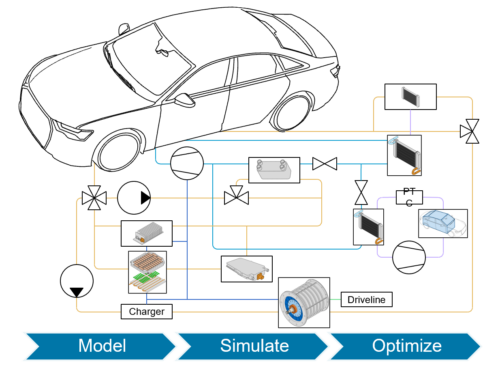
The relentless push for greater range, faster charging, and improved longevity in battery electric vehicles (BEVs) hinges on a critical, often unseen, component: the thermal management system. Maintaining optimal battery temperature is paramount, and automakers and technology developers are increasingly turning to sophisticated modeling and simulation techniques to refine these systems before a single physical prototype is built. This approach, leveraging virtual vehicle models and tools like Simulink and Simscape, allows for comprehensive testing and optimization, ultimately impacting vehicle performance and efficiency.
Optimizing a BEV’s thermal management isn’t simply about keeping the battery cool. It’s a complex balancing act. Batteries perform best within a specific temperature range, and deviations – whether too hot or too cold – can significantly degrade performance, shorten lifespan, and even pose safety risks. The thermal management system must therefore regulate temperature not only during demanding driving conditions but also during charging and in varying climates. This requires careful consideration of multiple subsystems working in concert, including the electric powertrain, driveline, refrigerant cycle, coolant cycle, and even the passenger cabin’s heating and cooling needs. According to a report by Mordor Intelligence, the global electric vehicle thermal management system market is projected to reach $12.89 billion by 2029, growing at a CAGR of 14.88% from 2024 to 2029, demonstrating the increasing importance of this technology.
The Power of Virtual Prototyping
Traditionally, automotive thermal management systems were developed through iterative physical prototyping – a costly and time-consuming process. Building and testing multiple physical prototypes to explore different design parameters is no longer the most efficient path. Now, virtual vehicle models offer a powerful alternative. These models, like the mid-size BEV model explored in a recent webinar, allow engineers to simulate real-world driving conditions and analyze the impact of various design choices without the expense and delays of physical testing. The webinar, which utilizes software like Simulink and Simscape, focuses on design exploration, component refinement, and system-level optimization. This digital twin approach allows for sensitivity analysis, identifying which parameters have the greatest impact on vehicle consumption and thermal performance.
The benefits of this virtual approach are substantial. Engineers can test a wider range of drive cycles and environmental conditions than would be feasible with physical prototypes. They can also quickly iterate on designs, evaluating the effects of different cooling strategies, component sizes, and control algorithms. This accelerated development cycle translates to faster time-to-market and potentially significant cost savings. Virtual testing can uncover potential issues that might not be apparent in physical testing, leading to more robust and reliable thermal management systems.
Key Components and Challenges in BEV Thermal Management
A typical BEV thermal management system is a complex network of components working to maintain optimal battery temperature. These include:
- Coolant System: Circulates coolant through the battery pack to remove heat. The coolant itself is often cooled by a radiator, similar to a traditional internal combustion engine vehicle.
- Refrigerant System: Used for both heating and cooling, often employing a heat pump to efficiently transfer heat between the battery, cabin, and ambient air.
- Heating, Ventilation, and Air Conditioning (HVAC) System: Manages cabin temperature, which can also impact battery temperature due to heat transfer.
- Battery Management System (BMS): Monitors battery temperature and controls the cooling and heating systems to maintain optimal operating conditions.
- Phase Change Materials (PCMs): Increasingly used to absorb and release heat, providing a passive thermal management solution.
However, several challenges remain in optimizing these systems. One significant hurdle is the varying thermal characteristics of different battery chemistries. Lithium-ion batteries, the most common type in BEVs, have specific temperature sensitivities that must be carefully managed. The increasing energy density of batteries – a key driver of longer range – also presents thermal challenges, as more energy is packed into a smaller space, generating more heat. According to research published in *Nature*, graphene-enhanced batteries offer a potential solution, promising enhanced charging efficiency and improved thermal management capabilities. Graphene’s high thermal conductivity could play a crucial role in dissipating heat more effectively.
The Role of Simulation and Modeling
Tools like Simulink and Simscape are becoming indispensable in the development of advanced thermal management systems. These platforms allow engineers to create detailed virtual models of the entire vehicle, including all relevant thermal components. By simulating different driving scenarios, cooling strategies, and environmental conditions, engineers can identify potential weaknesses and optimize the system for maximum performance and efficiency. The ability to perform sensitivity analysis – systematically varying different parameters to assess their impact – is particularly valuable. This allows engineers to pinpoint the most critical design factors and focus their efforts on optimizing those areas. The webinar mentioned utilizes this approach to analyze the impact of design parameters on vehicle consumption.
Beyond component-level optimization, simulation also enables system-level analysis. This means considering the interactions between different subsystems – for example, how the HVAC system affects battery temperature, or how regenerative braking impacts thermal load. This holistic approach is essential for achieving optimal thermal performance and maximizing vehicle range. Virtual testing can help identify potential safety issues, such as thermal runaway – a dangerous condition where the battery overheats and can potentially catch fire.
Future Trends in BEV Thermal Management
The field of BEV thermal management is rapidly evolving, with several promising trends emerging. One key area of innovation is the development of more efficient heat pumps. Traditional heat pumps can lose efficiency in extremely cold temperatures, but new designs are overcoming this limitation, enabling more effective heating in cold climates. Another trend is the use of direct cooling technologies, where coolant is circulated directly through the battery cells, rather than through a cooling plate. This can improve cooling efficiency and reduce thermal gradients within the battery pack.
advanced control algorithms are being developed to optimize thermal management based on real-time driving conditions and battery state. These algorithms can predict future thermal loads and proactively adjust the cooling and heating systems to maintain optimal temperature. The integration of artificial intelligence (AI) and machine learning (ML) is also gaining traction, enabling more sophisticated thermal management strategies. AI-powered systems can learn from driving data and adapt to individual driver behavior and environmental conditions, further improving efficiency and performance. Achieving micron-level tolerances in the manufacturing of these components, as highlighted in a recent article, is also crucial for optimal performance. CAD optimization for 3D printing is playing a key role in achieving these precise tolerances.
As battery technology continues to advance and BEV adoption accelerates, the importance of effective thermal management will only grow. The ability to optimize these systems through virtual prototyping and advanced control algorithms will be crucial for unlocking the full potential of electric vehicles and ensuring their long-term reliability and performance.
The next step in the development of these systems will likely involve increased collaboration between automakers, battery manufacturers, and technology providers. Sharing data and expertise will be essential for accelerating innovation and addressing the complex challenges of BEV thermal management. Further research into novel materials and cooling technologies will also be critical for pushing the boundaries of performance and efficiency.
Key Takeaways:
- Optimizing BEV thermal management is crucial for maximizing range, lifespan, and safety.
- Virtual prototyping using tools like Simulink and Simscape significantly accelerates development and reduces costs.
- Advanced control algorithms and AI/ML integration are enabling more sophisticated and efficient thermal management strategies.
- Future trends include more efficient heat pumps, direct cooling technologies, and novel materials like graphene.
Do you have thoughts on the future of electric vehicle technology? Share your comments below, and be sure to share this article with your network!
Related reading
- Oura Ring 5 Review: Is the Smaller Design Worth the Higher Price?
- Inflation Fears Surge: Bond Yields Hit Multi-Year Highs as Oil and Geopolitical Risks Pressure Markets
- Luke Littler Defends World Matchplay Title With Record-Breaking Performance (archyworldys.com)
- The Impact of Electric Utility Shut-Offs on Vulnerable Families (newsdirectory3.com)