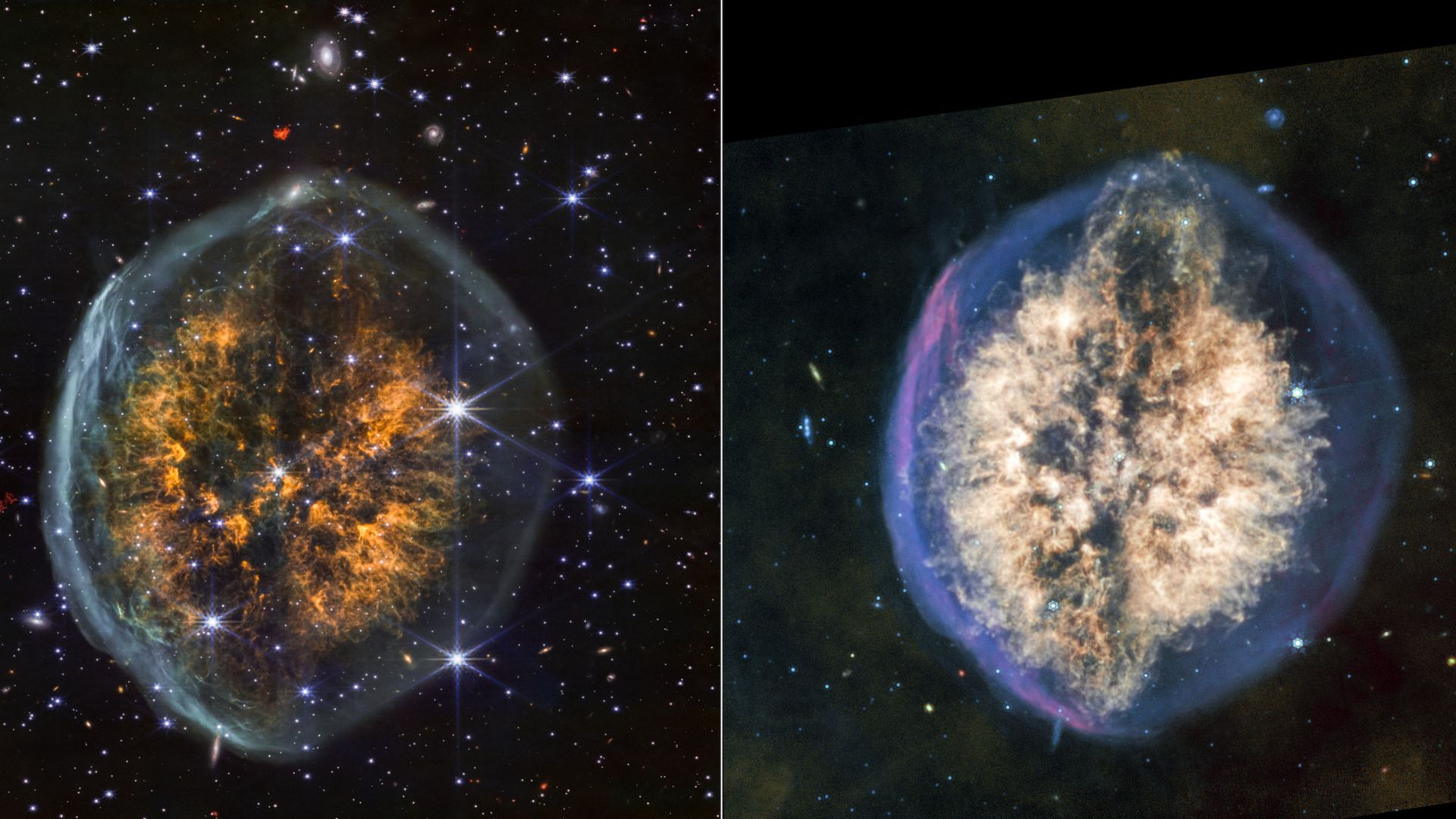
The cosmos continues to reveal its breathtaking beauty, and the latest images from the James Webb Space Telescope (JWST) are no exception. A newly released view of nebula PMR 1, affectionately nicknamed the “Exposed Cranium,” offers an unprecedented look at the remnants of a dying star, resembling a ghostly skull illuminated from within. This captivating image, captured on February 25, 2026, isn’t just visually stunning; it provides astronomers with valuable insights into the complex processes that occur as stars reach the end of their lives.
Located approximately 5,000 light-years away in the constellation Vela, PMR 1 is a planetary nebula – an expanding shell of gas and dust ejected by a star in its final evolutionary stages. Even as first observed in 2014 by the Spitzer Space Telescope, a predecessor to JWST, the nebula has remained relatively unstudied until now. The enhanced capabilities of the Webb telescope are allowing scientists to dissect its structure and understand the mechanisms driving its formation with remarkable clarity. This isn’t simply a beautiful picture; it’s a window into stellar evolution, offering clues about the fate of our own sun billions of years from now.
The “Exposed Cranium” moniker is particularly apt, as the nebula’s shape strikingly resembles a brain within a transparent skull. This eerie resemblance has captivated the public and scientists alike, highlighting the often-unexpected artistry found in the universe. But beyond the aesthetic appeal, the image reveals intricate details about the nebula’s composition and dynamics, details previously hidden from view.
Unveiling the Details with Near- and Mid-Infrared Light
The new images of PMR 1 are presented as a side-by-side comparison, showcasing data captured by two of JWST’s powerful instruments: the Near-Infrared Camera (NIRCam) and the Mid-Infrared Instrument (MIRI). Each instrument observes the nebula at different wavelengths of light, revealing distinct features. According to NASA, this multi-wavelength approach is crucial for a comprehensive understanding of the nebula’s structure and evolution. The ability to see in infrared allows the telescope to penetrate the dust clouds that obscure visible light, revealing hidden details.
In the NIRCam image, the outer bubble of the nebula appears bright white, while the inner clouds glow with an orange hue. A prominent dark lane bisects the nebula vertically, creating the illusion of two hemispheres – the “brain” within the “skull.” Stars and distant galaxies are also visible through the outer shell, providing a sense of the vastness of space. This view emphasizes the overall structure and highlights the contrast between the outer and inner regions of the nebula.
The MIRI image, however, presents a different perspective. The outer bubble appears bluish with a touch of purple, and the inner clouds appear thicker and more complex. While the central dark lane is less visible due to obscuration by dust and gas, the MIRI data reveals subtle details about the gas composition and temperature within the nebula. The differences between the NIRCam and MIRI images aren’t contradictory; they’re complementary, offering a more complete picture of the nebula’s intricate structure.
The Significance of the Dark Lane and Stellar Outbursts
The dark lane running through the center of PMR 1 is a particularly intriguing feature. Astronomers believe this lane is connected to an outburst or outflow from the central star, potentially representing twin jets of gas ejected in opposite directions. Evidence supporting this hypothesis is particularly noticeable in the MIRI image, where the inner gas appears to be ejected outward at the top of the nebula. This suggests a dynamic process is still underway, with the star continuing to shed its outer layers.
The Webb telescope’s high resolution allows astronomers to study this dark lane in unprecedented detail. It’s not simply a void; it’s a region where dust and gas are concentrated, obscuring the light from behind. Understanding the composition and dynamics of this lane is crucial for unraveling the history of the star’s evolution and the processes that shaped the nebula’s unique structure. The observation of these jets is consistent with models of planetary nebula formation, where mass loss from the central star plays a key role.
A Stellar Life Cycle in Action
The images of PMR 1 provide a snapshot of a star nearing the end of its life. As stars age, they eventually exhaust their nuclear fuel. When this happens, they begin to expel their outer layers into space, creating a planetary nebula. The outer shell of gas, visible in the NIRCam image, consists primarily of hydrogen, which was ejected earlier in the star’s life. The inner clouds, seen more clearly in the MIRI image, contain a mixture of different gases and dust, expelled more recently. This layered structure reflects the different phases of the star’s evolution.
The ultimate fate of the star at the center of PMR 1 depends on its mass. If the star is massive enough, it will eventually explode as a supernova, leaving behind a neutron star or black hole. However, if the star is less massive, like our sun, it will continue to shed layers, eventually collapsing into a dense, shriveled core known as a white dwarf. The JWST observations will help astronomers determine the star’s mass and predict its ultimate fate. The study of PMR 1 contributes to a broader understanding of stellar evolution and the life cycle of stars.
What is a Planetary Nebula?
Planetary nebulae, despite their name, have nothing to do with planets. The term originated with early astronomers who, using small telescopes, observed these objects and noted their resemblance to the disks of planets. In reality, they are the expelled outer layers of dying stars, illuminated by the hot core that remains. These nebulae are relatively short-lived, lasting only a few tens of thousands of years before dissipating into space. They represent a crucial stage in the life cycle of stars like our sun, enriching the interstellar medium with heavy elements that will eventually form new stars and planets.
The James Webb Space Telescope, with its unparalleled sensitivity and resolution, is revolutionizing our understanding of these celestial objects. By observing planetary nebulae like PMR 1 in unprecedented detail, astronomers are gaining new insights into the processes that shape the universe and our place within it. The “Exposed Cranium” nebula serves as a poignant reminder of the dynamic and ever-changing nature of the cosmos.
Further research and analysis of the JWST data are ongoing, and astronomers anticipate even more discoveries in the coming months. The telescope continues to push the boundaries of our knowledge, revealing the hidden wonders of the universe one image at a time. The next major data release from the Webb telescope is scheduled for late 2026, promising even more spectacular views and scientific breakthroughs.
What are your thoughts on this stunning image? Share your comments below, and don’t forget to share this article with your friends and colleagues!
- Dr. Bernard Roizman: Renowned Herpes Simplex Virologist Dies at 96
- Glucosamine Linked to Higher Alzheimer’s and Dementia Risk, Study Warns
- Kokoro Nakazawa’s Stunning Goal: Japan vs. Czechia | World Lacrosse Women’s Championship (archyde.com)
- Star Singer S10 Episode 103: Stunning Duets, Album Songs and a Surprise Birthday Celebration (world-today-news.com)