
Bangkok – Thailand’s Securities and Exchange Commission (SEC) is moving forward with proposed regulations designed to enhance transparency and curb illicit financial activity within the country’s rapidly growing digital asset market. The proposed “Travel Rule,” aligning Thailand with international standards, requires digital asset businesses to collect and transmit sender and recipient information for transactions exceeding 30,000 baht (approximately $830 USD as of March 12, 2026). While intended to combat money laundering and cybercrime, the proposal has sparked concern among industry stakeholders who fear overly restrictive implementation could stifle innovation and undermine the decentralized nature of blockchain technology.
The move comes as Thailand experiences increasing instances of financial fraud and the use of “mule accounts” – accounts used to receive and transfer illicit funds – facilitated by digital assets. The SEC views increased oversight as crucial to maintaining the integrity of the market and protecting investors. However, balancing security with the innovative potential of digital assets remains a key challenge. The proposed regulations are currently open for public comment until March 25, 2026, allowing industry participants to weigh in on the specifics of implementation.
The “Travel Rule” itself isn’t new; it’s a globally recognized standard developed by the Financial Action Task Force (FATF), an intergovernmental body dedicated to combating money laundering and terrorist financing. The FATF Recommendation 16 specifically addresses virtual assets and virtual asset service providers (VASPs), requiring them to implement customer due diligence and transaction monitoring procedures. Thailand’s proposal represents a significant step towards full compliance with these international guidelines.
Concerns Over Implementation and Innovation
Digital asset businesses operating in Thailand have voiced concerns that a rigid interpretation of the Travel Rule could inadvertently hinder the growth of the sector. Nirun Fuwattananukul, chief executive of Binance TH by Gulf Binance, emphasized the need for a balanced approach. “While many countries are adopting the Travel Rule, the exact design varies widely across jurisdictions,” Fuwattananukul stated, according to the Bangkok Post. “If the framework becomes overly restrictive, this may unintentionally undermine the open and decentralised nature of blockchain networks.”
The core of the concern lies in the potential for increased Know Your Customer (KYC) and Anti-Money Laundering (AML) requirements to create friction for users and limit the accessibility of digital assets. Some fear that overly burdensome regulations could drive users towards unregulated platforms or even outside of the formal financial system altogether. Industry representatives advocate for a risk-based approach, focusing compliance efforts on transactions and users deemed to be higher risk, while allowing lower-risk activities to continue with minimal disruption.
The SEC’s Perspective: Combating Financial Crime
The SEC maintains that the proposed Travel Rule is essential for protecting the Thai financial system from the growing threat of technology-enabled financial crime. Pornanong Budsaratragoon, secretary-general of the SEC, explained that the framework will provide digital asset operators with the data necessary to identify and prevent suspicious transactions. “The measures would also improve authorities’ ability to trace and recover illicit assets, while helping prevent the digital asset market from being exploited as a channel for money laundering,” Budsaratragoon stated.
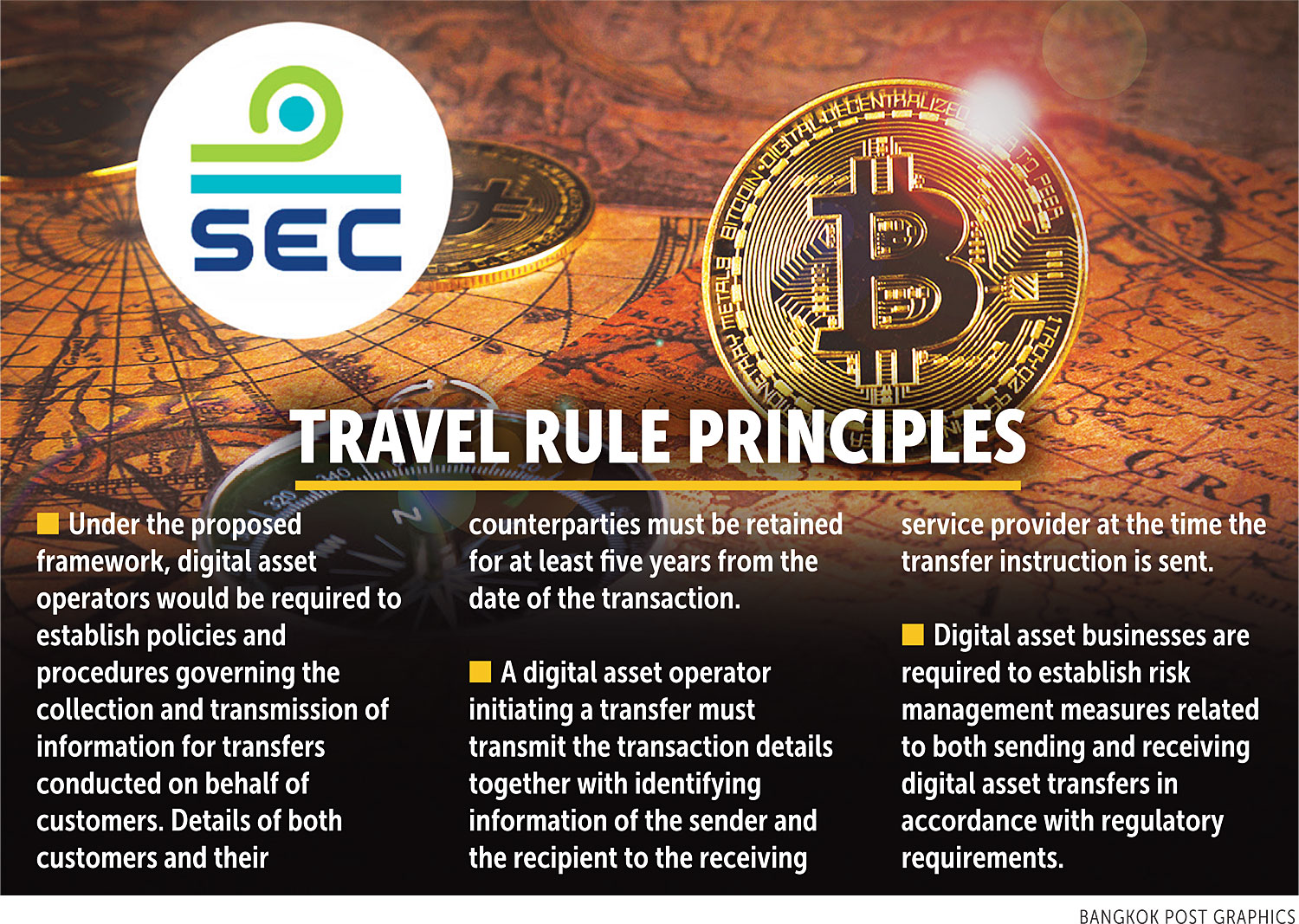
The proposed regulations outline specific requirements for digital asset operators, including establishing robust policies and procedures for collecting and transmitting customer and transaction information. Operators will be required to retain this information for at least five years to facilitate compliance checks and risk assessments. The SEC emphasizes a preventative approach to supervision, aiming to proactively mitigate risks before they materialize. This strategy aligns with a broader effort to strengthen oversight of financial intermediaries across the board.
Under the proposed rules, digital asset service providers must gather detailed transaction information, including the identities of both the sender and recipient, for transfers valued at 30,000 baht or more. This threshold is intended to strike a balance between capturing potentially illicit transactions and minimizing the burden on legitimate users. The SEC is also requiring businesses to implement comprehensive risk management measures related to both incoming and outgoing digital asset transfers.
International Context and the FATF
Thailand’s move to implement the Travel Rule is part of a global trend driven by the FATF’s efforts to regulate digital assets. Many countries are grappling with how to balance the benefits of innovation with the need to prevent illicit financial flows. The FATF has repeatedly emphasized the importance of applying the Travel Rule to virtual assets, warning that non-compliance could lead to increased scrutiny and potential sanctions. The FATF issued a public statement in June 2023 reiterating its commitment to combating illicit finance through virtual assets.
However, the implementation of the Travel Rule varies significantly across jurisdictions. Some countries have adopted a more flexible, risk-based approach, while others have opted for stricter regulations. This inconsistency creates challenges for digital asset businesses operating internationally, as they must navigate a complex web of differing requirements. The success of Thailand’s approach will likely depend on its ability to create a framework that is both effective in combating financial crime and conducive to innovation.
Key Takeaways
- Thailand’s SEC is proposing new regulations – the “Travel Rule” – for digital asset businesses.
- The rule requires the collection and transmission of sender and recipient information for transactions exceeding 30,000 baht.
- Industry stakeholders express concerns that overly strict implementation could stifle innovation.
- The SEC argues the rule is crucial for combating money laundering and cybercrime.
- Public feedback on the proposal is being accepted until March 25, 2026.
The SEC is actively soliciting feedback from industry participants and other stakeholders to refine the proposed regulations. Interested parties can submit comments through online platforms or via email before the March 25th deadline. This consultation process is a critical step in ensuring that the final regulations are both effective and practical. The outcome of this process will shape the future of the digital asset market in Thailand and could serve as a model for other countries in the region.
As Thailand continues to develop its digital asset ecosystem, striking the right balance between regulation and innovation will be paramount. The SEC’s commitment to preventative supervision and alignment with international standards demonstrates a proactive approach to managing the risks associated with this rapidly evolving technology. The next step in this process will be the SEC’s review of the public comments and the subsequent publication of the final regulations, expected in April 2026.
What are your thoughts on the proposed Travel Rule? Share your comments below and let us know how you think these regulations will impact the future of digital assets in Thailand.
Worth a look