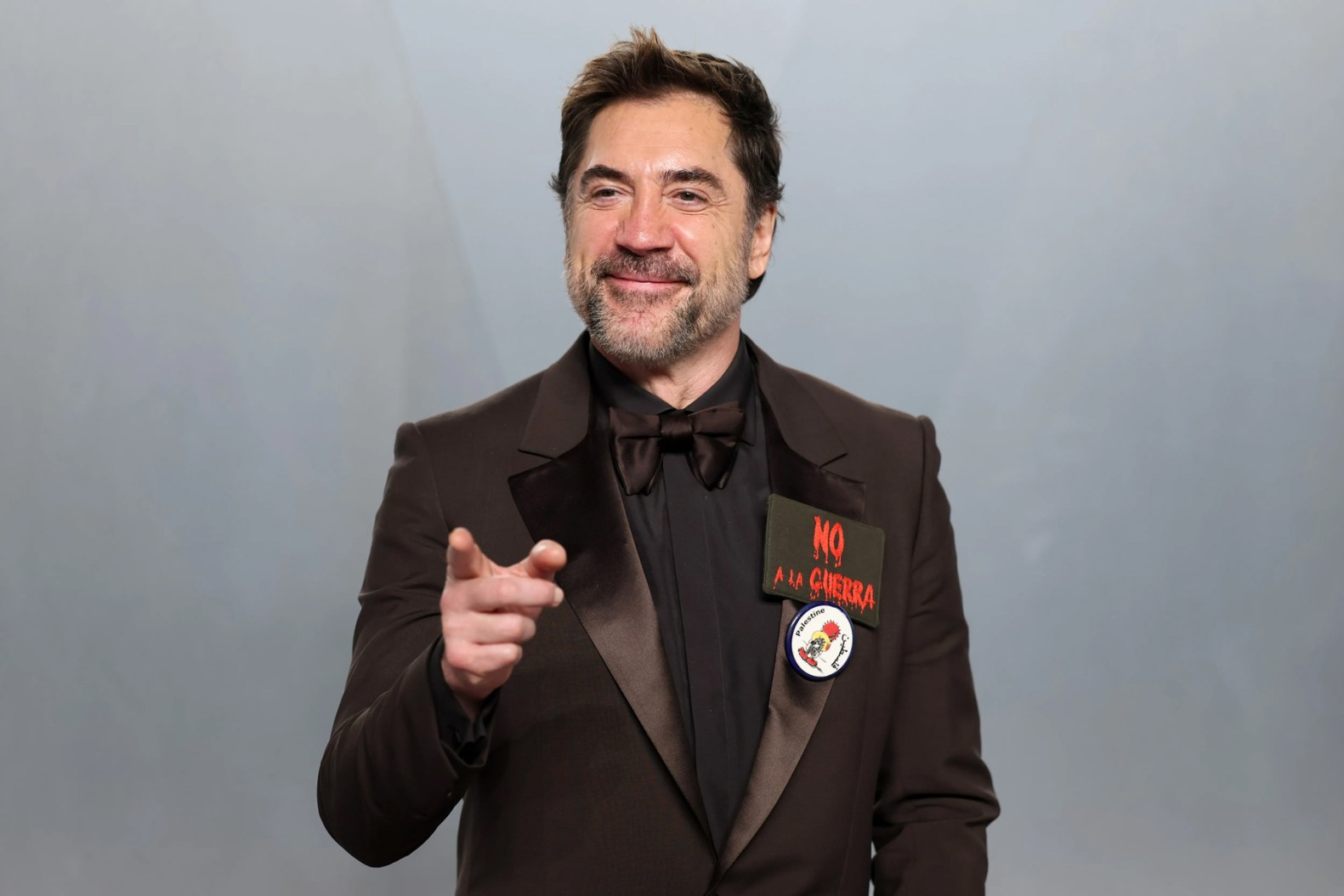
Los Angeles, CA – The 98th Academy Awards saw moments of both celebration and pointed political commentary, with Javier Bardem using his platform as a presenter to voice opposition to war and express solidarity with Palestine. The Spanish actor’s remarks, delivered while presenting the award for Best International Feature Film, sparked both praise and criticism, highlighting the ongoing complexities surrounding the conflicts in Iran and the Middle East. Bardem’s decision to speak out underscores a growing trend of celebrities leveraging high-profile events to advocate for their beliefs, even amidst calls for such ceremonies to remain apolitical.
Bardem’s statement, “No to war, and free Palestine,” was accompanied by visible symbols of his stance: a red patch reading “No a la guerra” (No to War) and a pin referencing the Israeli-Palestinian conflict. This wasn’t a spontaneous decision, as Bardem revealed he had worn the “No a la Guerra” patch previously, as early as 2003 during the Goya Awards in Spain, in protest against the U.S.-led invasion of Iraq. His choice to revisit this symbol at the Oscars, he explained, was a direct response to what he views as a continuation of unjust military actions, specifically citing the current war involving the United States, Israel, and Iran.
Bardem Connects Current Conflicts to Past Opposition
Speaking to reporters at the Vanity Fair Oscars party, Bardem framed the current situation as a repetition of past mistakes. He directly linked the ongoing conflict to the actions of former President Donald Trump and Israeli Prime Minister Benjamin Netanyahu, accusing them of initiating the war based on “another lie.” This assertion reflects a critical perspective on the origins of the conflict, a perspective that has gained traction among some international observers. The United States and Israel’s war with Iran had expanded to its third week at the time of the Oscars, with Israel launching new strikes in Iran and Lebanon, and President Trump calling for international support in the Strait of Hormuz amid a deepening energy crisis, according to reporting from USA Today.
Bardem emphasized the importance of using his position to raise awareness about what he considers injustices. “I think it’s important to understand, to bring awareness, that you can do both,” he told Variety. “You can be part of the movie-making community, which is an important community, and also be a citizen that uses this huge [platform] to denounce what one thinks is injustice. In this case, it’s the genocide in Palestine that is still going on.” This statement reflects a strong condemnation of the situation in Palestine, a region that has experienced decades of conflict and political instability.
Backlash and Debate Follow Bardem’s Remarks
Bardem’s comments were not without controversy. He faced immediate backlash, particularly from those who perceived his statement as anti-Israel. Critics quickly took to social media, with some questioning why he was given a platform at the Oscars. The New York Post reported that some users on X (formerly Twitter) accused Bardem of “vilifying Israel on the world stage,” while others suggested his presence was inappropriate given the current geopolitical climate. Samantha Ettus, a commenter cited by the New York Post, questioned the Academy’s decision to invite Bardem, framing it as part of a broader trend of “open hunting season on Jews worldwide.”
The debate surrounding Bardem’s remarks highlights the sensitivity surrounding the Israeli-Palestinian conflict and the challenges of navigating political statements at high-profile events. The conflict, rooted in competing claims to the same territory, has a long and complex history, marked by periods of intense violence and stalled peace negotiations. The recent escalation of tensions, coupled with the broader regional conflict involving Iran, has further inflamed passions and polarized opinions. The situation in the West Bank, specifically, has drawn increased scrutiny, with concerns raised about potential “ethnic cleansing,” as Bardem noted, and human rights abuses.
Other Political Statements at the 98th Academy Awards
While Bardem’s statement was the most direct political expression of the evening, he wasn’t alone in using the Oscars as a platform for advocacy. Several other celebrities wore pins promoting social justice movements. Pins bearing the message “Just Peace” and “Artists4Ceasefire” were visible throughout the ceremony, representing a collective of artists and advocates calling for peace in response to the ongoing violence in Israel and Palestine. This demonstrates a broader trend of Hollywood figures using their visibility to raise awareness about social and political issues.
David Borenstein, director of the winning documentary Mr. Nobody Against Putin, also delivered a politically charged speech. His film, which explores the erosion of freedom and democracy in Russia, served as a backdrop for a broader message about the importance of individual responsibility and resistance to authoritarianism. Borenstein argued that complicity in the face of injustice is a moral failing, and that even “a nobody” can wield significant power.
The Broader Context: US-Iran War and Regional Instability
Bardem’s comments came amidst escalating tensions between the United States and Iran, a conflict that had entered its third week at the time of the Oscars. As reported by USA Today, Israel was mounting a new wave of strikes in Iran and Lebanon, and President Trump was urging other nations to join the U.S. In deploying warships to the Strait of Hormuz, a strategically vital waterway. This escalation raised concerns about a wider regional conflict and a potential disruption to global energy supplies. The situation remains fluid, with no clear timeline for resolution, despite President Trump’s repeated assertions that the war would be over “soon.”
The conflict’s roots are complex, stemming from a combination of geopolitical rivalries, ideological differences, and historical grievances. The U.S. Withdrawal from the Iran nuclear deal in 2018, under the Trump administration, significantly exacerbated tensions, leading to increased sanctions and a build-up of military forces in the region. Israel’s concerns about Iran’s nuclear program and its support for regional proxies have also played a key role in escalating the conflict. The involvement of multiple actors, including Saudi Arabia, Yemen, and various non-state groups, further complicates the situation.
The situation in the West Bank, as Bardem highlighted, remains particularly volatile. Reports of increased Israeli military operations, settlement expansion, and restrictions on Palestinian movement have fueled tensions and raised concerns about human rights abuses. The potential for further escalation remains high, particularly in the absence of a credible peace process.
As of March 17, 2026, the US State Department continues to issue travel advisories for the region, urging American citizens to exercise extreme caution. Diplomatic efforts to de-escalate the conflict are ongoing, but progress remains limited. The international community is closely monitoring the situation, with calls for restraint and a return to negotiations.
The next major development to watch will be the upcoming United Nations Security Council meeting scheduled for March 24, 2026, where the situation in Iran and the West Bank will be discussed. Updates from the State Department and the UN can be found on their respective websites: https://www.state.gov/ and https://www.un.org/.
Javier Bardem’s decision to speak out at the Oscars serves as a reminder that even seemingly apolitical events can become platforms for important conversations about global issues. His remarks, while controversial, have undoubtedly sparked further debate and raised awareness about the ongoing conflicts in Iran and Palestine. What are your thoughts on celebrities using their platforms to advocate for political causes? Share your opinions in the comments below.