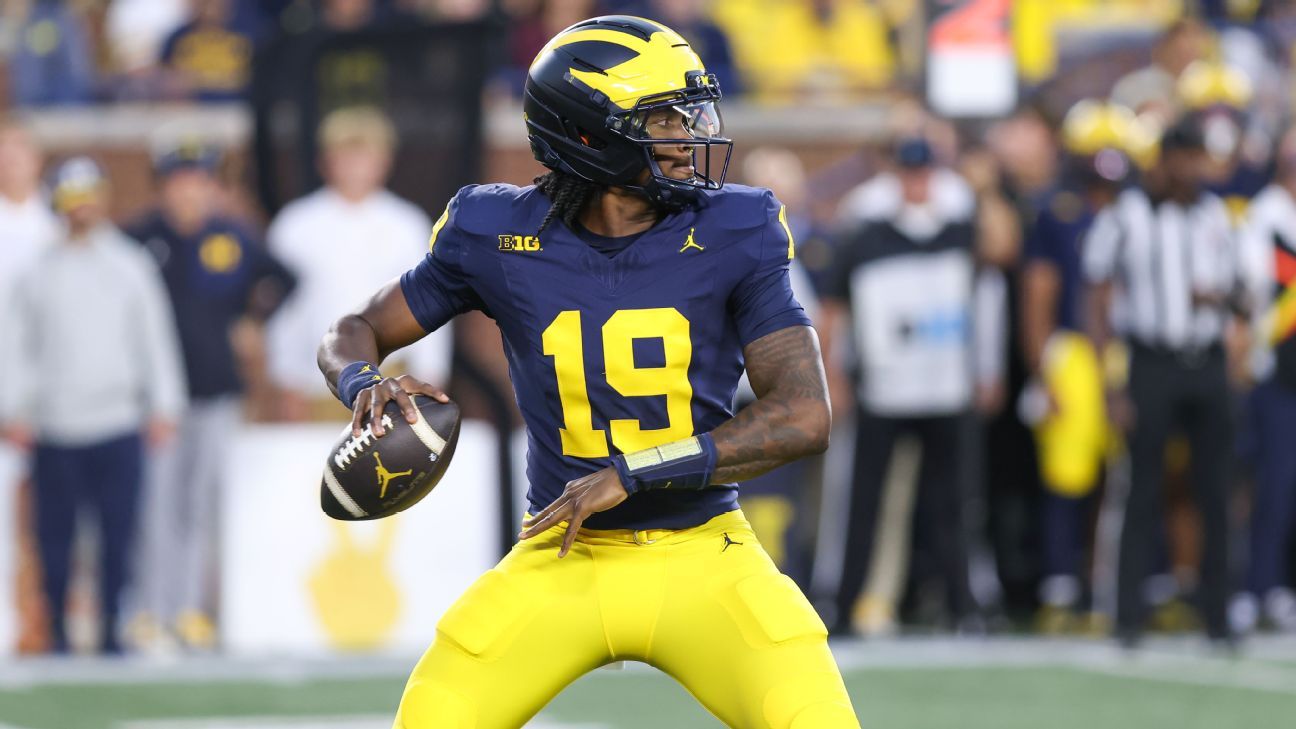
ANN ARBOR, Mich. – The University of Michigan football program has entered a new era with the arrival of Kyle Whittingham as head coach, and a significant part of his focus this spring is on developing sophomore quarterback Bryce Underwood. Whittingham, who recently concluded a highly successful 21-year tenure at the University of Utah, aims to transform the promising but currently raw talent of Underwood into a polished and productive leader for the Wolverines. The task is particularly crucial given Michigan’s recent struggles in the passing game, which ranked 105th nationally last year and 127th in total passing yards since the beginning of the 2024 season.
Whittingham’s arrival in Ann Arbor marks a pivotal moment for the storied program. He inherits a team with a strong foundation but one that needs refinement, particularly on the offensive side of the ball. Underwood, the former No. 1 overall recruit, represents a key piece of that future. While he demonstrated flashes of brilliance during his freshman campaign, including surpassing 200 passing yards in five of his first seven games, a late-season slump – highlighted by seven interceptions in his final five games, including three in the Citrus Bowl loss to Texas – underscored the need for focused development. ESPN reported Whittingham’s assessment of Underwood as a “mega-talent” who is, however, “raw” and not yet a “completely finished product.”
The coaching staff’s approach to Underwood’s development will be a collaborative one, leveraging the expertise of offensive coordinator Jason Beck and quarterbacks coach Koy Detmer Jr., both of whom followed Whittingham from Utah. This “tag-team approach,” as Whittingham described it, will focus on refining Underwood’s footwork, throwing motion, and understanding of the offensive scheme. Beck, in particular, is known for his ability to tailor offenses to the strengths of his quarterbacks, a skill that will be vital in maximizing Underwood’s potential. Whittingham’s success at Utah, where his offenses consistently ranked among the nation’s best, suggests a clear vision for how to unlock Underwood’s capabilities.
Whittingham’s Vision for the Michigan Offense
Beyond simply improving Underwood’s mechanics, Whittingham intends to fully utilize the quarterback’s dual-threat abilities. Wolverines Wire detailed Whittingham’s plans to incorporate Underwood’s running skills more frequently into the offense. At Utah, Whittingham’s teams were consistently among the nation’s leaders in rushing offense, often featuring the quarterback as a significant component of the ground attack. This contrasts with the previous Michigan staff’s tendency to limit Underwood’s rushing attempts, averaging less than seven carries per game during his freshman season.
This shift in philosophy is not merely about adding another dimension to the offense; it’s about playing to Underwood’s strengths. Standing at 6-foot-4 and weighing 228 pounds, Underwood possesses the size and athleticism to be a legitimate threat both as a passer and a runner. His ability to extend plays with his legs and create opportunities outside of the pocket will be crucial in unlocking the full potential of the Michigan offense. Whittingham recognizes this, stating that taking away Underwood’s running ability would be a disservice to his skillset.
The emphasis on utilizing Underwood’s athleticism is as well a reflection of Whittingham’s overall offensive philosophy. He believes in empowering players to use their unique talents and creating a system that allows them to thrive. This approach is further supported by Jason Beck’s reputation for designing “user-friendly” offenses that are not overly complex, allowing quarterbacks to quickly grasp the scheme and create informed decisions on the field.
Underwood’s Freshman Season: A Foundation for Growth
Despite the late-season struggles, Underwood’s freshman year provided valuable experience and a glimpse of his potential. He became only the fourth true freshman in Michigan’s history to start at quarterback, joining a distinguished group that includes Rick Leach (1975), Chad Henne (2004), and Tate Forcier (2009). Starting all 13 games, he completed 202 of 335 pass attempts for 2,428 yards, 11 touchdowns, and nine interceptions. He also contributed significantly on the ground, rushing for 392 yards and six touchdowns on 88 carries.
The statistics reveal a player who showed promise but also had room for improvement. While his early-season performance was encouraging, the increase in interceptions towards the complete of the year highlighted the need for better decision-making and a more refined understanding of opposing defenses. Whittingham and his staff will undoubtedly focus on addressing these areas during spring practice and throughout the offseason. The fact that Underwood started as an 18-year-old at a major college football program is also noteworthy, suggesting that his development is still in its early stages.
Whittingham has consistently praised Underwood’s work ethic and mentality, describing him as “willing” and “hungry.” This positive attitude, coupled with the team’s apparent eagerness for structure and discipline, creates a favorable environment for growth. Whittingham noted that the team responded well to the rigorous winter conditioning program, indicating a commitment to improvement across the board.
Looking Ahead: Expectations for the 2026 Season
The success of the 2026 Michigan football season will largely depend on Underwood’s development under Whittingham’s guidance. Improving the passing game is a top priority, and Underwood is the key to achieving that goal. The coaching staff’s ability to refine his mechanics, enhance his decision-making, and fully utilize his dual-threat abilities will be critical. The Detroit News reported Whittingham unequivocally stating that Underwood is “QB1 ” signaling a clear commitment to the sophomore quarterback.
The addition of Jason Beck and Koy Detmer Jr. To the coaching staff further strengthens the outlook for the offense. Their experience and expertise will be invaluable in implementing Whittingham’s vision and helping Underwood reach his full potential. The focus on a “user-friendly” offense should also facilitate a smoother transition for Underwood and allow him to play with greater confidence and efficiency.
The Wolverines’ schedule in 2026 will present a challenging test for the new-seem offense. Facing tough competition from within the Big Ten and beyond, Michigan will need a consistent and productive passing game to compete for a conference championship and a potential playoff berth. The development of Bryce Underwood is not just about individual improvement; it’s about the future of Michigan football.
Key Takeaways
- Kyle Whittingham has identified Bryce Underwood as the clear starting quarterback for the 2026 season.
- The coaching staff will focus on refining Underwood’s mechanics, decision-making, and understanding of the offensive scheme.
- Whittingham plans to utilize Underwood’s running ability more frequently, adding a new dimension to the Michigan offense.
- Improving the passing game, which ranked poorly in recent seasons, is a top priority for the program.
- Underwood’s work ethic and the team’s willingness to embrace a new approach are positive signs for the future.
The next key date for the Michigan football program is the spring game, scheduled for April 26th, which will provide fans with their first glimpse of the new offense in action. Continued updates on Underwood’s progress and the team’s overall development will be available through the official Michigan Athletics website and various sports media outlets. We encourage readers to share their thoughts and predictions for the upcoming season in the comments below.
Related reading