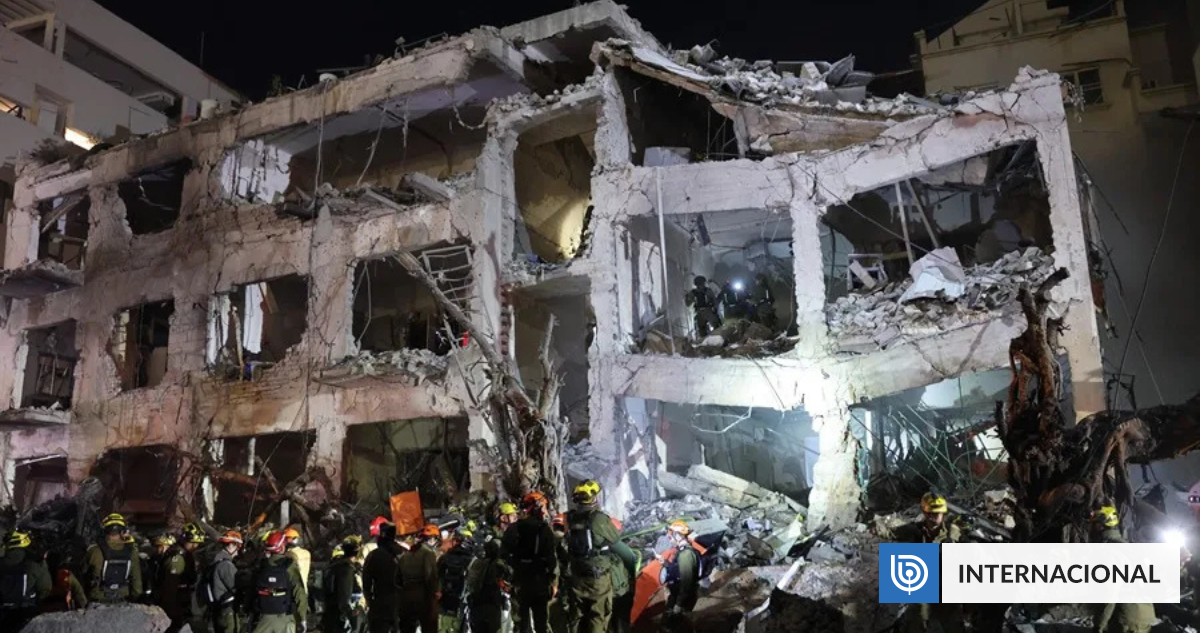
Tel Aviv, Israel – Two people were killed and several others wounded in a barrage of Iranian missiles launched against Israel overnight, marking a significant escalation in regional tensions. The attacks, which began late Tuesday and continued into Wednesday morning, targeted multiple locations across Israel, including the Tel Aviv metropolitan area and the northern regions of the country. This latest exchange follows a recent Israeli strike on an Iranian consulate in Damascus, which killed two senior Iranian military officials.
The deaths occurred in Ramat Gan, a district east of Tel Aviv, when a missile struck a residential building. Emergency responders found the two victims, both believed to be in their 70s, unconscious among the rubble and were unable to revive them, according to Magen David Adom (MDA), Israel’s national emergency medical service. Preliminary reports suggest one of the victims may have had a disability that hindered their ability to reach a nearby bomb shelter quickly enough. The incident underscores the devastating human cost of the escalating conflict.
Iranian Missile Barrage Targets Multiple Israeli Cities
The Iranian attacks, described by officials as a retaliatory response to the Damascus strike, involved a combination of ballistic missiles, cruise missiles and drones. Sirens wailed across central Israel, including in Tel Aviv and Jerusalem, as air defense systems were activated to intercept incoming projectiles. Explosions were heard in Tel Aviv, and reports indicate impacts in several areas, including the Tel Aviv Savidor Center train station. The Israel Defense Forces (IDF) stated they intercepted a significant number of the incoming missiles, but some managed to evade defenses and cause damage.
According to the IDF, approximately 170 drones and missiles were launched from Iran, with some similarly originating from Yemen and Lebanon. The majority of the projectiles were reportedly intercepted by Israel’s multi-layered air defense system, which includes the Iron Dome, David’s Sling, and Arrow systems, as well as assistance from the United States and the United Kingdom. The United States reportedly shot down dozens of drones heading towards Israel. The scale of the attack represents a direct and unprecedented military confrontation between the two nations.
Cluster Munitions and Civilian Impact
Concerns are growing over the use of cluster munitions in the Iranian attacks. United Hatzalah, another Israeli emergency medical service, reported that its paramedics responded to 45 impact sites and treated eight people with minor injuries. Israeli officials have stated that around 50% of the missiles fired since February 28th have been equipped with cluster munitions, which disperse smaller bomblets over a wide area, posing a significant risk to civilians. The IDF confirmed to EFE that the fatal strike in Ramat Gan was “with all probability” caused by a cluster missile.
The use of cluster munitions has drawn condemnation from international human rights organizations, who point to the indiscriminate nature of these weapons and the long-term danger they pose to civilian populations due to unexploded ordnance. Previous incidents have involved cluster munitions falling in the Tel Aviv area without being intercepted, raising questions about the effectiveness of Israel’s defense systems against this type of weaponry. Two construction workers were previously killed by a cluster missile near Ben Gurion Airport, a frequent target of Iranian attacks.
Response from Israel and International Community
Israeli Prime Minister Benjamin Netanyahu convened an emergency meeting of his security cabinet to discuss a response to the Iranian attacks. Even as details of the discussions remain confidential, officials have indicated that Israel will respond “decisively” to the aggression. The timing and nature of Israel’s response remain uncertain, but it is expected to be carefully calibrated to avoid further escalation of the conflict.
The international community has largely condemned the Iranian attacks and called for de-escalation. The United States reaffirmed its unwavering support for Israel’s security and pledged to continue providing assistance with its defense. President Biden spoke with Prime Minister Netanyahu, emphasizing the need for a diplomatic solution to the crisis. The United Nations Security Council is scheduled to hold an emergency meeting to discuss the situation. Several countries, including the United Kingdom and Germany, have also urged restraint and called for a return to diplomatic efforts.
Background: Rising Tensions and Recent Events
The current escalation is rooted in a long-standing rivalry between Israel and Iran, fueled by regional power struggles and differing geopolitical interests. Iran views Israel as an illegitimate state and has consistently supported militant groups opposed to Israel’s existence. Israel, in turn, has conducted numerous strikes against Iranian targets in Syria and elsewhere, aimed at disrupting Iran’s nuclear program and limiting its regional influence.
The recent strike on the Iranian consulate in Damascus on April 1st, which killed senior Iranian military commanders, served as a catalyst for the current crisis. Iran vowed to retaliate for the attack, and the overnight missile barrage represents the fulfillment of that promise. The slain officials, Ali Larijani, secretary of Iran’s Supreme National Security Council, and Gen. Gholam Reza Soleimani, head of the Revolutionary Guard’s Basij, were key figures in Iran’s security apparatus. Their deaths represent a significant blow to the Iranian leadership.
The situation is further complicated by the ongoing conflict in Gaza and the broader regional instability. Iran has been a staunch supporter of Hamas, the Palestinian militant group that controls Gaza, and has provided it with financial and military assistance. The war in Gaza has heightened tensions across the region and created a volatile environment in which miscalculation could lead to a wider conflict.
The attacks also come amid growing concerns about a potential global energy crisis. Iran controls a significant portion of the world’s oil supply and has threatened to disrupt shipping through the Strait of Hormuz, a crucial waterway for oil tankers. Any disruption to oil supplies could have a significant impact on global energy markets and the world economy.
As of Wednesday afternoon, Israeli officials are assessing the full extent of the damage and casualties from the Iranian attacks. The IDF has stated that it is prepared for further attacks and will continue to defend Israel’s citizens. The international community is working to de-escalate the situation and prevent a wider conflict, but the path forward remains uncertain. Further updates will be provided as they become available.
Key Takeaways:
- Two people were killed in Ramat Gan, Israel, as a result of an Iranian missile attack.
- Iran launched a large-scale missile and drone barrage against Israel in retaliation for a recent strike on its consulate in Damascus.
- The use of cluster munitions by Iran has raised concerns about civilian casualties.
- The international community is calling for de-escalation and a return to diplomatic efforts.
The situation remains highly fluid, and further developments are expected in the coming days. World Today Journal will continue to provide comprehensive coverage of this evolving story. We encourage readers to share their thoughts and perspectives in the comments section below.
Worth a look
- Idaho In-N-Out Shooting: Victims Identified and Good Samaritan Speaks Out
- Deadly Shooting at Hart Park in Orange Leaves One Dead, Suspect Arrested
- Russian Missile and Drone Strikes Kill at Least 14 in Kyiv Region (archyworldys.com)
- Russia Accused of War Crimes After Drone Hunts Ukrainian Civilian in ‘Safari’ Attack (world-today-news.com)