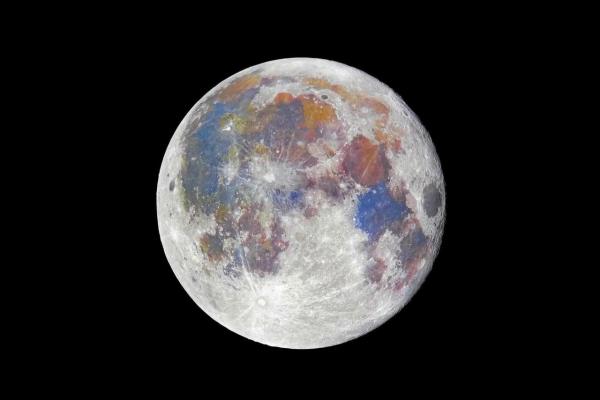
For centuries, the Moon has been viewed as a stark, monochromatic world of grey craters and desolate plains. However, recent astronomical imaging and data have challenged this perception, revealing that the lunar surface possesses a hidden spectrum of colors. These revelations have sparked significant interest online, as new imagery highlights a “colorful” side of our closest celestial neighbor that remains invisible to the naked human eye.
The phenomenon of the colorful lunar surface is not a result of atmospheric effects or artistic filters, but rather a reflection of the Moon’s complex chemical composition. By utilizing advanced imaging technology and spectroscopic analysis, scientists can map the distribution of various minerals across the lunar landscape, transforming the traditional grey image into a vibrant map of geological diversity.
These colors serve as a visual representation of the elements present in the lunar regolith. For instance, variations in the concentration of titanium and iron create distinct signatures that, when processed through specific imaging filters, appear as vibrant hues. This scientific approach allows researchers to identify mineral-rich regions, which is critical for future exploration missions and the potential sourcing of lunar resources.
The intersection of this data with upcoming missions, such as the Artemis program, underscores a new era of lunar science. While the Moon may appear grey from Earth, the data reveals a world of hidden chemical complexity that provides clues about the early history of our solar system and the volcanic processes that once shaped the lunar crust.
The Science Behind the Colors: Titanium and Iron
The “colors” seen in these viral images are essentially data visualizations of the Moon’s mineralogy. The lunar surface is composed of various silicate minerals, but the most significant contributors to the color variations are titanium and iron. Titanium dioxide, found in high concentrations in some lunar maria (the dark plains), creates a different reflective signature than the iron-rich highlands.
When astronomers apply multispectral imaging, they capture light at wavelengths that the human eye cannot perceive. By assigning specific colors to these different wavelengths—a process known as false-color imaging—the distribution of these elements becomes visible. This allows scientists to distinguish between different types of basalt and anorthosite, the primary rock types on the Moon.
This mapping is not merely an aesthetic exercise. Understanding where titanium and iron are concentrated helps scientists understand the thermal evolution of the Moon. Regions with higher titanium levels often indicate a different volcanic history, suggesting that the magma that surfaced in those areas had a different chemical makeup than magma in other regions.
Artemis II and the Future of Lunar Exploration
The pursuit of understanding the Moon’s composition is a central pillar of modern space exploration. The Artemis II mission, which is designed to return humans to the vicinity of the Moon, represents a significant leap in this journey. According to recent reports, the lunar mission of Artemis II has been described as “nakasaganan” via Bombo Radyo Vigan, highlighting the ambitious scale of the endeavor.
By sending astronauts back to lunar orbit, NASA and its international partners aim to conduct more detailed observations and prepare for the eventual establishment of a sustainable human presence on the surface. The ability to identify mineral-rich zones using the aforementioned colorful imaging will be vital for selecting landing sites that offer both scientific value and potential resources for life support.
The Artemis program is not just about footprints on the dust. it is about the systematic study of the lunar environment. The “hidden colors” of the Moon provide a roadmap for where to look for volatiles, such as water ice in permanently shadowed regions, and where to mine minerals that could be used for construction in space.
Why This Matters for Global Science
The transition from seeing the Moon as a dead rock to a chemically diverse body has profound implications for planetary science. The Moon acts as a “time capsule” for the early solar system given that it lacks the tectonic activity and atmospheric erosion that have erased much of Earth’s earliest history. By analyzing the distribution of iron and titanium, scientists can infer the conditions of the protoplanetary disk from which the Earth and Moon formed.
the technology used to reveal these colors—astronomical imaging and spectroscopy—is being applied to other bodies in our solar system. The same principles used to map the Moon are now being used to analyze the surfaces of Mars and the moons of Jupiter and Saturn, helping us understand the diversity of planetary evolution across the galaxy.
For the general public, these images serve as a reminder that there is always more to discover, even in a place as familiar as the Moon. The viral nature of these photos emphasizes the power of visual science to engage people in complex topics, bridging the gap between academic research and public curiosity.
Key Takeaways on Lunar Coloration
- Not True Color: The vibrant colors seen in viral images are false-color representations of mineral data, not what a human would see standing on the surface.
- Chemical Markers: The primary elements responsible for these variations are titanium and iron.
- Scientific Utility: These maps help identify geological boundaries and resource-rich areas for future missions.
- Mission Integration: Data from imaging is used to inform the landing sites and objectives of missions like Artemis II.
As the Artemis program continues to move toward its goal of returning humans to the lunar surface, the scientific community expects further updates on mission timelines and technical milestones. We look forward to the next official NASA briefings regarding the crewed flight of Artemis II.
Do you think the discovery of lunar minerals will change how we view space colonization? Share your thoughts in the comments below and share this article with fellow space enthusiasts.
Keep reading