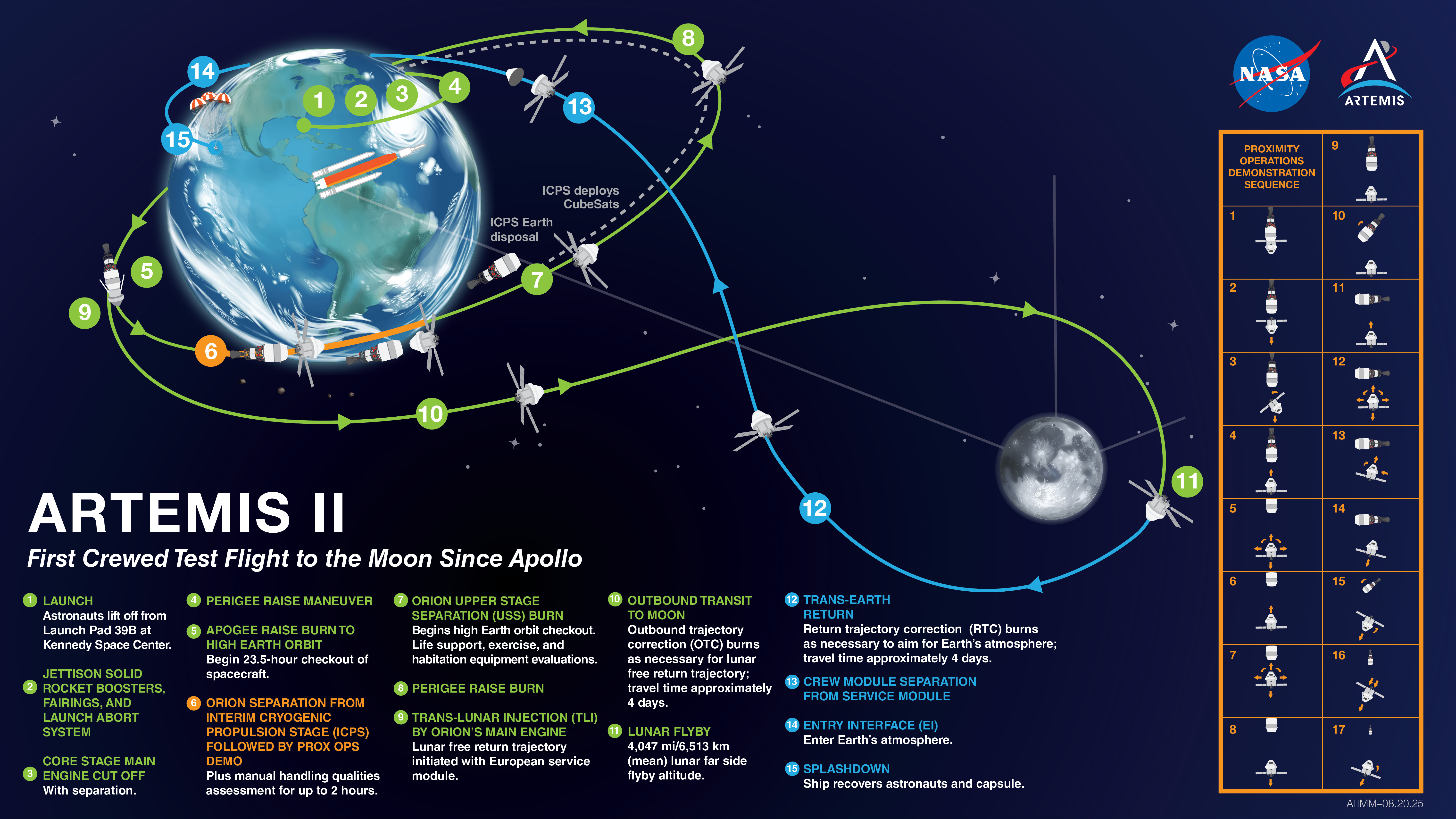
The Artemis II mission has officially pushed the boundaries of human exploration, marking a historic milestone as the first crewed flight to journey around the Moon in over half a century. On April 1, 2026, the Space Launch System (SLS) rocket lifted off from Launch Pad 39B at NASA’s Kennedy Space Center in Florida at 6:35 p.m., carrying a four-person crew aboard the Orion spacecraft NASA.
Among the crew is Christina Koch, who has made history as the first woman to travel beyond low Earth orbit and the first woman to journey around the Moon Wikipedia. The mission, designed as a lunar fly-by, covers a total distance of 685,000 miles over a 10-day journey, serving as a critical test of safety and systems before future missions attempt to land humans on the lunar surface ABC News.
The crew consists of NASA astronauts Reid Wiseman, Victor Glover, and Christina Koch, alongside Canadian Space Agency astronaut Jeremy Hansen ABC News. By venturing into deep space, these four individuals have become the humans who have traveled the farthest from Earth Wikipedia.
As the mission progresses toward its conclusion, the focus of NASA and its international partners has shifted to the most perilous phase of the journey: the re-entry into Earth’s atmosphere. Ensuring the safety of the crew during this high-velocity descent is the primary objective, as the Orion spacecraft must withstand extreme thermal stress to deliver the astronauts safely back to the Pacific Ocean.
Christina Koch: A Legacy of Record-Breaking Flight
Christina Koch’s assignment as Mission Specialist I for Artemis II is the culmination of a career defined by endurance and firsts. Selected as a NASA astronaut in 2013, Koch first gained international recognition during her time on the International Space Station (ISS) for Expeditions 59, 60, and 61 NASA.
During that tenure, she set the record for the longest single spaceflight by a woman, spending 328 consecutive days in space NASA. Her contributions to extravehicular activity (EVA) are equally significant; she participated in the first all-female spacewalks in October 2019 alongside Jessica Meir ABC News. In total, Koch has completed six EVAs, totaling 42 hours and 15 minutes of time spent outside the station Wikipedia.
Before her journey with Artemis II, Koch’s professional experience included serving as the Branch Chief of the Assigned Crew Branch in the Astronaut Office and a rotation as Assistant for Technical Integration for the Center Director at NASA’s Johnson Space Center NASA. Her background as an engineer also includes remote scientific field engineering in the Antarctic and Arctic, as well as work at the Goddard Space Flight Center and serving as station chief for the National Oceanic and Atmospheric Administration’s American Samoa Observatory Wikipedia.
The Technical Challenge of Lunar Fly-By and Re-entry
Unlike the Apollo missions of the 1960s and 70s, Artemis II is not designed to land on the Moon. Instead, it is a crewed flight test intended to validate the Orion spacecraft’s ability to support human life in deep space and, most importantly, to ensure the safety of the crew during the return trip ABC News.
The return from a lunar trajectory involves speeds significantly higher than those experienced during a return from the ISS. As the Orion capsule hits Earth’s atmosphere, it will experience intense frictional heating. The spacecraft’s heat shield is the only barrier between the crew and the plasma generated by these extreme speeds. Any failure in the thermal protection system could be catastrophic, making the re-entry phase the most critical safety window of the entire mission.
The success of this mission is a prerequisite for Artemis III, which aims to return humans to the lunar surface. By proving that the Orion spacecraft can safely transport a crew to the vicinity of the Moon and bring them back securely, NASA is establishing the operational baseline for permanent lunar presence.
Key Mission Details at a Glance
| Category | Detail |
|---|---|
| Launch Date | April 1, 2026 |
| Launch Vehicle | Space Launch System (SLS) |
| Spacecraft | Orion |
| Crew Members | 4 (Reid Wiseman, Victor Glover, Christina Koch, Jeremy Hansen) |
| Mission Duration | 10 days |
| Total Distance | 685,000 miles |
The Human Element of Deep Space Exploration
While the technical specifications of the SLS and Orion are the focus of engineers, the human impact of Artemis II is profound. For the first time, a woman and a Canadian citizen are part of a crew venturing toward the Moon, symbolizing a more inclusive era of space exploration.

The psychological and physical toll of such a journey is significant. The crew must manage isolated environments while relying on automated systems and ground control over vast distances. The experience of seeing the “earthset” and the lunar far side provides a perspective on Earth’s fragility that few humans have ever witnessed.
For Christina Koch, this mission is a bridge between the records she set in low Earth orbit and the future of lunar habitation. Her role as a mission specialist ensures that the scientific and operational data gathered during the fly-by will be used to refine the safety protocols for the first woman who will eventually step foot on the lunar surface.
The mission’s success depends not only on the hardware but on the rigorous training the crew underwent. Koch, for instance, had previously trained extensively in Russia to fly on the Soyuz rocket for her ISS missions, a testament to the international cooperation that continues to underpin NASA’s lunar ambitions NASA.
As the Orion spacecraft prepares for its final descent, the global community awaits the confirmation of a safe splashdown. The successful return of the Artemis II crew will mark the definitive transition from the experimental phase of the Artemis program to the operational phase of lunar exploration.
The next confirmed checkpoint for the mission is the scheduled re-entry and splashdown of the Orion capsule, marking the end of the 10-day journey. Official updates on the recovery operation will be provided by NASA via their official communications channels.
We would love to hear your thoughts on this historic mission. Do you believe the Artemis program will lead to a permanent lunar base? Share your comments below and share this article with other space enthusiasts.