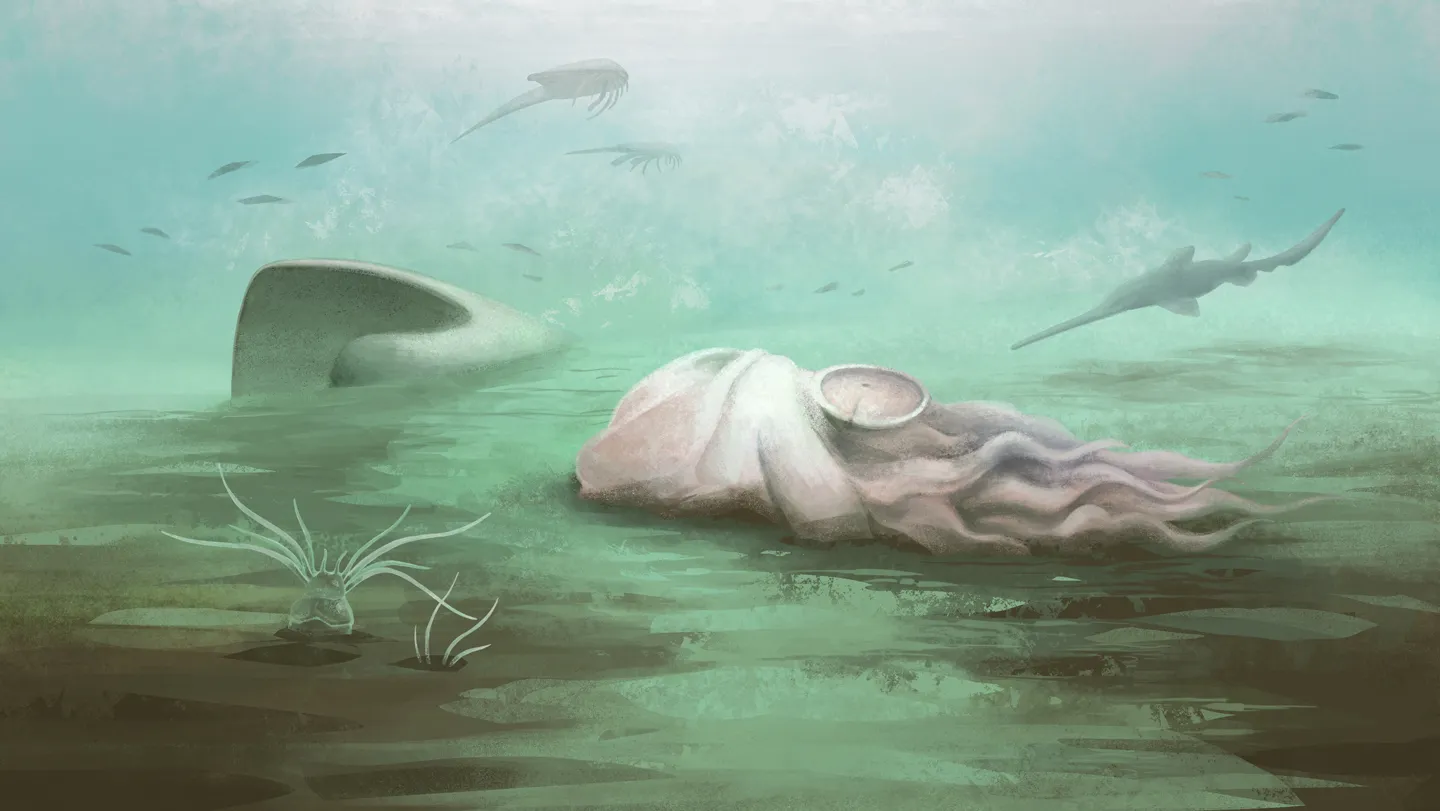
A scientific mystery that has persisted for a quarter of a century has finally been solved, revealing that the oldest fossil octopus was never actually an octopus at all. New research indicates that a specimen previously celebrated as a groundbreaking discovery in cephalopod evolution is instead a relative of the modern nautilus that underwent significant decomposition before being preserved in rock.
The fossil, known as Pohlsepia mazonensis, was first described by researchers in 2000 after being discovered at Mazon Creek in Illinois, U.S. For decades, its unique features—including a round body, finlike structures, and a tangle of arms—led scientists to believe they had found an octopus dating back roughly 310 million years. This classification was so widely accepted that the specimen even earned a place in the Guinness Book of Records as the earliest known member of its kind.
However, the timeline created by Pohlsepia mazonensis always presented a significant challenge for paleontologists. While this specimen suggested octopuses existed over 300 million years ago, other well-known fossil octopuses did not appear in the geologic record until at least 150 million years ago. This massive time gap created a “trouble” for researchers trying to map the evolutionary trajectory of these marine animals.
The breakthrough came when a team led by Dr. Thomas Clements, a lecturer in invertebrate zoology at the University of Reading, applied cutting-edge imaging technology to look beneath the surface of the rock. By using high-powered synchrotron X-rays, the researchers were able to identify chemical signatures and tiny physical structures that had remained hidden from the naked eye for millions of years.
The Role of Advanced Imaging in Reclassification
To resolve the identity of the mystery mollusk, Dr. Clements and his colleagues utilized synchrotron imaging to illuminate different chemicals within the minerals that formed around the animal’s soft tissues. This high-resolution technique allowed the team to detect a preserved radula—the rasping, tongue-like organ found in many mollusks, including snails, and cephalopods.
Crucially, the imaging revealed compact, tooth-like features within the fossil. These “hidden teeth” provided the definitive evidence needed to reclassify the animal. Because octopuses do not possess these specific structures, the presence of the radula and teeth proved that Pohlsepia mazonensis belonged to a group related to the modern Nautilus, marine animals characterized by multiple tentacles and a distinctive external shell according to University of Reading research.
How Decomposition Created a Case of Mistaken Identity
The central question for researchers was why the fossil looked so convincingly like an octopus if it was actually a nautilus relative. The answer lies in the process of decay. Zoologists believe the animal decomposed for several weeks before it was buried and fossilized. This period of decay altered the animal’s shape, stripping away the external shell and distorting the soft tissues.
Dr. Thomas Clements explained that “it was a nautilus relative that had been decomposing for weeks before it became buried and later preserved in rock, and that decomposition is what made it look so convincingly octopus-like.” The resulting fossil appeared to have eight arms and fins, features that mirrored the anatomy of an octopus and misled scientists for 25 years.
This discovery, published on April 8, 2026, in Proceedings of the Royal Society B, effectively removes the 310-million-year-old specimen from the octopus lineage as detailed in the research findings.
Implications for Cephalopod Evolution
The reclassification of Pohlsepia mazonensis does more than just correct a record; it rewrites a portion of evolutionary history. By removing this outlier, the “conspicuous time gap” in the fossil record is resolved, pushing the true origin of octopuses much later in time. This provides a more accurate and cohesive picture of when octopuses first appeared on Earth.
On a positive note, the study has provided a different kind of record-breaking discovery. Scientists now possess the oldest soft tissue evidence of a nautiloid ever found. This allows researchers to better understand the early biology of nautilus relatives and how they differed from the cephalopods that would eventually evolve into modern octopuses and squids.
Key Takeaways from the Discovery
- Identity Shift: The fossil Pohlsepia mazonensis is now identified as a nautilus relative, not an octopus.
- Technological Breakthrough: Synchrotron X-ray imaging revealed hidden teeth and a radula that were invisible to previous researchers.
- The “Decay” Factor: Weeks of decomposition before fossilization caused the animal to resemble an octopus.
- Evolutionary Impact: The discovery corrects a 150-million-year gap in the octopus fossil record and provides the oldest known soft tissue evidence of a nautiloid.
The resolution of this case highlights the importance of re-examining controversial fossils with new technology. As imaging techniques evolve, paleontologists can uncover “tiny clues” that fundamentally change our understanding of prehistoric life.
With the reclassification now official in the scientific literature, researchers will continue to look for the genuine earliest evidence of octopuses in the geologic record. We invite our readers to share their thoughts on this discovery in the comments below.
Keep reading