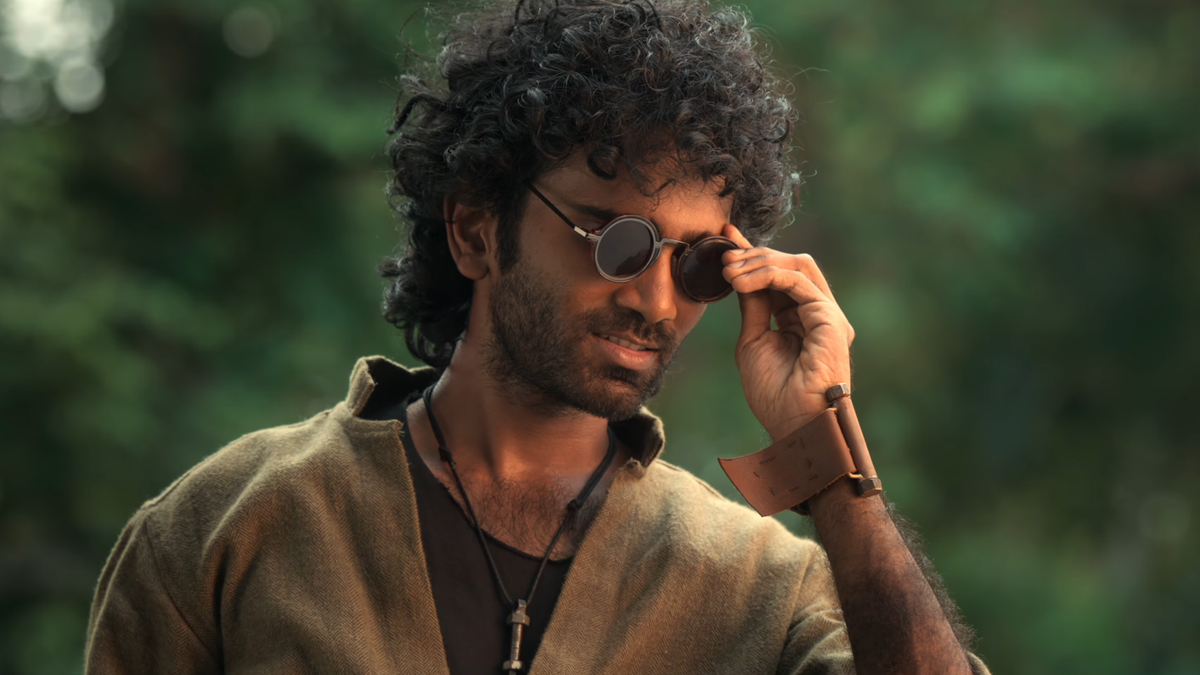
The intersection of love and technology has long been a fascination for filmmakers, but Vignesh Shivan’s latest venture, Love Insurance Kompany, takes this exploration to a neon-lit extreme. Set in a futuristic Chennai of 2040, the film attempts to blend the traditional tropes of a romantic comedy with a dystopian cautionary tale about our growing dependence on artificial intelligence.
Featuring Pradeep Ranganathan, the ‘Love Insurance Kompany’ movie review highlights a production that is visually ambitious and conceptually intriguing, yet one that struggles to maintain its momentum. While the film manages to charm audiences in several segments, it ultimately falls victim to a common pitfall in Tamil cinema: a second half that fails to sustain the energy and ideas established in the opening act.
At its core, the film presents a world where human connection is mediated by an AI-powered mobile application. This app doesn’t just help users find love; it “protects” relationships through constant surveillance and a complex system of credits. Shivan uses this premise to pose a fundamental question: would you trust a programmed system to secure your happiness, or would you rely on human instinct and the beauty of imperfection?
A Neon-Drenched Vision of Chennai 2040
Vignesh Shivan has constructed a meticulous vision of a future megalopolis. His version of Chennai in 2040 is a “neon-drenched technopolis” characterized by towering skyscrapers adorned with holographic signboards and state-of-the-art mobility innovations. The attention to detail extends to public infrastructure, such as the reimagined Rajiv Gandhi Government Hospital, which is depicted as a high-tech utopian medical center equipped with air ambulances.
This futuristic setting is not merely a backdrop but a reflection of a society deeply addicted to the escape provided by smartphones. In this world, technology is so pervasive that drones are used for the delivery of personal items, including condoms, highlighting a society where convenience has completely superseded traditional human interaction.
The film also incorporates playful, “boomercore” elements and nods to pop culture that anchor the futuristic setting in a recognizable Indian context. Shivan imagines a future where Thalaivar Rajinikanth is appearing in his 189th film and the city skyline is dotted with posters for a Kamal Haasan reality show. Even the sporting world is touched by this vision, with grey-haired versions of players like Abhishek Sharma and Vir Suryavanshi leading the Indian cricket team.
Set in 2040, #VigneshShivan’s #LoveInsuranceKompany grapples …
The Conflict Between AI and the Human Heart
The narrative of Love Insurance Kompany serves as a critique of influencer culture and the perils of extreme technological dependence. By setting the story in 2040, Shivan attempts to create a cautionary tale for today’s “Gen Alphas,” suggesting that no robot or algorithm can fully comprehend the intricacies and wonders of the human heart.
However, critics have noted that the film’s execution sometimes feels more like a lecture than a compelling argument. The heavy reliance on instant messaging and the “boomer” perspective on technology can occasionally undermine the film’s attempt to be a cutting-edge commentary on the digital age. While the premise is ambitious—comparing the fate of humanity to a Black Mirror-style dystopia—the result is often described as a futuristic movie grappling with “medieval problems.”
Pradeep Ranganathan, who leads the film, finds himself in a challenging position. While the film is described as “LIK-able,” some reviewers argue that Ranganathan is unable to do much with the material provided, as the script’s struggle to sustain its ideas limits the impact of his performance.
Key Elements of the ‘LIK’ World
- The AI App: A central plot device that uses surveillance and credits to “insure” and protect romantic relationships.
- The Setting: A high-tech, Singapore-esque version of Chennai with holographic signage and drone deliveries.
- The Social Commentary: A warning against the replacement of genuine human connection with phone-based interactions.
- Pop Culture Satire: Imaginative leaps regarding the longevity of cinema icons and the evolution of the Indian cricket team.
Critical Reception and the ‘Second-Half Blues’
The reception of Love Insurance Kompany reflects a divide between its imaginative world-building and its narrative pacing. The first half is generally praised for its charm and the novelty of its futuristic rom-com approach. However, the film struggles significantly as it progresses, mirroring a recurring issue in Tamil cinema where the second half loses the edge and coherence of the beginning.

According to reports from The Hindu, the film is an imaginative effort that “charms in parts” but ultimately fails to sustain its core ideas. This inconsistency prevents the movie from fully landing its cautionary message about technology.
Similarly, analysis from The Hollywood Reporter India describes the film as a “boomercore take on influencer culture,” noting that the ambition of the project is often undercut by a lack of compelling arguments, making the experience perceive like a lecture on the dangers of smartphones.
Despite these criticisms, the film’s willingness to experiment with the rom-com genre and its bold visual choices craft it a notable entry in Shivan’s filmography, following his previous works like Naanum Rowdy Dhaan and Kaathuvaakula Rendu Kaadhal.
As the film continues its run, the conversation around it serves as a broader reflection on how cinema handles the tension between tradition and technology. While Love Insurance Kompany may not have perfectly balanced its scales, its vision of a neon-drenched Chennai remains a striking piece of imaginative storytelling.
For those following the release and critical reception of the film, further updates regarding box office performance and streaming availability are expected in the coming weeks.
Do you think AI could ever truly “insure” a relationship, or is the beauty of love found in its unpredictability? Share your thoughts in the comments below.
Worth a look