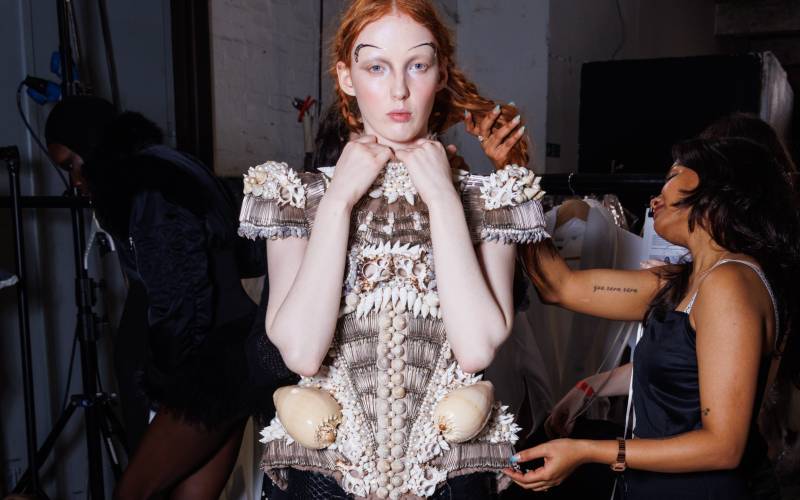
London has long been the epicenter of fashion’s most daring experiments, a city where the boundaries between wearable clothing and conceptual art are frequently blurred. In recent months, a striking new trend has emerged from the streets and runways of the British capital: the integration of natural sea elements, specifically seashells, into high-fashion couture. This “shell fashion” movement is not merely about ornamentation but represents a fundamental shift toward using raw, natural materials as primary structural components in garment construction.
Leading this avant-garde charge is Dilara Findikoglu, a young Turkish designer who has rapidly become a favorite among Hollywood celebrities. Findikoglu has captured the industry’s attention by pushing the limits of natural materials, transforming the organic geometry of seashells into sophisticated silhouettes. Her approach reflects a broader trend in the London scene where new designers are moving away from traditional formulas in favor of provocative, original experiments that challenge the status quo of contemporary dress.
The impact of this movement is most evident in the recent Spring/Summer 2025 collections, where the shell trend has transitioned from a niche curiosity to a focal point of global fashion discourse. By weaving together countless shells to create intricate bustiers and see-through dresses, designers are exploring the intersection of nature, mythology and modern identity.
Dilara Findikoglu and the “Venus in Chaos”
Central to the current fascination with shell-based attire is Dilara Findikoglu’s Spring/Summer 2025 collection, titled “Venus in Chaos.” The collection draws direct inspiration from Sandro Botticelli’s 15th-century Renaissance masterpiece, The Birth of Venus. Findikoglu reinterprets the iconic image of Venus emerging from a giant scallop shell, translating that classical imagery into a “destructive” and modern worldview. According to reports, she has achieved this by weaving numerous seashells into garment structures, creating a juxtaposition between the delicacy of the sea and the boldness of high fashion verified via Elle.
The industry’s response to Findikoglu’s work has been overwhelmingly positive, with some critics labeling her the “Next McQueen” due to her technical brilliance and conceptual depth. The visibility of this trend reached a peak when actress Cate Blanchett wore one of Findikoglu’s signature shell bustiers, further cementing the designer’s status as a rising star in the international fashion circuit.
The NEWGEN Ecosystem: Cultivating London’s Talent
The rise of shell fashion and other experimental styles is not an isolated phenomenon but is supported by a robust infrastructure designed to foster new talent. A key driver of this innovation is the NEWGEN program, an incubator platform operated by the British Fashion Council. This initiative provides essential financial support and mentoring to promising designers, allowing them to present their collections during the official London Fashion Week schedule.
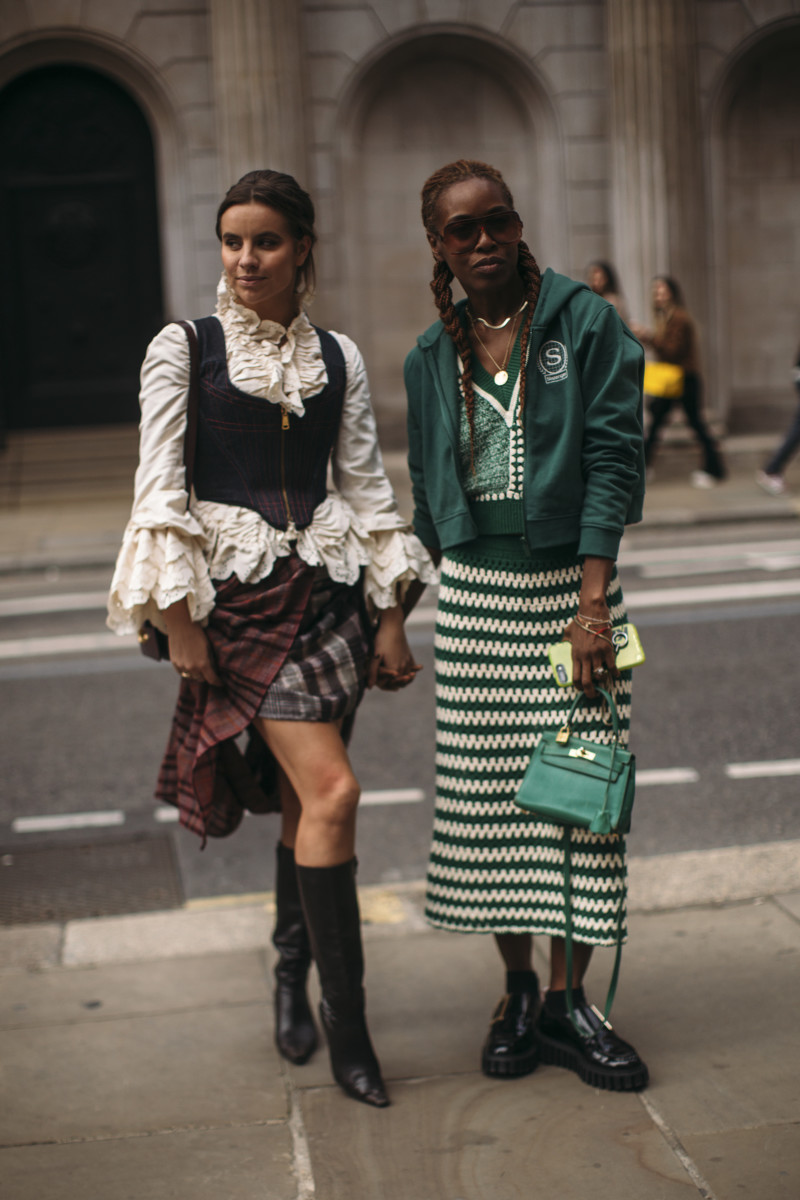
For many emerging designers, the NEWGEN program is a critical lifeline. The costs associated with producing a single professional runway show are often prohibitive; the Council’s support is viewed as a necessity for survival and a catalyst for expansion. The 2026 F/W season highlighted 10 specific names under the NEWGEN umbrella—including Charlie Constantinou, Karoline Vitto, and Tolu Coker—who are pushing the boundaries of functional design, sculptural knitwear, and cultural storytelling.
Narrative-Driven Design at London Fashion Week 2026
Beyond the shell trend, the Autumn 2026 London Fashion Week has been characterized by “world-building,” where designers create distinct characters and narratives to anchor their collections. This shift toward storytelling is evident in the work of several standout new designers:
- Petra Fagerström: A semi-finalist for the LVMH Prize, Fagerström presented a collection inspired by the complex dynamics of figure skating mothers and coaches. Her work features signature trompe l’oeil lenticular prints and padded coats, with plans to showcase her collection at Dover Street Market Paris verified via WWD Korea.
- Lucila Safdie: Safdie explored the concept of the “deviant debutante”—a young woman rejecting traditional social debuts in favor of wandering and rebellion. Her presentation featured a mix of polo shirts, ruffles, and micro shorts, highlighted by a gold bouclé drop-waist skirt paired with a cropped navy jacket.
- Denzil Patrick: Co-founded by James Bosley and Daniel Gayle, this brand focused its 2026 Autumn menswear on a foundation of traditional tailoring infused with material experimentation and a distinctly British sensibility.
Key Takeaways of the London Fashion Shift
| Trend/Entity | Core Focus | Key Influence/Driver |
|---|---|---|
| Shell Fashion | Natural materials as structure | Dilara Findikoglu / Renaissance Art |
| NEWGEN Program | Incubation of new talent | British Fashion Council |
| Narrative Design | Character-driven collections | World-building and social satire |
| Material Experimentation | Lenticular prints, bouclé, tailoring | Emerging designers (Fagerström, Safdie) |
The current state of London fashion suggests a move toward a more visceral, tactile experience. Whether through the use of seashells or the exploration of niche social archetypes, the city’s designers are prioritizing “the unexpected” over the “familiar.” This willingness to embrace uncertainty and risk is what continues to define London as a global leader in fashion innovation.
As the industry looks toward the next cycle, the focus remains on how these experimental materials—like the shells championed by Findikoglu—will transition from the runway to broader commercial applications, and how the NEWGEN program will continue to shape the next generation of global couture.
The next major milestone for these designers will be the upcoming seasonal presentations and the final results of the LVMH Prize, which will further determine which of these experimental visions achieve mainstream longevity.
Do you believe natural materials like seashells are the future of sustainable couture, or are they purely artistic statements? Share your thoughts in the comments below.
Keep reading