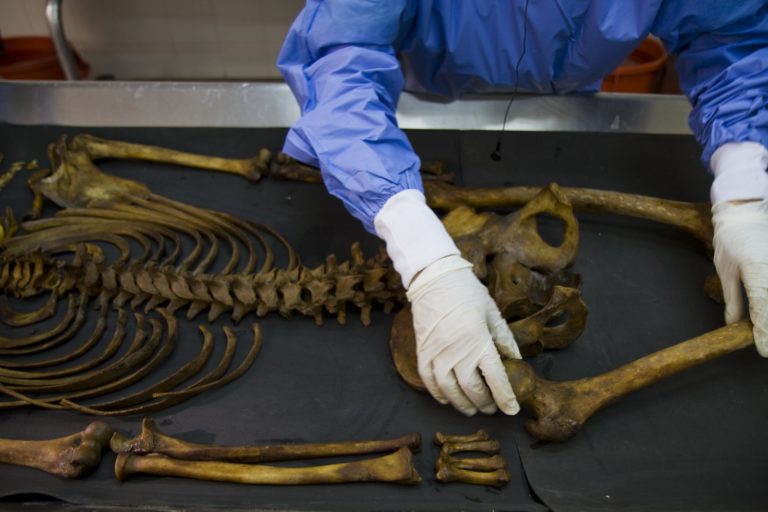
In the eastern outskirts of Mexico City, near the shores of Lake Chalco, authorities have uncovered more than 1,000 human bone fragments during ongoing search operations that began ten days ago. The discoveries, reported by local collectives and confirmed by forensic experts on site, have intensified scrutiny over the scale of enforced disappearances in Mexico and the challenges facing forensic teams tasked with identifying the remains.
The operations, focused on the Tlahuac borough, involve forensic anthropologists carefully sorting, labeling, and documenting skeletal remains recovered from the lakebed and surrounding areas. According to visual documentation from the scene shared by international media, a forensic expert is seen handling bones with gloved hands, placing each fragment into labeled evidence bags as part of a meticulous process aimed at eventual identification and return to families.
What began as a targeted search effort has evolved into what advocacy groups describe as a growing forensic crisis, stemming from years of unresolved cases linked to organized crime, state violence, and systemic impunity. Mexico continues to grapple with one of the highest numbers of missing persons in Latin America, with official registries listing over 100,000 individuals as disappeared since 2006, many of whom are believed to be victims of enforced disappearances.
The scale of the discovery at Lake Chalco underscores both the persistent violence in certain regions of Mexico and the limitations of current forensic infrastructure. Experts note that while modern techniques in DNA analysis, dental comparison, and anthropological profiling have improved identification rates, the sheer volume of remains often exceeds the capacity of local laboratories and storage facilities.
Human rights organizations operating in the region have long called for greater investment in forensic sciences, stronger coordination between state and federal authorities, and the establishment of a national database for missing persons. They argue that without systemic reform, efforts to identify remains will continue to lag behind the pace of new discoveries, prolonging anguish for thousands of families seeking answers.
As of mid-April 2026, search teams remain active at the site, with no official timeline released for the conclusion of recovery operations. Authorities have not disclosed how many of the recovered fragments have been successfully identified or returned to families, nor have they confirmed whether any of the remains are linked to specific cases or criminal investigations currently underway.
The situation at Lake Chalco reflects a broader national challenge: balancing the urgent need for dignified identification of the disappeared with the realities of under-resourced morgues, fragmented jurisdictional authority, and the ongoing threat of violence in areas where searches are conducted. Forensic teams emphasize that each bone fragment represents not just evidence, but a potential path toward closure for a family still waiting for news.
International observers have pointed to Mexico’s obligations under international human rights law, including the International Convention for the Protection of All Persons from Enforced Disappearance, to which Mexico is a signatory. Compliance requires effective investigation, prevention, and redress mechanisms—areas where advocates say progress has been uneven.
While the exact origins of the remains found near Lake Chalco remain under investigation, the discovery has renewed public debate over the root causes of disappearances in Mexico, including the role of drug cartels, collusion with state actors, and the failure of early intervention systems. Families of the missing continue to demand access to search sites, transparency in forensic processes, and meaningful participation in investigations.
For now, the work continues quietly along the lake’s edge, where each labeled bag of bones carries the weight of a name yet to be spoken, a story yet to be told, and a hope, though faint, that one day, the silence will be broken.
Worth a look