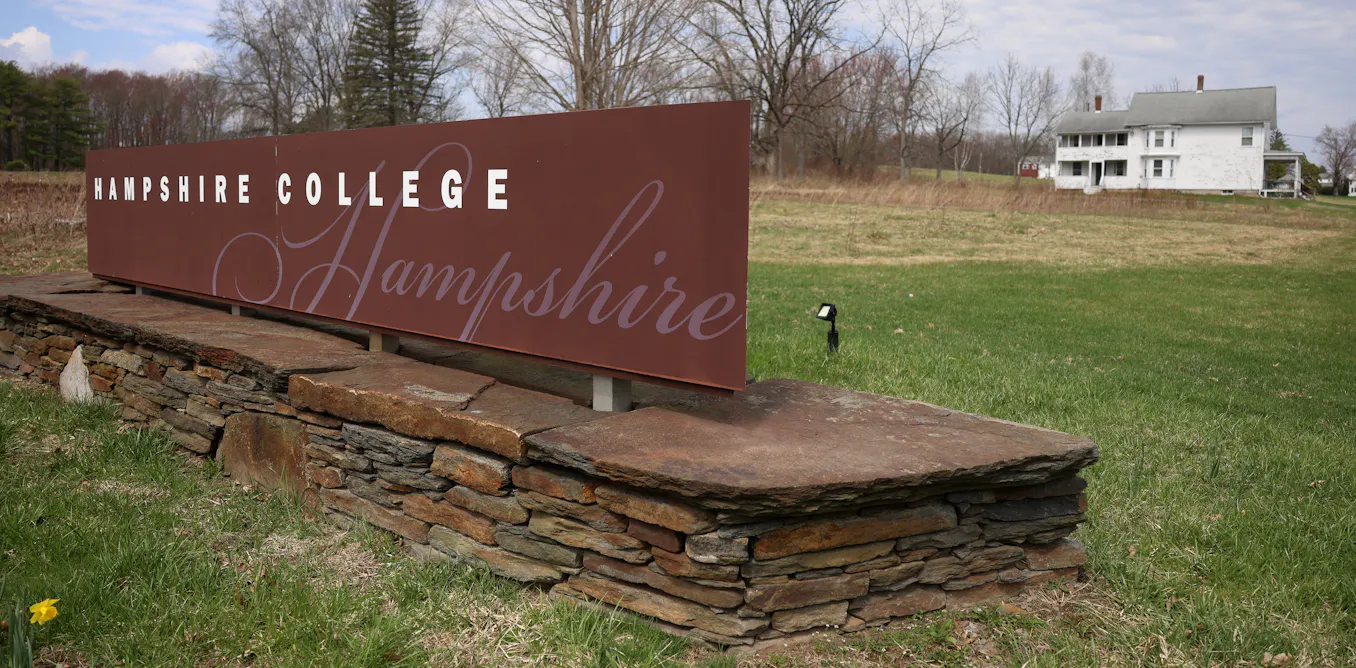
Hampshire College, a small liberal arts institution in Amherst, Massachusetts, announced on April 14, 2026, that it would cease operations by December 2026. The decision marks the latest in a series of closures among experimental liberal arts colleges that have struggled to sustain their unconventional models amid shifting student priorities and financial pressures. Founded in 1965, Hampshire distinguished itself by rejecting traditional academic structures in favor of student-driven learning, narrative evaluations instead of grades, and a curriculum shaped by individual interests rather than prescribed majors.
The college’s board cited declining enrollment, long-standing debt, and stalled land development as the primary reasons for the closure. At the time of the announcement, Hampshire enrolled approximately 625 students—about half the number it attracted in the early 2000s. Tuition and housing for the 2025–26 academic year exceeded $72,000, placing it among the most expensive small colleges in the nation. Current students completing capstone projects were permitted to graduate, even as newly admitted students received deposit refunds. Others were offered pathways to transfer within the Five College Consortium, which includes Amherst, Smith, Mount Holyoke, and the University of Massachusetts Amherst.
Hampshire’s closure reflects a broader trend in U.S. Higher education where small, tuition-dependent institutions with limited endowments face increasing difficulty competing against wealthier peers. Unlike schools with substantial financial reserves or strong vocational programming, Hampshire remained committed to its experimental ethos, even as students and families increasingly prioritized clear career outcomes and return on investment. The college’s motto, “Non Satis Scire” (“To Recognize Is Not Enough”), embodied its belief that education should inspire action and critical engagement—not merely the accumulation of knowledge.
A legacy of experimental learning
Hampshire was part of a wave of experimental colleges inspired by educational reformers like John Dewey and Alexander Meiklejohn, who advocated for learning through experience, cooperation, and student autonomy. These ideals took root in institutions such as Deep Springs College (founded 1917 in California), Antioch College (which launched the first U.S. Liberal arts co-op program in 1921), and later, Bennington and Sarah Lawrence Colleges. Hampshire’s model—eliminating core requirements, de-emphasizing faculty research, and empowering students to design their own majors—resonated with learners who felt alienated by traditional high school environments.
Throughout the 1960s and 1970s, dozens of similar colleges emerged, including Evergreen State College in Washington. These institutions were not intended to replace mainstream higher education but to diversify its offerings. They attracted students seeking intellectual freedom, interdisciplinary exploration, and a voice in institutional governance. Yet, even at their peak, experimental colleges rarely matched the financial stability or prestige of more conventional peers. Hampshire’s membership in the Five College Consortium offered access to shared resources and cross-registration, but it did not shield the school from demographic and economic headwinds.
Why experimental colleges are struggling today
The challenges facing Hampshire are emblematic of a larger shift in how students and families evaluate college value. A growing number of applicants now ask whether a degree will lead to immediate employment or marketable skills, particularly amid rising tuition and student debt. According to a 2025 survey by the Strada Education Foundation, 65% of prospective students said job preparation was their top reason for attending college—up from 48% a decade earlier. This mindset favors institutions with strong career services, internship pipelines, and programs aligned with high-demand fields like engineering, computer science, and healthcare.
Experimental colleges, by contrast, often emphasize broad intellectual development over specific vocational training. While graduates of such schools frequently report high levels of lifelong learning, civic engagement, and adaptability, these outcomes are harder to quantify in traditional employment metrics. As Ken Burns, the acclaimed documentary filmmaker and Hampshire alumnus, told The New York Times upon the college’s closure announcement: “Hampshire was dedicated to a transformational education, in an era when higher education has been hijacked by the transactional. A college education is, to some, like a Louis Vuitton handbag. And that’s not Hampshire.”
Financial sustainability has also develop into a critical vulnerability. Hampshire’s endowment stood at approximately $90 million in 2024—far below the $1 billion+ benchmarks of peer institutions like Amherst ($2.8 billion) and Williams ($3.1 billion). Without significant returns on investments or substantial fundraising capacity, the college relied heavily on tuition revenue. As enrollment declined, fixed costs became increasingly difficult to sustain. Efforts to develop unused land for revenue generation stalled due to zoning restrictions and community opposition, further straining the budget.
What happens next for students and the consortium
For current students, the teach-out plan allows those in their final year to complete capstone projects and receive Hampshire degrees. The college has committed to providing academic support and advising through the fall 2026 semester. Students who wish to transfer may do so without penalty into other Five College Consortium schools, where they can continue their studies with minimal disruption. Hampshire’s transcripts and academic records will be managed by a designated custodian institution, ensuring accessibility for future verification.
The closure also raises questions about the future of experimental education within the consortium. While no immediate plans exist to replicate Hampshire’s model elsewhere, faculty and administrators at member schools have expressed interest in preserving elements of its approach—such as narrative assessments and independent study options—within existing frameworks. The Five College Consortium continues to explore shared innovations in interdisciplinary learning, though any expansion would require significant investment and faculty buy-in.
Nationally, Hampshire’s demise adds to a list of small liberal arts colleges that have closed or merged in recent years, including Marlboro College (2020), Goddard College (2024), and Green Mountain College (2019). These closures underscore the fragility of institutions that depend heavily on tuition and lack diverse revenue streams. Experts warn that without policy interventions or new funding models, more schools with distinctive missions may face similar fates.
As of May 2026, Hampshire College is operating under a formal wind-down plan overseen by its board of trustees. Official updates are posted regularly on the college’s closure information page. Prospective students and families seeking guidance on transfer options or teach-out details are encouraged to contact the Five College Consortium office directly.
Hampshire College’s story is not just about one institution’s end—it is a signal about what kinds of education society is willing to sustain in an age of economic anxiety and utilitarian expectations. Its closure invites reflection on whether space remains for learning that values questions over answers, experimentation over certainty, and transformation over transaction.
If you have insights or experiences related to Hampshire College or the future of experimental education, we invite you to share them in the comments below. Please share this article to help others understand the broader implications of this pivotal moment in higher education.
Worth a look