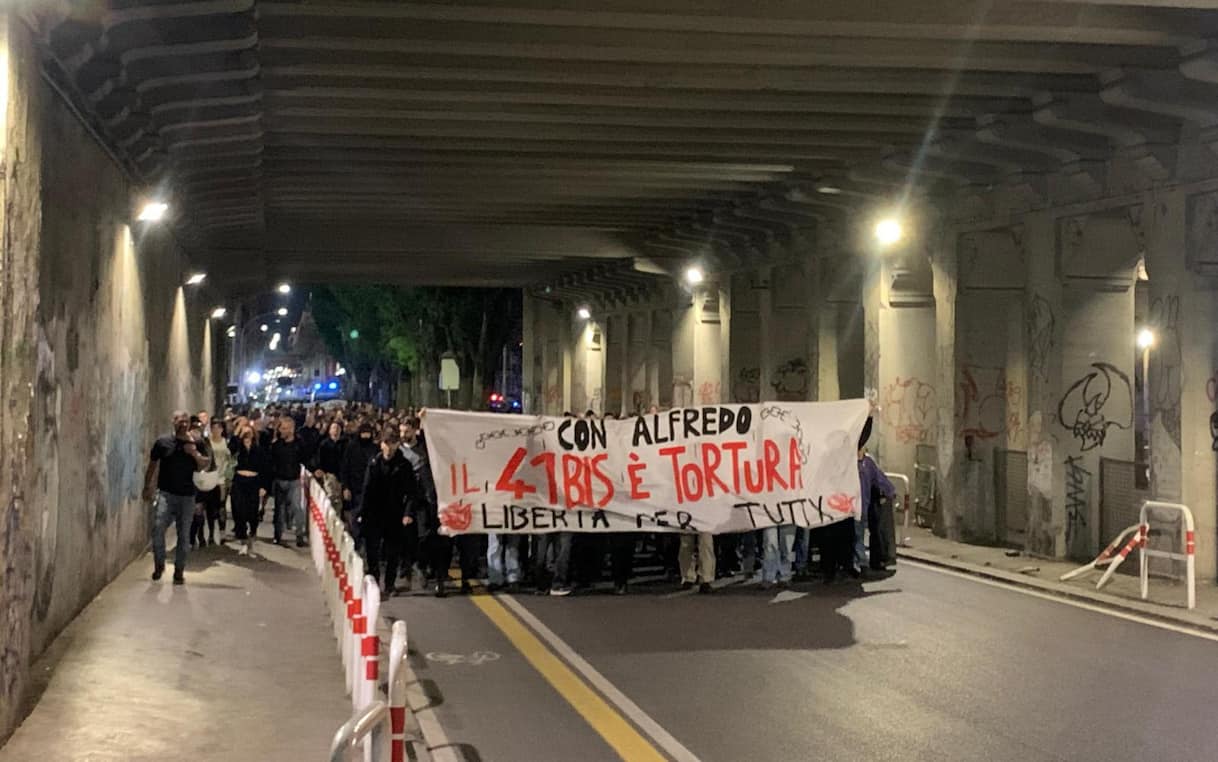
Hundreds of anarchist activists marched through Rome on Saturday in support of imprisoned anarchist Alfredo Cospito, culminating in a confrontation that left a police officer injured after being struck in the head by a thrown bottle. The demonstration, which began in the San Lorenzo district and proceeded toward the Pigneto neighborhood, drew approximately 200 participants according to multiple eyewitness accounts and local media reports. Organizers framed the march as part of an ongoing campaign demanding the release of Cospito, who has been held under Italy’s strict 41-bis prison regime since 2020.
The incident occurred near the intersection of Via Prenestina and Via del Mandrione, where demonstrators clashed with a line of police officers attempting to redirect the march. Video footage circulated online shows a glass bottle being thrown from the crowd, striking an officer in the head before shattering on impact. The officer, identified by Italian authorities as a senior official from the Digos unit — the political crimes division of the national police — was treated at the scene and later transported to Umberto I Hospital for observation. He was released several hours later with a minor head contusion, according to hospital sources confirmed by Italy’s Ministry of Interior.
Alfredo Cospito, the focal point of the protest, is a prominent figure in Italy’s anarchist movement who was convicted in 2020 for his role in a series of small-scale bombings targeting corporate and institutional sites between 2002 and 2006. Though no one was injured in those attacks, prosecutors argued they were part of a broader campaign of intimidation. Cospito received a sentence of over 10 years, later extended due to additional charges related to prison solidarity actions. His case has drawn international attention from civil liberties groups who argue that the application of the 41-bis regime — typically reserved for mafia bosses and terrorists — constitutes cruel and inhumane treatment when applied to non-violent political prisoners.
The 41-bis regime, formally known as Article 41-bis of the Italian Penitentiary System, imposes strict isolation measures including limited communication, restricted family visits, and constant surveillance. Originally designed to prevent mafia bosses from communicating with criminal organizations outside prison, its application to anarchists and other political dissidents has been criticized by the European Parliament and human rights organizations such as Amnesty International and the Italian Antigone association. In 2023, the European Court of Human Rights began reviewing a case challenging the apply of 41-bis against Cospito, though no ruling has been issued as of mid-2024.
Supporters of Cospito have organized regular demonstrations across Italy and abroad, often coinciding with court hearings or anniversaries related to his arrest. The Rome march on Saturday followed a similar pattern, with participants carrying banners reading “Libero Alfredo” and chanting slogans against state repression. While the majority of demonstrators remained peaceful, a small faction engaged in sporadic acts of property damage, including the throwing of projectiles toward police lines. Authorities confirmed that no arrests were made during the event, though several individuals were identified for potential future investigation based on video evidence.
The Italian government has maintained that the application of 41-bis to Cospito is legally sound and necessary to prevent him from continuing to inspire or coordinate acts of sabotage from behind bars. Justice Minister Carlo Nordio reiterated this position in a press briefing earlier this week, stating that the decision to maintain the regime is based on assessments by the National Anti-Mafia and Counterterrorism Directorate (DNA), which considers Cospito a continued threat to public order due to his influence within anarchist networks.
Legal experts remain divided on the matter. Some constitutional scholars argue that extending 41-bis to individuals convicted of non-lethal property damage stretches the law beyond its original intent, potentially setting a precedent for broader use against political activists. Others contend that the persistent threat of coordinated action, even without direct violence, justifies heightened monitoring. The debate has intensified amid rising concerns about political extremism in Europe, though Italian authorities insist there is no equivalence between anarchist networks and jihadist or far-right terrorist organizations in terms of operational capacity or lethality.
As of now, Cospito remains incarcerated at the Opera prison in Milan, where he has been held since his transfer from Sassari in 2022. His legal team continues to pursue appeals through Italy’s judicial system, with a hearing scheduled before the Milan Supervisory Court in late October 2024 to review the conditions of his detention. No further public demonstrations have been announced, though solidarity networks indicate that actions may resume depending on the outcome of upcoming legal proceedings.
For updates on Alfredo Cospito’s legal status and developments regarding the 41-bis regime, readers are encouraged to consult official sources such as the Italian Ministry of Justice website and the European Court of Human Rights’ case database. Those interested in following related civil liberties discussions can too refer to periodic reports from the Antigone association and the Italian League for Human Rights.
Stay informed, share responsibly, and join the conversation below.
Worth a look