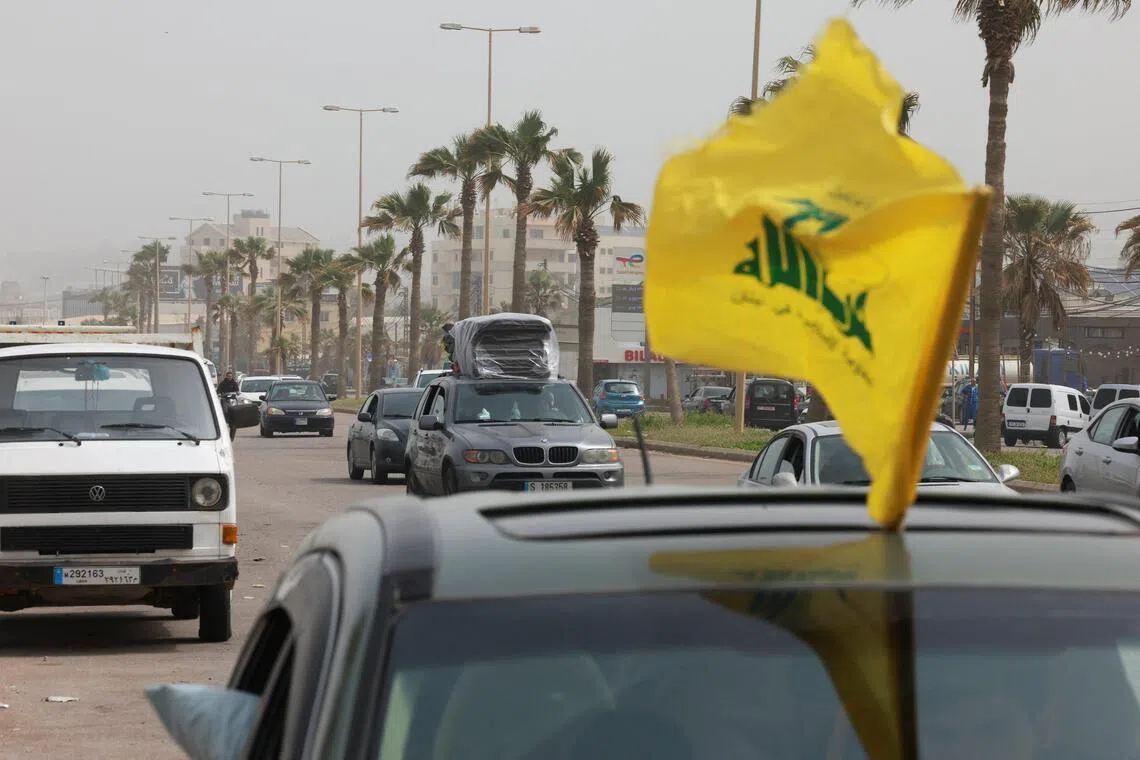
Hezbollah has signaled a willingness to cooperate with a ceasefire agreement with Israel, according to recent statements from the group’s leadership, marking a potential shift in the dynamics of the ongoing conflict that has caused significant casualties and displacement across southern Lebanon and northern Israel.
The development comes amid intense international diplomatic efforts to de-escalate hostilities that have flared repeatedly since October 2023, with both sides exchanging fire across the Blue Line boundary. While Hezbollah’s openness to a truce does not guarantee an immediate finish to fighting, it reflects growing pressure on the Iran-backed militia to halt operations that have drawn widespread condemnation and intensified regional instability.
Officials familiar with backchannel negotiations told Reuters that Hezbollah’s condition for cooperation centers on securing guarantees that Israel will cease its military operations in Gaza and withdraw forces from southern Lebanese villages it has occupied during recent ground incursions. These demands align with the group’s longstanding position that its actions are linked to the broader Palestinian-Israeli conflict.
The willingness to engage in ceasefire talks emerged following weeks of intensified Israeli airstrikes targeting Hezbollah infrastructure in Lebanon’s Bekaa Valley and southern suburbs of Beirut, which Israeli officials say were necessary to dismantle rocket launch sites and weapons smuggling routes. Lebanon’s caretaker government has repeatedly urged restraint, warning that continued escalation risks collapsing the country’s fragile economy and pushing more civilians into poverty.
According to the Lebanese Ministry of Public Health, over 2,300 people have been killed in Lebanon since the escalation of hostilities began in October 2023, with thousands more injured and nearly one million displaced from their homes in the south and east of the country. These figures, regularly updated in official government bulletins, include both combatants and civilians, though the ministry does not always distinguish between the two in its public reports.
Reuters reported on September 23 that an Israeli strike killed a senior Hezbollah commander in the Bekaa Valley, underscoring the high-value targets Israel has pursued in its campaign to degrade the group’s military capabilities. The strike prompted Hezbollah to launch a barrage of rockets into northern Israel, one of which struck a military base near Haifa, causing material damage but no fatalities, according to the Israel Defense Forces (IDF).
The IDF confirmed in a statement issued on September 25 that its forces had conducted limited ground raids into southern Lebanon to destroy tunnels and weapons caches believed to be used for cross-border attacks, operations that Israeli officials described as necessary to protect communities near the border. These incursions have drawn criticism from the United Nations Interim Force in Lebanon (UNIFIL), which has called for all parties to respect the cessation of hostilities agreement and avoid actions that could trigger a wider war.
UNIFIL’s spokesperson, Andrea Tenenti, told BBC News on September 26 that the mission had observed increased military activity along the Blue Line and urged both sides to allow unimpeded access for peacekeepers to monitor compliance with any future ceasefire. He emphasized that UNIFIL remains committed to its mandate under UN Security Council Resolution 1701, which calls for the disarmament of all armed groups in Lebanon except the state army and the deployment of Lebanese forces south of the Litani River.
Hezbollah’s public stance has evolved in recent days, with Deputy Secretary-General Naim Qassem stating in a televised interview on Al-Mayadeen on September 24 that the group is “not opposed to a ceasefire if it serves Lebanese national interests and stops Israeli aggression.” He added that any agreement must include assurances against future Israeli violations of Lebanese sovereignty, a reference to past incidents where Israeli aircraft have entered Lebanese airspace without authorization.
The group’s conditional openness to dialogue contrasts with its earlier rhetoric, which had vowed to continue fighting until Israel halted its campaign in Gaza. Analysts at the International Crisis Group noted in a briefing published on September 25 that Hezbollah’s calculation appears to be shifting due to mounting losses, including the deaths of several field commanders and the depletion of long-range rocket stocks, which have limited its ability to sustain sustained barrages into Israel.
Lebanon’s caretaker Prime Minister Najib Mikati welcomed the signs of de-escalation in a statement released on September 27, calling on all Lebanese factions to prioritize national unity and urging the international community to pressure Israel into ending its occupation of Lebanese territory. He reiterated Lebanon’s commitment to implementing Resolution 1701 in full, a framework that has governed the southern border since the 2006 war but has been repeatedly violated by both sides over the years.
Israel’s government has not publicly responded to Hezbollah’s latest signals, though security officials told Kan Public Broadcasting on September 26 that any ceasefire would require to be verified and enforceable, with mechanisms to prevent Hezbollah from rearming or repositioning fighters near the border. Defense Minister Yoav Gallant has previously insisted that Israel will not accept a return to the status quo ante, demanding instead a new security arrangement that eliminates the threat of cross-border attacks.
The United States, which has been mediating indirectly through French and Egyptian intermediaries, urged restraint in a joint statement with the European Union on September 25, calling for an immediate halt to violence and the resumption of political negotiations to address the root causes of the conflict. U.S. Special Envoy for Middle East Affairs Amos Hochstein has been engaged in shuttle diplomacy, though his efforts have so far focused on preventing escalation rather than achieving a comprehensive settlement.
Humanitarian organizations operating in Lebanon have warned of a deepening crisis, with the World Food Programme reporting on September 24 that food insecurity has risen sharply in displacement shelters, particularly among children and elderly residents. The agency, which receives funding from multiple donor governments, said it has scaled up emergency distributions but faces funding shortfalls that could limit its reach as winter approaches.
As of September 28, no formal ceasefire agreement has been signed, and both sides continue to exchange fire intermittently, though at reduced intensity compared to peak periods in late September. Diplomatic sources told Agence France-Presse that negotiations are ongoing in Naqoura, the site of UNIFIL’s headquarters, where Lebanese and Israeli military officials meet under UN supervision to discuss technical aspects of border security.
The next key development to watch is the scheduled meeting of the Lebanon-Israel Mixed Armistice Commission on October 2, 2024, where both parties are expected to raise concerns about recent violations and discuss mechanisms to strengthen monitoring along the Blue Line. Any progress there could pave the way for broader political talks, though analysts caution that deep mistrust and divergent objectives remain significant obstacles.
For readers seeking official updates, the Lebanese Ministry of Public Health maintains a daily situation report on its website, while the IDF publishes operational summaries in English and Hebrew on its official portal. UNIFIL also issues regular briefings on its activities and observations along the border, all of which are accessible to the public.
We invite our global audience to share perspectives and insights in the comments below. Your contributions help foster informed dialogue on complex international developments. If you found this report useful, please consider sharing it with others who may benefit from a clear, verified account of the evolving situation.