
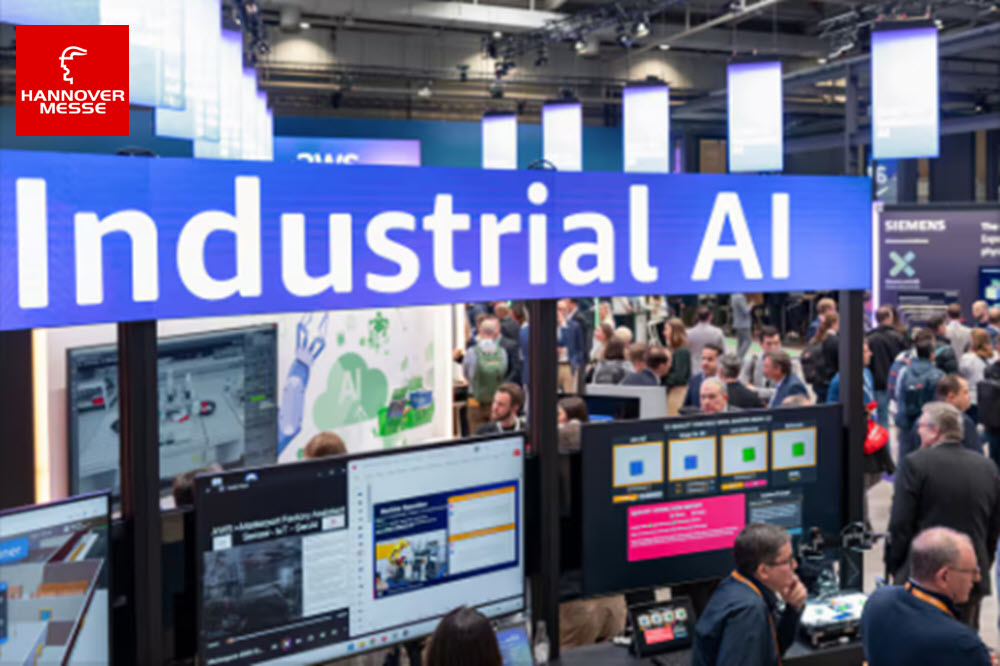
At the 2026 Hannover Messe, one of the world’s premier industrial technology exhibitions, robotics took center stage as companies showcased how automation and artificial intelligence are reshaping manufacturing. Held in Hannover, Germany, the event drew global industry leaders seeking solutions to pressing challenges in productivity, sustainability, and workforce transformation. Among the standout themes was the growing integration of intelligent robotic systems across sectors, from automotive assembly to electronics and logistics.
Schneider Electric, a French multinational specializing in energy management and automation, used its platform at the fair to highlight advancements in software-defined automation and AI-driven robotics. The company presented its vision under the theme “智造跃迁,正当其时” (“Intelligent Manufacturing Leap, Now Is the Time”), emphasizing how integrated technologies can unlock new levels of efficiency and innovation. Its exhibit featured five immersive zones focused on software-defined systems, energy optimization, high-efficiency production, talent empowerment, and safe operations—each demonstrating real-world applications of AI-integrated robotics in industrial environments.
According to verified reports from the event, Schneider Electric collaborated with its subsidiaries AVEVA, ETAP, and ProLeiT to demonstrate scalable solutions already delivering immediate value to customers. Gwenaelle Huet, Executive Vice President of Schneider Electric’s Industrial Automation business, stated that the showcased innovations are designed for broad deployment and help clients address current development challenges although expanding the boundaries of industrial operations. Ding Xiaohong, Senior Vice President and head of Schneider Electric’s Industrial Automation business in China, emphasized the company’s commitment to deepening its presence in the Chinese market, describing it as a key strategic region for long-term investment and innovation localization.
Huang Xiao, Senior Vice President overseeing global industrial control and drive operations and head of Schneider Electric’s China Center, noted that the company continues to introduce globally leading technologies while adapting them to local industrial needs. He highlighted that products and solutions developed in response to Chinese market demands are now being scaled for global rollout, reflecting a two-way flow of innovation between regional insights and worldwide application.
The Hannover Messe 2026 also featured dedicated forums on the future of AI and robotics in industry, including discussions on regulatory frameworks in Europe. Reports indicated that German policymakers are exploring ways to streamline approval processes for industrial AI applications to accelerate technology adoption without compromising safety or ethical standards. These efforts aim to support faster integration of intelligent systems into factories while maintaining oversight aligned with EU AI Act principles.
In addition to corporate exhibitions, the fair included special programming under the theme “Invest in China,” featuring a series of events designed to connect international businesses with opportunities in China’s evolving industrial landscape. Activities highlighted China’s role as a hub for advanced manufacturing, renewable energy integration, and digital transformation, with participation from government agencies, industry associations, and technology partners.
Robotics demonstrations at the event spanned collaborative robots (cobots) working alongside humans in assembly lines, autonomous mobile robots (AMRs) navigating warehouse floors, and AI-powered vision systems enabling precision quality control. Exhibitors emphasized that modern robotic systems are no longer limited to repetitive tasks but are increasingly capable of adaptive learning, real-time decision-making, and seamless interaction with digital twins and industrial IoT platforms.
Analysts note that the convergence of AI, edge computing, and advanced sensorics is enabling a new generation of robots that can perceive, learn, and respond dynamically to changing production environments. This shift supports trends toward mass customization, predictive maintenance, and resilient supply chains—key priorities for manufacturers navigating geopolitical uncertainty and climate-related disruptions.
Safety and human-robot collaboration remained central topics throughout the exhibition. Standards organizations and industry groups showcased updated guidelines for risk assessment, speed and separation monitoring, and force-limiting technologies designed to ensure safe interaction in shared workspaces. Vendors highlighted compliance with ISO 10218 and ISO/TS 15066 as foundational to deploying cobots in industrial settings.
The event also underscored the importance of skills development in an era of increasing automation. Schneider Electric and other participants promoted initiatives aimed at upskilling workers to operate, maintain, and collaborate with robotic systems. Training programs featuring augmented reality (AR) simulations and AI-driven learning platforms were presented as tools to bridge the gap between traditional manufacturing roles and the demands of smart factories.
Environmental sustainability was another cross-cutting theme, with several robotic solutions highlighted for their role in reducing energy consumption, minimizing waste, and enabling circular manufacturing processes. Examples included robots optimized for precision material handling to reduce scrap, and AI-driven scheduling tools that improve machine utilization while lowering carbon footprints.
As the 2026 Hannover Messe concluded, industry observers pointed to several takeaways: the accelerating pace of AI-robotics integration, the growing importance of software-defined infrastructure, and the need for coordinated action among policymakers, industry leaders, and educators to ensure inclusive and responsible adoption. The fair reinforced its role not only as a showcase of innovation but as a platform for shaping the future trajectory of global industry.
For ongoing updates on developments in industrial automation, AI, and robotics, readers can follow official channels such as the Hannover Messe website, the International Federation of Robotics (IFR), and publications from leading standards bodies like ISO and IEC. These sources provide timely information on upcoming events, technical reports, and policy developments shaping the sector.
What aspects of industrial robotics are most relevant to your operations or interests? Share your thoughts in the comments below, and consider sharing this article with colleagues or networks interested in the future of manufacturing.