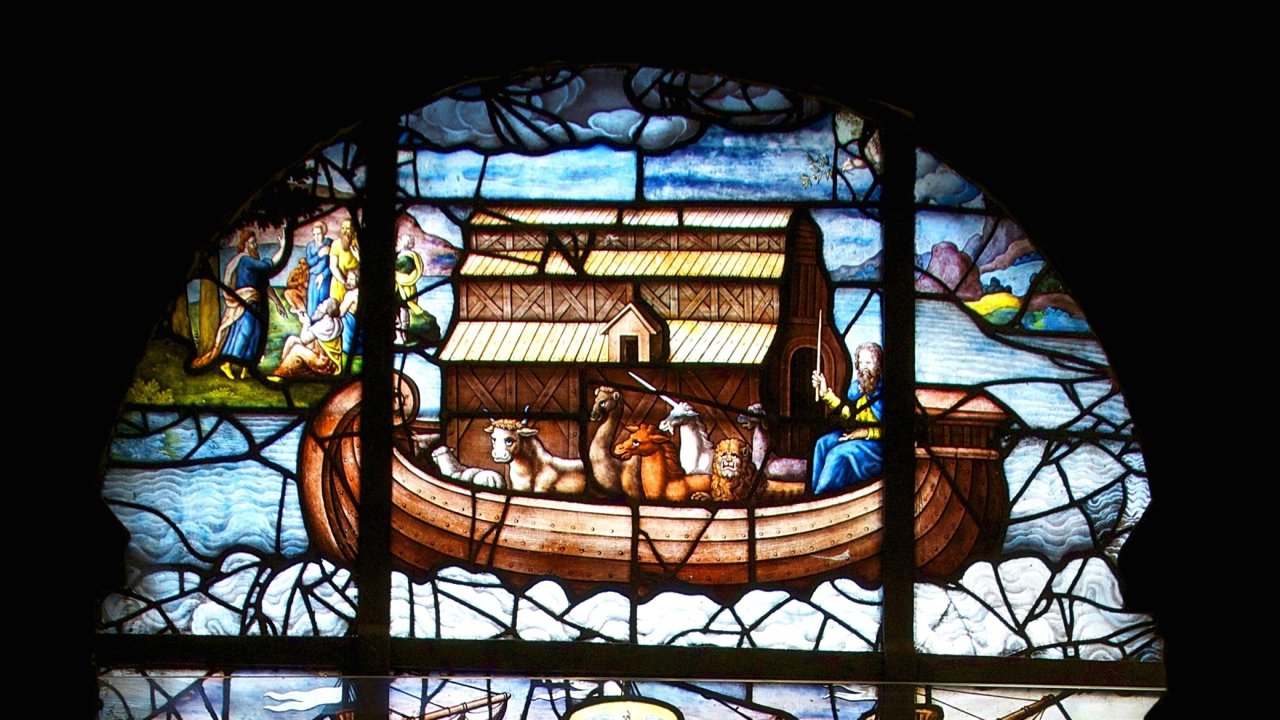
Recent developments in Turkey have reignited public and scientific interest in one of history’s most enduring mysteries: the possible location of Noah’s Ark. According to reports from independent research teams using ground-penetrating radar technology, subsurface structures have been detected near the Durupınar formation, approximately 29 kilometers south of Mount Ararat in eastern Turkey. These findings, while not conclusive, have prompted renewed discussion about whether the biblical account of the Ark’s resting place might have a basis in geological reality.
The latest investigations were conducted by the Noah’s Ark Scans project, a U.S.-based research initiative that has been studying the Durupınar site for several years. In April 2026, team member Andrew Jones reported that georadar surveys revealed a network of underground corridors converging toward a central cavity, which he described as resembling an atrium. Jones suggested that the multi-level layout of these subterranean features could align with the biblical description of the Ark having three internal decks, as mentioned in Genesis 6:16. Though, he emphasized that georadar can only detect potential voids beneath the surface and cannot confirm the nature or origin of such structures without further excavation or direct observation.
Mount Ararat, located in Turkey’s Ağri Province near the borders with Iran and Armenia, has long been associated in tradition with the final resting place of Noah’s Ark following the great flood described in the Book of Genesis. The biblical narrative states that the Ark came to rest on the “mountains of Ararat” after the waters receded (Genesis 8:4). While the exact identification of this location remains debated among scholars, the Durupınar formation—a natural geological structure resembling a boat-shaped outline when viewed from above—has drawn particular attention due to its visual similarity to a large vessel.
Previous studies of the site have yielded mixed results. Some early surveys in the late 20th century suggested the presence of unusual subsurface anomalies, but later geological analyses concluded that the formation is likely a syncline—a fold in sedimentary rock layers—shaped over time by natural erosion processes. Mainstream geologists generally regard the Durupınar site as a product of natural geological forces rather than an archaeological artifact. Despite this, interest persists among certain religious and historical researchers who argue that the site warrants further investigation using non-invasive scanning technologies.
The April 2026 findings were reported by several international news outlets, including Turkish and European media, which highlighted the potential significance of the detected tunnels, and chambers. However, no peer-reviewed scientific paper has yet been published detailing the methodology or results of the most recent scans. Experts in archaeology and geophysics caution that interpretations of ground-penetrating radar data require careful validation, as similar technologies have occasionally produced false positives in complex terrain.
To date, no official excavation permits have been granted for the Durupınar site by Turkish authorities, and no physical artifacts or organic materials have been recovered from the area that could be definitively linked to a prehistoric vessel. The Turkish Ministry of Culture and Tourism oversees all archaeological activities in the country, and any invasive investigation would require formal approval under national heritage laws.
The story of Noah’s Ark appears in the religious texts of Judaism, Christianity, and Islam, describing a divine command to build a large vessel to preserve life during a catastrophic flood. While the tale is considered symbolic or theological by many scholars, others have sought historical or archaeological evidence to support its historicity. Similar flood narratives exist in ancient Mesopotamian literature, such as the Epic of Gilgamesh, suggesting shared cultural motifs across early civilizations.
As of now, the Durupınar formation remains a subject of debate rather than confirmation. Researchers involved in the Noah’s Ark Scans project have stated that additional scans and possibly seismic testing are planned to better map the subsurface features. Until verifiable evidence emerges through transparent, peer-reviewed scientific processes, the site will continue to occupy a space between faith, folklore, and ongoing scientific inquiry.
For readers interested in following developments, updates from the Noah’s Ark Scans team are occasionally shared through their official channels, though no major academic institutions have yet endorsed the findings as conclusive. The broader scientific consensus maintains that extraordinary claims require extraordinary evidence—and in the case of Noah’s Ark, such evidence has not yet been produced.
What do you think about the ongoing search for Noah’s Ark? Share your thoughts in the comments below, and feel free to share this article if you found it informative.
Worth a look