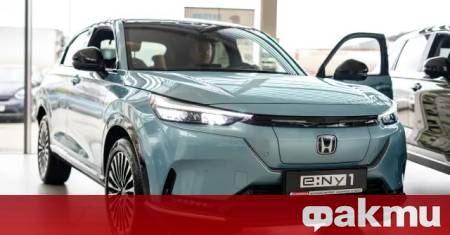
Honda is discontinuing its only fully electric vehicle sold in Europe, the e:Ny1 SUV, after struggling to gain traction in key markets. The Japanese automaker confirmed the withdrawal from Germany, Italy, Spain, the UK and Switzerland, with the model no longer available for order on its official websites in those countries. Even as the e:Ny1 remains configurable in France and Austria, Honda is redirecting remaining stock toward the UK and Nordic regions where demand has been relatively stronger. This move marks a significant pivot in Honda’s European electric vehicle strategy just three years after the e:Ny1’s launch in mid-2023.
The decision comes amid persistently low sales figures that failed to meet expectations despite a price reduction in Germany from €47,590 to €38,990. According to registration data analyzed by German automotive portal InsideEVs, Honda sold only 266 units of the e:Ny1 in Germany during its launch year of 2023. Registrations increased to 795 units in 2024 but plummeted to just 105 units in 2025, underscoring the model’s inability to compete with newer, more affordable rivals from both European and Chinese manufacturers. Even after the price cut, the e:Ny1 struggled to attract buyers in a rapidly evolving EV market.
Technically, the e:Ny1 is built on Honda’s e:N Architecture F platform and features a single electric motor producing 150 kW (201 hp) and 310 Nm of torque. It is powered by a 68.8 kWh battery delivering a WLTP range of 412 kilometres (256 miles). Standard charging from 10 to 80 percent takes approximately 45 minutes. The motor, supplied by Vitesco Technologies as the EMR3 unit, was already not the supplier’s most advanced offering at launch, with the successor EMR4 having been introduced as early as 2021. This contributed to perceptions of outdated technology despite the vehicle’s modern styling, which includes a redesigned front end with an integrated charging port in the grille, clear taillights, and a 15.1-inch portrait touchscreen display.
Honda’s retreat from the e:Ny1 does not signal a full exit from electric vehicles in Europe. Instead, the company is preparing to launch a new model, the Super-N hatchback, in July 2026 for the European and UK markets. Developed through Honda’s joint venture with Dongfeng, the Super-N represents a strategic shift toward a different market segment, targeting consumers seeking a more affordable and practical electric option. Unlike the e:Ny1, which was positioned as an electric counterpart to the HR-V crossover, the Super-N is designed as a compact hatchback aimed at urban drivers.
The discontinuation reflects broader challenges Honda has faced in adapting its global EV strategy to regional market realities. While the e:Ny1 found some success in China under the names e:NS1 and e:NP1 since 2022, its European reception was lukewarm due to high pricing, modest range by 2023 standards, and intense competition. Industry analysts note that Honda’s initial EV push in Europe underestimated the pace of innovation and price declines driven by Chinese manufacturers and established European brands alike.
Looking ahead, Honda has not issued an official statement detailing the full scope of its revised EV roadmap for Europe beyond the confirmation of the e:Ny1’s withdrawal and the upcoming Super-N launch. The company continues to evaluate consumer demand and regulatory developments across the region, particularly as emissions standards tighten and infrastructure for electric vehicles expands. For now, the focus appears to be on rebuilding credibility in the EV space with a more competitively priced and strategically positioned product lineup.
As Honda recalibrates its approach, the e:Ny1’s short tenure in Europe serves as a case study in the risks of launching electric vehicles without sufficient cost competitiveness or technological differentiation in a crowded market. The automaker’s next steps will be closely watched by industry observers seeking signs of a renewed and sustainable commitment to electrification in one of the world’s most environmentally conscious automotive regions.
For ongoing updates on Honda’s electric vehicle developments in Europe, readers are encouraged to monitor the automaker’s official press releases and regional news outlets. Share your thoughts on Honda’s EV strategy in the comments below, and consider sharing this article with others interested in the evolving landscape of electric mobility.
Worth a look
- Elon Musk’s Fortune Plummets by $650 Billion
- This Is an ICE Murder Too”: Wife of Detained Hunger Striker Demands Closure of NJ Jails After 3rd Death
- Philippe Strehlé: An Extraordinary Journey from China to France (archynewsy.com)
- GM and SAIC Extend China Joint Venture for 20 Years Through 2047 (time.news)