
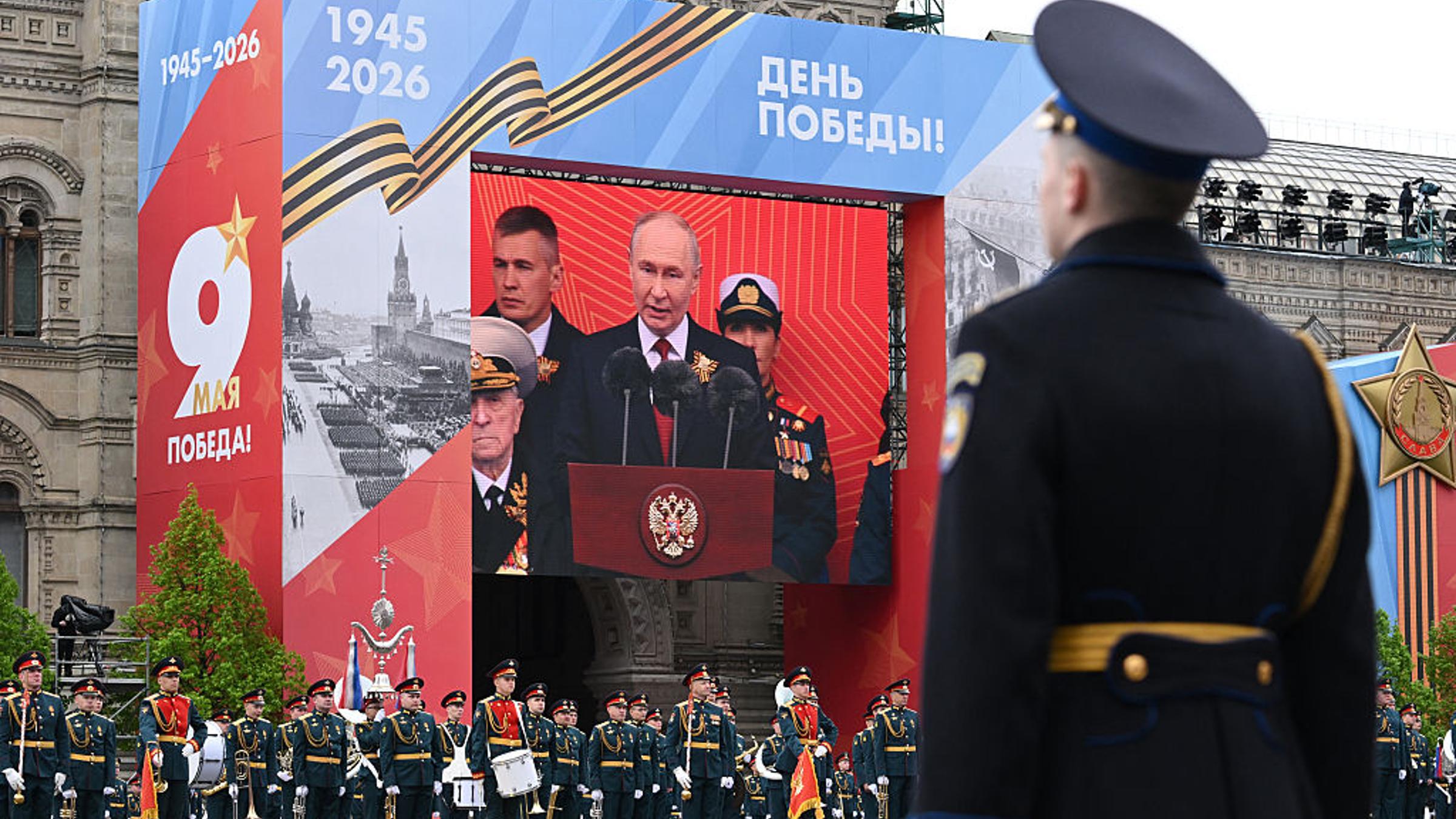
Russian President Vladimir Putin oversaw a starkly diminished military display in Moscow on Saturday, marking a significant departure from the usual displays of imperial strength. In a ceremony that lasted just 45 minutes, Putin Marks Pared-Down Victory Day Parade in Moscow After Zelensky Gives ‘Permission’, signaling a moment of vulnerability for the Kremlin as the conflict in Ukraine enters its fourth year.
The event, held on May 9, 2026, to commemorate the 81st anniversary of the Soviet Union’s victory over Nazi Germany, was devoid of the heavy military hardware that typically defines the Red Square festivities. For the first time in nearly two decades, there were no lines of tanks or missile carriers rolling through the capital, a shift CNN reports was a marked departure from previous years.
This scaled-back approach comes amid a fragile diplomatic window and escalating security threats. The parade took place under a last-minute, three-day ceasefire brokered by U.S. President Donald Trump, which includes a suspension of kinetic activity and a reciprocal swap of 1,000 prisoners from each country. While the Kremlin maintains its strength, the optics of the day suggested a leadership more concerned with survival than spectacle.
A Red Square Without Steel
The absence of military hardware was the most glaring omission of the day. Russia’s Defense Ministry attributed the low-key nature of the ceremony to the “current operational situation,” a direct reference to the ongoing invasion of Ukraine. Instead of the traditional display of intercontinental ballistic missiles and armored vehicles, the Kremlin relied on high-definition, pre-recorded videos broadcast on massive screens throughout Red Square.

These videos showcased drones, air defense systems, long-range bombers, and nuclear-capable submarines—an attempt to project power digitally while keeping actual assets away from the capital. The ceremony was brief, lasting only 45 minutes, and featured a smaller contingent of international guests and journalists than in previous years. Time reports that attendees included Belarusian leader Alexander Lukashenko, Laotian President Thongloun Sisoulith, and Malaysian King Sultan Ibrahim.
Adding a layer of geopolitical complexity, the parade featured North Korean troops marching alongside Russian soldiers and sailors, a visual confirmation of the deepening military ties between Moscow and Pyongyang as the war of attrition continues.
The ‘Permission’ and the Prisoner Swap
The most unusual aspect of the event was the diplomatic framing surrounding it. Last week, Russia unsuccessfully sought a ceasefire from Ukrainian President Volodymyr Zelenskyy for the parade day. However, on Friday, President Donald Trump announced via Truth Social that both nations had agreed to a three-day ceasefire from May 9 to May 11.
In a move described as being tinged with sarcasm, President Zelenskyy issued an official presidential decree stating he would “permit the holding of a parade.” Writing on X, Zelenskyy emphasized that “the Red Square is less important to us than the lives of Ukrainian prisoners who can be brought home,” linking the ceasefire directly to the swap of 1,000 prisoners of war.
The Kremlin dismissed the notion that it required external approval. Spokesman Dmitry Peskov told reporters that Russia did not “need anyone’s permission to be proud of our Victory Day.” This tension was heightened by previous threats from the Russian Defense Ministry to launch “retaliatory, massive missile strikes” on central Kyiv should the parade be disrupted.
Security Fears and Strategic Vulnerability
Beyond the battlefield, the scaled-back nature of the event reflected growing security anxieties within Moscow. Russian leaders were reportedly consumed by the threat posed by Kyiv’s increasingly sophisticated fleet of long-range drones. Just days before the parade, a Ukrainian drone crashed into a high-rise building in western Moscow, miles from the Kremlin, highlighting the reach of Ukrainian intelligence and strike capabilities.
This vulnerability extended to the press. The Kremlin restricted the number of journalists accredited for the event, with Dmitry Peskov stating that the limited number of press reflected the “limited” nature of the ceremony. CNN reported that its accreditation privileges were stripped on Thursday, forcing many international outlets to rely on Russian state media for coverage.
President Putin himself was protected by an unusually large security detail. This heightened vigilance follows reports that the Kremlin has tightened monitoring of the president amid concerns regarding potential coup plots or assassination attempts, as The New York Times suggests the event’s shrunken scale adds to a sense of growing vulnerability.
The Attritional Grind: Reality vs. Rhetoric
During his address, President Putin attempted to bridge the gap between the 1945 victory and the current conflict, stating, “The great feat of the generation of victors inspires the soldiers carrying out the goals of the special military operation today.” He framed the war as a confrontation against “an aggressive force armed and supported by the whole bloc of NATO.”
However, the rhetoric of “heroes moving forward” stands in contrast to data regarding the actual progress on the ground. After more than four years, the invasion has slowed to an attritional grind. Figures released by independent outlets Meduza and Mediazona indicate that approximately 352,000 Russian soldiers died in the war from February 2022 through the end of 2025.

The Center for Strategic and International Studies (CSIS) has provided similar estimates, noting that Russia is advancing “remarkably slowly.” In one specific instance, a Russian offensive targeting the city of Pokrovsk reportedly advanced at a rate of only 70 meters per day between February 2024 and January 2026. CSIS characterized this pace as slower than some of the most brutal campaigns of the last century, including the Battle of the Somme in World War I.
Despite these staggering losses and the economic strain of the war, Moscow continues to profess its ability to outlast Kyiv, maintaining a gradual advance across a 600-mile front line.
Key Takeaways: Victory Day 2026
- Hardware Absence: No tanks or missiles were displayed in Red Square. military strength was shown via pre-recorded videos.
- Diplomatic Leverage: A three-day ceasefire (May 9–11) was brokered by Donald Trump, facilitating a 1,000-prisoner swap.
- Zelenskyy’s Stance: The Ukrainian president sarcastically “permitted” the parade to prioritize the return of prisoners.
- Security Risks: The event was scaled back partly due to the threat of long-range Ukrainian drones and internal security concerns.
- Battlefield Stagnation: Reports indicate extreme casualty rates and glacial territorial gains, contrasting with Putin’s triumphalist rhetoric.
The current ceasefire is scheduled to expire on May 11, 2026. All eyes now turn to whether this brief pause in kinetic activity will serve as a genuine starting point for negotiations or simply a tactical breath before the resumption of hostilities.
World Today Journal encourages readers to share their perspectives on the shifting optics of the Kremlin’s power in the comments below.