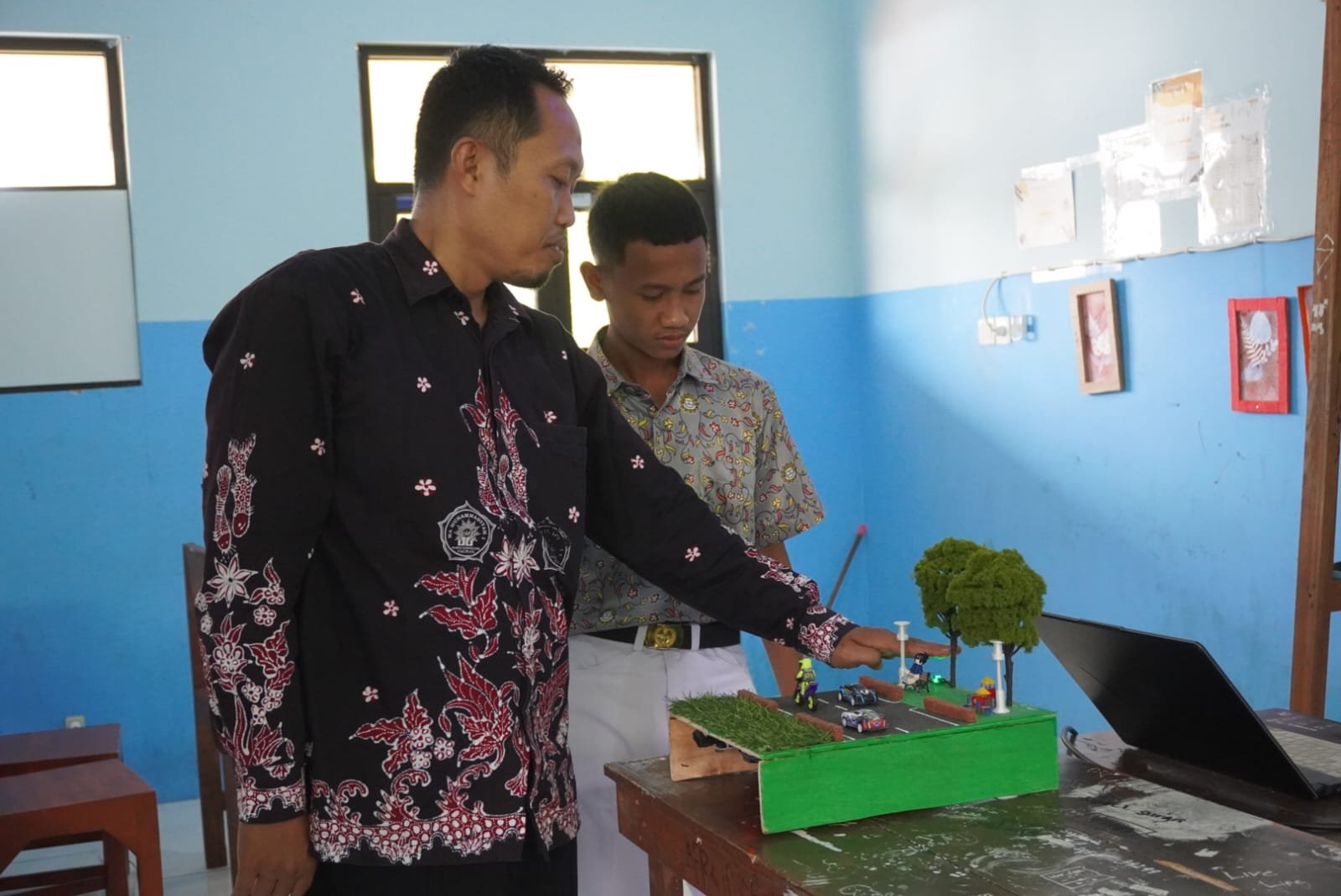
In a quiet corner of Paciran, a traditional classroom recently underwent a dramatic transformation. Tables that usually hold notebooks and pens were replaced by a chaotic yet purposeful array of jumper wires, sensors, blinking LEDs, and miniature architectural models. For the eleventh-grade students of the Information Technology Class Program (ITCP) at Madrasah Aliyah Muhammadiyah 1 Karangasem (Mamsaka), this was not a science fair, but a high-stakes project examination.
On Saturday, May 9, 2026, the school’s laboratories and classrooms functioned as a mini research and development center. The event served as a critical milestone for students who have spent their term moving beyond theoretical textbooks to engage with the tangible world of digital engineering. This shift toward applied technology is designed to prepare students for a basic technology certification from the Universitas Muhammadiyah Malang (UMM), bridging the gap between secondary education and professional technical standards.
The exhibition highlighted a growing trend in vocational and religious education where STEM (Science, Technology, Engineering, and Mathematics) integration is becoming a priority. By challenging students to build functional prototypes that solve real-world problems, Mamsaka is positioning its graduates not just as consumers of technology, but as creators capable of implementing automation to increase efficiency and safety in daily life.
From Classrooms to Research Hubs: The ITCP Approach
The Information Technology Class Program (ITCP) at Mamsaka represents a departure from conventional rote learning. Instead of simply studying the logic of programming or the physics of electricity, students are tasked with the end-to-end development of robotic systems. This process involves conceptual design, hardware assembly, and software programming—a workflow that mirrors professional software and hardware engineering cycles.
The goal of this pedagogical approach is to foster critical thinking and problem-solving skills. By requiring students to build a physical product that must function under the scrutiny of examiners, the program emphasizes the importance of iterative testing and debugging. The atmosphere during the May 9 exams reflected this intensity, with students fine-tuning their circuits and refining their code in real-time to ensure their prototypes operated flawlessly.
A Portfolio of Practical Automation
The projects presented by the Grade XI students showcased a wide spectrum of applications, ranging from domestic convenience to disaster mitigation. Each project was designed to address a specific modern challenge using sensor-based automation.
Among the most notable innovations were:
- Sensor-Based Smart Homes: These prototypes demonstrated how integrated sensors can automate home environments, potentially reducing energy consumption and increasing security.
- Earthquake Mitigation Simulations: A critical project given the regional geography, these simulations aimed to demonstrate how technology can detect seismic activity and trigger safety protocols.
- Smart Greenhouses and Automated Watering Systems: These projects focused on agricultural efficiency, using sensors to monitor soil moisture and automate irrigation, ensuring plants receive optimal hydration without human intervention.
- Miniature Fire-Fighting Vehicles: These robots were designed to detect heat or flames and navigate toward the source to extinguish fires, showcasing the potential for robotics in hazardous environments.
- Automatic Trash Bins: A simple but effective application of motion sensors to promote hygiene and touchless interaction in public spaces.
The Technical Foundation: Arduino and Microcontrollers
At the heart of nearly every project was the use of microcontrollers, specifically the Arduino platform. For those unfamiliar with the tech, a microcontroller is essentially a compact computer on a single integrated circuit. It allows students to write code that tells the hardware how to react to inputs from sensors—such as a moisture sensor in a greenhouse or an ultrasonic sensor in an automatic trash bin—and then trigger an output, such as turning on a pump or opening a lid.
The use of these tools allows students to experiment with “embedded systems,” the invisible technology that powers everything from microwave ovens to automotive braking systems. By mastering the interaction between software (the code) and hardware (the sensors and actuators), Mamsaka students are gaining a foundational understanding of the Internet of Things (IoT), where physical objects are connected to the internet and can communicate data.
Breaking Gender Barriers in STEM
One of the most significant aspects of the ITCP project exhibition was the visible inclusivity of the program. In many technical fields globally, there remains a persistent gender gap; however, the event at Mamsaka demonstrated a different trajectory. Female students were not merely participants but were actively leading the process of design, hardware assembly, and complex programming.
This integration suggests that the school’s approach to technology is intentionally inclusive, encouraging all students regardless of gender to pursue roles in digital engineering and robotics. By providing equal access to the tools and mentorship required for these projects, Mamsaka is helping to dismantle stereotypes about who belongs in a robotics lab.
The Road to Professional Certification
The culmination of these projects is not just a grade on a report card, but a pathway to professional recognition. The collaboration with Universitas Muhammadiyah Malang (UMM) ensures that the curriculum aligns with higher education and industry standards. The basic technology certification provided by UMM serves as a credential that validates the students’ technical competencies.
This certification is particularly valuable in a global economy where “skills-first” hiring is becoming more common. By obtaining a university-backed certification while still in high school, Mamsaka students enter the job market or higher education with a verified portfolio of work, proving they can take a project from the conceptual stage to a working prototype.
As the students move toward their final certifications, the focus will likely shift toward more complex integrations, potentially incorporating wireless communication and cloud data logging to move their “smart” projects into the realm of fully connected ecosystems.
The next confirmed milestone for these students is the formal issuance of their basic technology certifications from Universitas Muhammadiyah Malang following the successful completion of these project examinations.
Do you think applied robotics should be a mandatory part of high school curricula globally? Share your thoughts in the comments below.