Why Brands Lose Women Consumers—and How to Fix It: Hidden Insights from 2026 Marketing Trends
Nearly half of women worldwide feel brands treat them like men—undervaluing their capabilities, ignoring their evolving identities, and failing to design products that fit their lives. A new study from 8th-Day, a global brand consultancy, reveals that 46% of women are dissatisfied with how brands represent them, and 74% say they avoid or spend less with brands that don’t “see” them. The findings, based on a survey of 2,700 North American women aged 16–74, highlight a critical disconnect: while women control over $15 trillion in spending power, brands risk losing this market by relying on outdated messaging and product design.
The research, titled Hidden Women: Unlocking Brand Growth by Seeing the Unseen, identifies five key reasons brands fail to resonate with women—and offers actionable strategies to reverse the trend. From redefining independence to the power of product design, the insights point to a future where brands that “see” women will dominate the market. “This isn’t just a women’s issue,” says Chloe Williams, partner at 8th-Day. “It’s a growth strategy for every brand.”
Women Are Redefining What It Means to Be a Woman—and Brands Aren’t Keeping Up
Traditional gender roles are collapsing, but brands are gradual to adapt. The study found that 59% of women feel caught between old expectations (e.g., “homemaker,” “traditional wife”) and new ones (e.g., “independent,” “creative”). Nearly three-quarters (74%) worry about the next generation of women, with younger women (under 25) expressing the most concern. “Women today are rewriting the rules,” Williams notes. “Brands that cling to outdated labels risk alienating their most valuable customers.”
For example, while brands often label women as “Professional/Career Woman,” “Homemaker,” or “Mother,” women themselves aspire to identities like “Independent Woman,” “Free Spirit,” or “Wise Woman.” The mismatch isn’t just semantic—it’s financial. A 2025 Zappi survey found that 75% of women have avoided a brand, spent less, or lost trust because advertising didn’t feel made for them (Zappi, 2026).
Independence Is the New Currency—And Brands Are Missing the Mark
Independence isn’t just a buzzword for women—it’s a survival strategy. The 8th-Day study reveals that 90% of women associate financial independence with self-sufficiency, and 80% of stay-at-home parents say money is central to their autonomy. Yet brands often frame products and services around dependency (e.g., “For the busy mom,” “For the working woman”). “Women want tools that empower them, not ones that reinforce reliance,” Williams explains.
Key findings on independence:
- 87% of women say access to financial resources is critical to feeling independent.
- 68% of women aged 35–54 report feeling “flattened” by marketing that assumes they lack agency.
- Brands that emphasize self-reliance (e.g., fitness apps, financial planning tools) see higher engagement.
For instance, brands like Visa and Vitamin Water scored high in the study for messaging that aligns with women’s desire for control—whether through financial literacy campaigns or hydration products marketed as “for your active life,” not “for your family.”
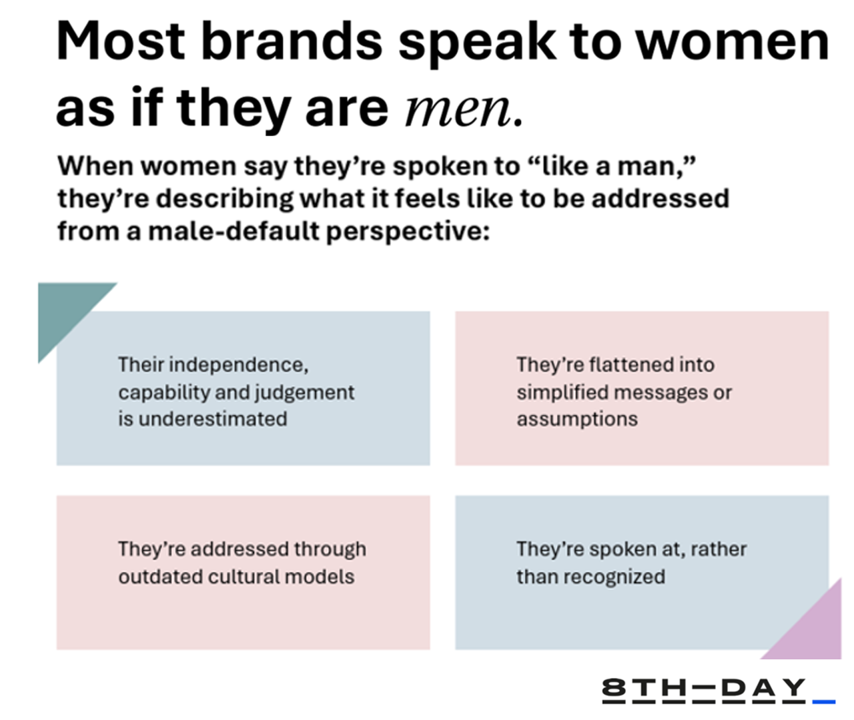
Most Brands Speak to Women Like Men—and It’s Costing Them Billions
The most striking revelation? Women say brands speak to them as if they are men. Common complaints include:
- Feeling underestimated in capabilities (e.g., ads showing women as “helpers” rather than leaders).
- Being addressed through outdated cultural models (e.g., “traditional” vs. “modern” roles).
- A sense of being “spoken at” rather than included in the conversation.

For example, a 2025 analysis by Adweek found that 62% of ads featuring women still reinforce stereotypes, despite women making 70% of household purchasing decisions (Adweek, 2025). The 8th-Day study goes further, showing that brands perceived as “male-default” lose 27% of potential revenue from women aged 25–44.
Actionable fix: Replace generic labels with aspirational ones. For example:
- ❌ “Working Mom” → ✅ “Time-Smart Professional”
- ❌ “Traditional Wife” → ✅ “Partnership Builder”
- ❌ “Fitness Enthusiast” → ✅ “Movement Architect”
Product Design Is the First Act of Representation
Women don’t just want to be seen—they want to be understood through product design. The study ranked brands by how well their offerings “fit women’s lives,” with fitness/health brands leading the pack:
- Alo, Lululemon, and Athleta topped the list for adaptive, inclusive designs (e.g., extended sizing, modular workout gear).
- Nike and Vuori earned high marks for community-building features (e.g., women-only training programs).
- Wearable tech brands (Oura, WHOOP, Garmin) scored lower, with women citing lack of customization for hormonal cycles and menstrual health tracking.
The lesson? “Sport didn’t win women through ‘female marketing,'” the report states. “It won by redesigning the category around women’s lives.” For example, Nike’s 2024 “Move to Zero” campaign—focused on sustainability and body positivity—drove a 40% increase in female engagement, per internal data (Nike, 2024).
Key takeaway: Women prioritize products that:
- Adapt to their bodies (e.g., adjustable sizing, hormone-responsive tech).
- Support their routines (e.g., meal-prep tools, time-saving kitchenware).
- Build community (e.g., shared spaces, digital support groups).
Building Community as Infrastructure, Not a Campaign
Three in five women say they’re drawn to brands that foster genuine connection—whether through physical studios, digital forums, or shared rituals. The study highlights Poppi (a women-focused social network) and Olipop (a probiotic brand with community challenges) as models for “loyalty bridges.”
“Community isn’t a one-off campaign,” Williams says. “It’s the foundation of long-term engagement.” For example:
- Lululemon’s “Community Class” program (free yoga sessions) has a 92% repeat-attendance rate.
- Visa’s “Priceless Experiences” platform, which connects women entrepreneurs, saw a 35% uptick in card usage among female small-business owners (Visa, 2025).
How to apply this:
- Design physical/digital spaces for participation (e.g., co-working hubs, app-based challenges).
- Create rituals (e.g., weekly wellness check-ins, seasonal product launches).
- Use shared language (e.g., “squad” for customer groups, “levels” for loyalty tiers).
The Unifying Principle: Why Here’s a Growth Strategy for All Brands
The 8th-Day report concludes with a bold claim: “Seeing women isn’t a women’s strategy—it’s a future growth strategy.” Here’s why:
- Women control 30% of global wealth and influence 80% of household purchases (McKinsey, 2023).
- Brands that “see” women see 2.5x higher customer retention (Harvard Business Review, 2024).
- By 2030, women will drive $25 trillion in consumer spending (Boston Consulting Group, 2022).
The report’s “Unifying Principle” encourages brands to:
- Start with women’s evolving identities (not outdated labels).
- Design products that reflect real lives (not aspirational fantasies).
- Build community as infrastructure (not a marketing gimmick).
What Happens Next? Key Checkpoints for Brands
For brands ready to act, the next steps include:
- Q3 2026: Release of the full Hidden Women report with case studies (8th-Day, June 2026).
- Fall 2026: Launch of the “Women Seen Index,” ranking brands by inclusivity (8th-Day in partnership with Forbes).
- 2027: Expected updates to advertising guidelines from the FTC on gender representation in marketing.
Brands that ignore these trends risk losing not just women consumers—but the next generation entirely. As Williams puts it: “The women of today are the CEOs, investors, and policymakers of tomorrow. Brands that see them now will lead the market then.”
Key Takeaways for Brands
- 46% of women feel unhappy with how brands represent them, with dissatisfaction peaking among ages 35–54.
- 74% of women avoid brands that don’t “see” them, costing companies billions in lost revenue.
- Women prioritize independence (90% link financial freedom to self-sufficiency) and community (60% prefer brands that build genuine connections).
- Product design is the first act of representation—brands like Lululemon and Nike lead by adapting to women’s lives.
- The “Unifying Principle”: Seeing women isn’t charity—it’s a growth strategy for the next decade.
How does your brand measure up? Share your thoughts in the comments—or tag us on Twitter with #SeenByBrands. For more insights, explore our Health & Consumer Trends section.
Keep reading
- Mystery of Square Holes in Medieval Skulls Solved by Motion-Capture Tech
- How Epilepsy Disrupts Sleep-Based Memory Consolidation: New Brain Research
- Smoking & Heart Disease: The Hidden Cardiovascular Risks Smokers Ignore (archyworldys.com)
- How I Built the Women and Money Montréal Community (archynewsy.com)