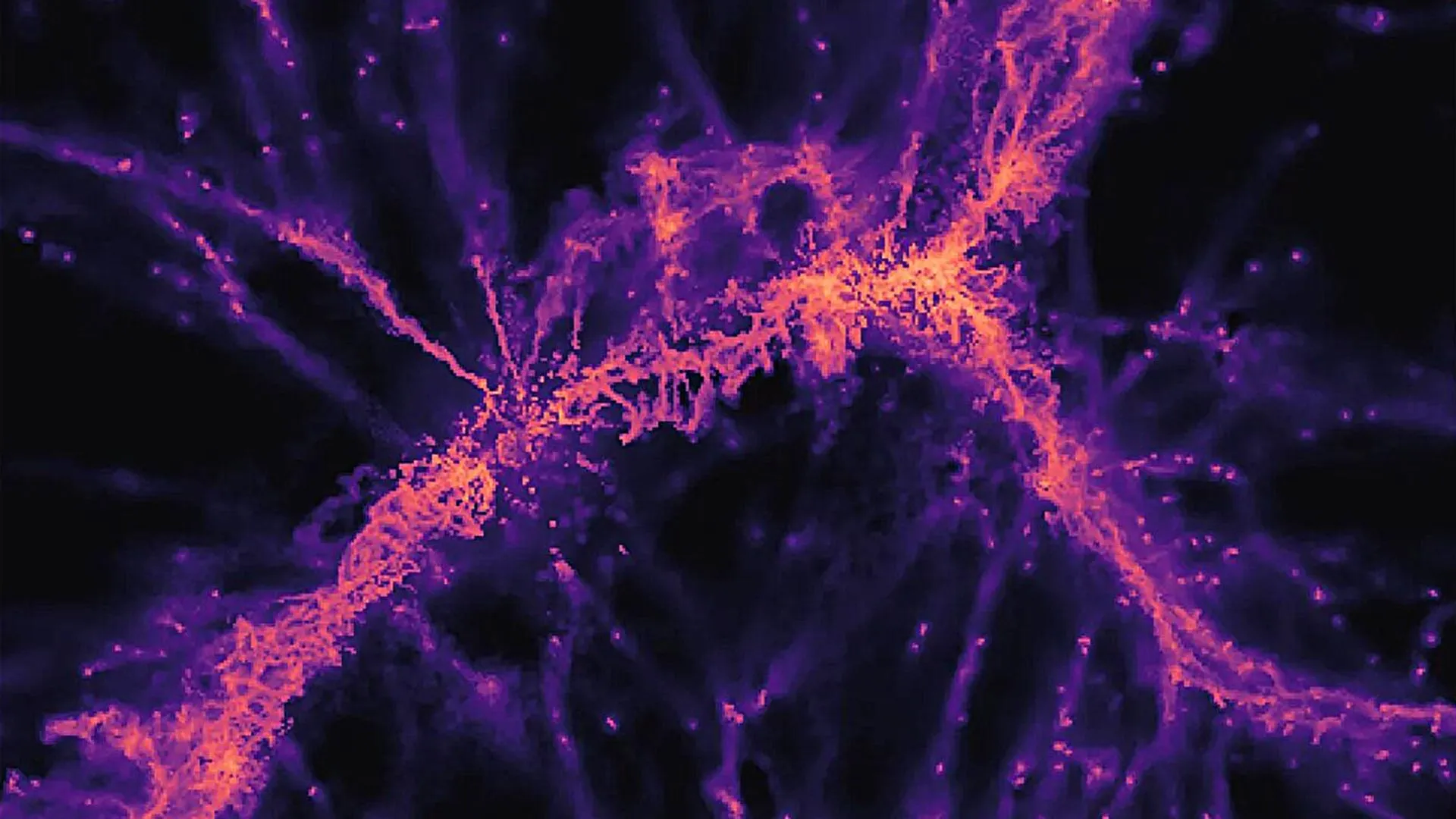
In the vast, silent expanses between the stars, a hidden architecture has long been theorized to govern the movement of the cosmos. For decades, astronomers have worked under the assumption that galaxies do not drift aimlessly through a void, but are instead strung along a complex, interconnected network of matter known as the cosmic web. Today, that theoretical scaffolding has moved from the realm of mathematical models into the light of direct observation.
In a landmark achievement for observational cosmology, astronomers have revealed the sharpest direct image ever captured of a filament within this cosmic web. This glowing, ethereal strand—a massive “highway” of intergalactic gas—stretches across 3 million light-years, providing a rare and detailed glimpse into the structural bones of our universe. The discovery offers more than just a stunning visual; it provides a direct look at the mechanisms that have fueled galaxy formation for billions of years.
The captured filament serves as a bridge, linking two distinct galaxies from a period when the universe was in its relative youth. By observing this faint intergalactic gas with unprecedented clarity, researchers are gaining critical insights into how the large-scale structure of the universe dictates the growth, evolution, and life cycles of the galaxies residing within it.
Mapping the Universe’s Hidden Highways
The concept of the cosmic web describes a universe organized into a web-like pattern of filaments, nodes, and voids. In this model, galaxies are not isolated islands; they are the bright “cities” located at the intersections of massive, invisible filaments. These filaments act as conduits, channeling gas and matter toward the galaxies, providing the essential raw materials needed for star formation and galactic expansion.
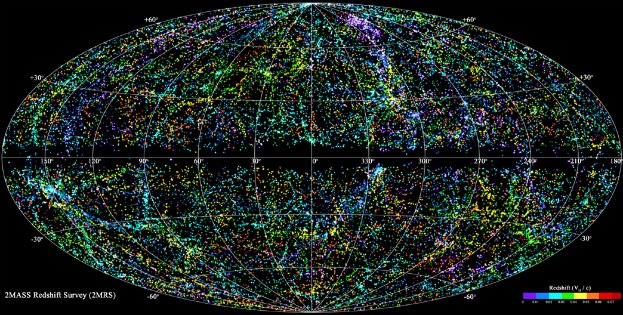
The recently imaged filament is a prime example of this phenomenon. Spanning 3 million light-years, the strand is a massive structure that has survived the turbulent evolution of the cosmos. What makes this specific observation so significant is its age. The filament links two galaxies that existed nearly 12 billion years ago—a time when the universe was only about 2 billion years old. This allows scientists to study the “building blocks” of the universe in a state that closely resembles the early stages of cosmic development.
For much of modern astronomy, these filaments have been “invisible.” While supercomputer simulations have long predicted their existence and mapped their distribution, capturing a direct image of the gas within them has proven to be one of the most significant technical challenges in the field. The gas within these filaments is incredibly diffuse and faint, making it nearly impossible to distinguish from the background noise of the deep sky without extreme precision and hundreds of hours of dedicated observation.
The Invisible Scaffolding: Dark Matter and the Cosmic Web
To understand why these filaments exist, one must look toward the most mysterious component of our universe: dark matter. While the glowing gas in the newly imaged filament is what makes the structure visible to our instruments, it is not the primary driver of the web’s shape. Instead, dark matter acts as the invisible gravitational scaffolding upon which all visible matter is hung.
Current cosmological models suggest that dark matter makes up approximately 85% of all matter in the universe. Because dark matter does not emit, absorb, or reflect light, it cannot be seen directly through traditional telescopes. However, its gravitational influence is profound. It is believed that dark matter formed the initial “clumps” and long-reaching filaments in the early universe, creating gravitational wells that pulled in ordinary, baryonic gas.
As this gas was drawn into the dark matter filaments, it became compressed and heated, eventually forming the luminous structures we recognize as the cosmic web. The direct observation of this gas provides a way to “trace” the invisible dark matter. By seeing where the gas flows and how it is distributed, astronomers can map the underlying dark matter framework that governs the large-scale structure of the universe.
How Galaxies Are Fueled: The Role of Intergalactic Gas
One of the most pressing questions in astrophysics is how galaxies manage to sustain star formation over billions of years. Stars require a constant supply of cold, dense gas to collapse and ignite. Without a mechanism to replenish this supply, galaxies would eventually “run out of fuel,” leading to a cessation of star formation and the eventual “death” of the galaxy.
The discovery of the 3-million-light-year filament provides a visual answer to this mystery. The filament acts as a cosmic pipeline. As gas flows along these intergalactic highways, it is funneled toward the intersections where galaxies reside. This continuous stream of matter ensures that galaxies have the necessary ingredients to continue growing and forming new generations of stars.
By studying the density and temperature of the gas within these filaments, researchers can better understand the “accretion” process—the way galaxies pull in surrounding matter. This insight is crucial for refining our understanding of galaxy evolution. It allows scientists to move beyond observing galaxies as static objects and instead view them as dynamic systems that are constantly interacting with their larger environment.
Key Takeaways: The Cosmic Web Discovery
- Unprecedented Detail: This represents the sharpest direct image ever captured of a cosmic web filament.
- Immense Scale: The observed filament stretches approximately 3 million light-years across space.
- Ancient Origins: The structure links galaxies from roughly 12 billion years ago, dating back to when the universe was 2 billion years old.
- Galaxy Fueling: The observation confirms how intergalactic gas flows along filaments to feed galaxy formation.
- Dark Matter Connection: The visible gas serves as a proxy for mapping the invisible dark matter framework that makes up 85% of the universe’s matter.
The Technical Challenge of Deep-Space Imaging
Capturing an image of this nature is an exercise in extreme patience and technological precision. Unlike the bright, concentrated light of a star or the distinct spiral arms of a nearby galaxy, the gas in a cosmic filament is incredibly tenuous. It is spread so thin across millions of light-years that its signal is often lost in the “glow” of more distant or brighter objects.
To isolate this signal, astronomers must utilize highly sensitive instruments capable of detecting incredibly faint wavelengths of light. The process typically involves “deep field” observations, where a telescope is pointed at a single, seemingly empty patch of sky for hundreds of hours. By stacking these long exposures, researchers can gradually pull the faint signal of the intergalactic medium out of the darkness.
This breakthrough is a testament to the evolution of astronomical instrumentation. As our ability to detect low-surface-brightness features improves, we are transitioning from an era of observing “objects” (stars, galaxies, clusters) to an era of observing the “medium” (the gas and dark matter that connects them). This shift is fundamental to our quest to understand the universe as a single, interconnected system.
The Future of Cosmological Research
The successful imaging of this filament marks a new chapter in observational cosmology. It provides a proof of concept that the “invisible” components of our universe—the filaments and the dark matter they trace—can indeed be studied through direct observation rather than just through simulation.
Moving forward, astronomers will look to apply these techniques to even more distant and fainter structures. The goal is to create a comprehensive “map” of the cosmic web across different epochs of the universe. By comparing filaments from the early universe to those in our local cosmic neighborhood, researchers can track how the web has grown, tightened, and evolved over the last 13 billion years.
This research will likely involve a multi-wavelength approach, combining data from optical telescopes with X-ray and radio observations. While optical telescopes see the glowing gas, X-ray observatories can detect the much hotter gas found in larger clusters, and radio telescopes can map the neutral hydrogen that makes up much of the cosmic web’s substance. Together, these tools will allow us to see the universe in its entirety—not just as a collection of bright points, but as a vast, flowing, and interconnected web.
As we continue to peel back the layers of the cosmos, each new discovery brings us closer to understanding the fundamental laws that shaped everything from the smallest atoms to the largest structures in existence. The “hidden highways” of the universe are finally coming into view, and they are revealing a cosmos far more interconnected than we ever imagined.
Notice no further scheduled official updates or hearings regarding this specific observation at this time. Researchers are expected to publish detailed spectroscopic analyses of the filament in upcoming peer-reviewed journals.
What do you think about this glimpse into the “bones” of our universe? Does the idea of a cosmic web change how you view the vastness of space? Let us know in the comments below and share this story with your fellow space enthusiasts.
Related reading