
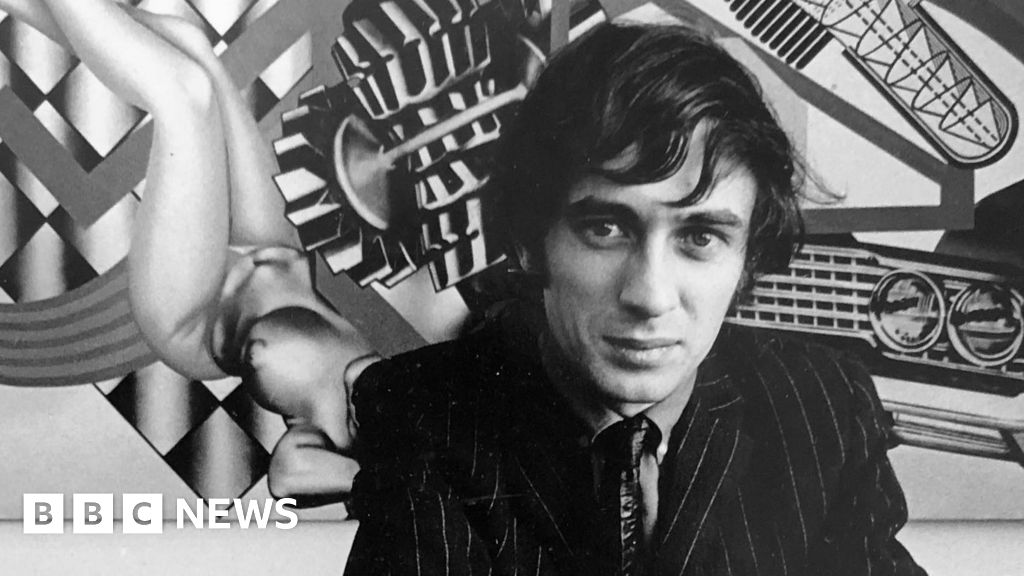
In the high-stakes, often London-centric world of British fine art, there is a particular kind of irony reserved for the legends who conquered the globe only to remain strangers in their own backyards. For decades, the art community has whispered the name Peter Phillips with a mixture of reverence and curiosity—a man who stood at the vanguard of the 1960s Pop Art movement, yet whose roots remained largely uncelebrated in the very city that shaped his early years.
That silence is finally being broken. The “Prince of Pop Art,” as he has been affectionately dubbed by critics, is finally receiving the homecoming his legacy demands. A major exhibition dedicated to his transformative work is set to grace the galleries of Birmingham, marking a profound cultural correction for a city that, for too long, seemed to look past one of its most significant creative exports.
As an editor who has spent over fifteen years navigating the intersection of celebrity culture and fine art, I have seen many “comeback” stories. But What we have is different. This isn’t a comeback for an artist whose fame has faded; it is a delayed recognition for an artist whose influence has never wavered. For Peter Phillips, the journey from the industrial heart of the Midlands to the heights of international Pop Art is a narrative of patterns, consumerism, and a unique visual language that continues to resonate in our hyper-visual age.
A Legacy Painted in Pattern and Pop
To understand why this exhibition is a watershed moment, one must first understand the specific, almost mathematical brilliance of Peter Phillips’ contribution to the Pop Art movement. While his contemporaries like Andy Warhol were busy elevating the soup can to the status of high art through repetition and celebrity iconography, Phillips was carving out a niche that was arguably more complex and structurally sophisticated.
Phillips’ work emerged during the peak of the 1960s zeitgeist, a period when the boundaries between high culture and mass consumption were dissolving. However, where other Pop artists leaned into the grit or the gloss of advertising, Phillips turned his gaze toward the structural elements of modern life. He became a master of the “graphic landscape,” utilizing maps, intricate patterns, and the geometric shapes of consumer products to create compositions that feel both meticulously ordered and vibrantly chaotic.
His ability to weave together the disparate threads of the modern experience—the way a topographical map might mirror the layout of a consumer goods package—set him apart. His work does not merely reflect the culture of the 1960s; it deconstructs the very visual systems we use to navigate the world. This intellectual depth is precisely why he remains a pivotal figure for collectors and historians alike, even as the trends of the art market shift toward the ephemeral.
The Long Road Home: Why Birmingham Missed the Mark
The central tension of this story lies in the geographical disconnect between the artist and his origins. Birmingham, a city defined by its industrial prowess and its role as a powerhouse of the British Midlands, has often found itself at odds with the “fine art” establishment. For much of the 20th century, the cultural narrative of Britain was heavily skewed toward London, leaving the creative output of the Midlands to be viewed through a secondary lens.

This “London-centric” bias meant that while Phillips was gaining international acclaim, his connection to Birmingham remained a footnote rather than a headline. There is a palpable sense of missed opportunity in how the city’s cultural institutions engaged with his rise. While his work was being celebrated in major international galleries, the local recognition that should have accompanied such a monumental figure was conspicuously absent.
However, this oversight may have been a byproduct of the very era Phillips was documenting. The 1960s were a time of rapid urban change and a shifting social hierarchy. As Birmingham underwent its own massive industrial and social transformations, the focus was often on the tangible—the steel, the manufacturing, the movement of goods. The abstract, pattern-heavy, and conceptually dense world of Pop Art may have felt worlds away from the lived experience of the Midlands at the time. This exhibition represents a bridge between those two worlds, finally connecting the industrial heritage of the city with the sophisticated visual language of its most famous son.
What to Expect: A Visual Feast of Geometric Brilliance
For those attending the exhibition, the experience promises to be more than just a retrospective; it is a deep dive into the evolution of a visual pioneer. The collection is expected to span the breadth of his career, showcasing the transition from his early explorations of pattern to the more complex, multi-layered works that defined his maturity.
Visitors can expect to see several key elements that define the Phillips aesthetic:
- The Map Motif: A recurring fascination with how we represent space, using cartographic lines to create a sense of movement and discovery within a two-dimensional plane.
- Consumer Geometry: The transformation of everyday objects—labels, packaging, and commercial symbols—into high-concept geometric abstractions.
- Chromatic Vibrancy: A sophisticated use of color that captures the optimism and the sensory overload of the mid-century modern era.
- Structural Complexity: A look at how Phillips uses repetition not just for effect, but to build intricate, almost architectural layers of meaning.
Art historians suggest that seeing these works in a Birmingham context provides a new layer of meaning. There is a certain poetic symmetry in viewing works that celebrate the patterns of modern life within a city that was, for so long, the very engine generating those patterns.
Key Takeaways of the Peter Phillips Exhibition
| Feature | Significance |
|---|---|
| Artistic Movement | A definitive pillar of the 1960s British Pop Art era. |
| Core Aesthetic | The intersection of cartography, consumerism, and geometric pattern. |
| Cultural Impact | A long-overdue “homecoming” and historical correction for Birmingham. |
| Primary Theme | Deconstructing the visual language of the modern world. |
Why This Moment Matters for British Art
Beyond the personal triumph for Phillips, this exhibition serves as a vital moment for the broader British art landscape. It challenges the notion that significant cultural movements are the exclusive domain of the capital. By embracing Phillips, Birmingham is asserting its own place in the history of modernism, proving that the “periphery” has often been at the very center of innovation.

in an era where digital imagery and pattern-based design dominate our screens, Phillips’ work feels more contemporary than ever. We live in a world of constant visual data—GPS maps, brand logos, and infinite scrolling patterns. Phillips was exploring these exact themes decades before they became the primary interface of human existence. His work provides a historical anchor for our current obsession with the visual architecture of the digital age.
For the next generation of artists emerging from the Midlands, this exhibition is a powerful signal. It demonstrates that a global career is not predicated on staying within the London bubble, and that the unique perspective offered by one’s home environment can be a source of immense creative strength.
As we prepare to walk through these galleries, we are not just looking at paintings; we are witnessing the reconciliation of an artist with his origins. The “Prince of Pop Art” has finally returned, and in doing so, he has invited his home city to finally see him clearly.
Next Scheduled Update: Official exhibition dates and full gallery schedules are expected to be released via the Birmingham museum’s press office in the coming weeks. We will be following the installation closely.
What are your thoughts on the importance of regional recognition in the art world? Have you experienced the impact of Pop Art firsthand? Let us know in the comments below and share this story with your fellow art enthusiasts.