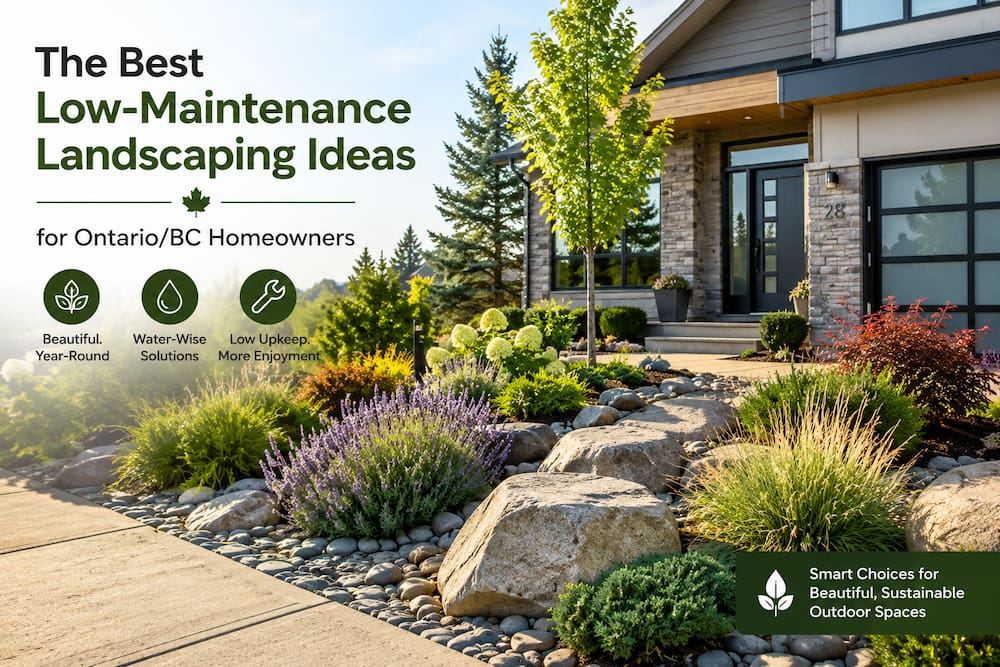
For many homeowners in Canada, the backyard is intended to be a sanctuary—a private retreat for mental decompression and physical relaxation. However, the reality of maintaining a pristine outdoor space often transforms this restorative environment into a source of significant physical strain and psychological stress. When the weekend is consumed by the repetitive, labor-intensive tasks of mowing, weeding, and pruning, the health benefits of nature are frequently offset by the toll of the work itself. Finding effective low-maintenance landscaping ideas for Ontario and BC homeowners is not merely a matter of aesthetics; it is a strategy for preserving both time and well-being.
As we observe shifting climate patterns across the country, the “one-size-fits-all” approach to gardening is becoming obsolete. From the humid, high-growth summers of Southern Ontario to the lush, moisture-heavy environments of the British Columbia coast, the requirements for a resilient and sustainable yard vary wildly by province. By integrating smarter plant choices, durable hardscaping, and advanced automation, homeowners can transition from constant labor to meaningful enjoyment.
In this guide, we will explore how to design landscapes that work with your local environment rather than against it, bridging the gap between professional-grade curb appeal and manageable daily upkeep.
The Psychological and Physical Toll of Traditional Yard Work
From a public health perspective, the “toil” of gardening is often underestimated. Traditional lawn maintenance involves repetitive motions, heavy lifting, and prolonged exposure to heat and UV radiation. For many, especially as they age, the ergonomic demands of operating a manual push mower or spending hours on their knees weeding can lead to musculoskeletal issues or heat exhaustion. The mental load of managing a “perfect” lawn—constantly battling weeds and irregular growth—can trigger a sense of unending domestic obligation.

Conversely, the concept of “soft fascination”—a term used in Attention Restoration Theory—suggests that viewing natural, low-intensity stimuli, such as a well-designed garden, can significantly reduce mental fatigue and lower cortisol levels. The goal of modern, low-maintenance landscaping is to maximize this restorative “soft fascination” while minimizing the “hard labor” that prevents it.
Regional Landscaping Strategies: Adapting to Ontario and British Columbia
To achieve a low-maintenance yard, one must first understand the specific ecological stressors of their region. A strategy that works in the dry heat of a prairie might fail in the temperate rainforest conditions of the West Coast.
Ontario: Managing Heat and Humidity
In Ontario, the primary challenge for homeowners is the aggressive growth spurt that occurs between June and August. The combination of high humidity and summer heat creates an environment where lawns and weeds grow at an accelerated rate, requiring frequent intervention. To combat this, focus on two main pillars: hardscaping and drought-tolerant native species.

- Hardscaping with Flagstone: One of the most effective ways to reduce maintenance is to simply reduce the amount of grass that requires mowing. Replacing peripheral lawn areas with local flagstone patios or walking paths creates a permanent, beautiful structure that requires zero weekly upkeep.
- Drought-Tolerant Native Perennials: Instead of high-maintenance annual flowers that require constant watering and deadheading, opt for native perennials. Species such as Black-eyed Susans (Rudbeckia hirta) and Coneflowers (Echinacea) are well-suited to the Ontario climate. These plants have evolved to thrive in local soil conditions and can withstand periods of summer heat with minimal supplemental irrigation.
British Columbia: Embracing the Lush Green
In British Columbia, particularly in coastal regions, the struggle is not a lack of water, but an abundance of it. The high moisture levels can lead to rapid moss accumulation and soil erosion, making traditional lawn care demanding and often unsightly.
- Rain Gardens and Water Management: Rather than fighting the rainfall, BC homeowners can use it to their advantage by installing rain gardens. By using rock swales and water-loving plants like Sedges (Carex), you can manage heavy runoff while creating a visually striking, naturalistic feature that requires very little intervention once established.
- Strategic Ground Covers: For steep slopes or areas prone to moss, replacing hard-to-mow grass with ground covers like creeping thyme or clover can be transformative. These plants create a dense mat that suppresses weeds and stabilizes the soil, all while requiring significantly less mowing than a standard turfgrass lawn.
The Rise of Automated Maintenance: Technology as a Wellness Tool
While native plants and smart design reduce the workload, the central element of most Canadian yards remains the lawn. For families and pet owners, a grass area is often a non-negotiable component of the landscape. The modern solution to this challenge is no longer “getting rid of the grass,” but rather automating the labor through smart home ecosystems.
Advanced robotic lawn mowers have evolved far beyond the basic models of the past. Current technology allows for a “set and forget” approach that maintains a pristine lawn without the physical or temporal cost of manual mowing. For complex landscapes, such as those found in established Ontario suburbs or tiered BC lots, certain technical specifications are crucial for success.
For instance, in neighborhoods with mature tree canopies—common in cities like Toronto, Ottawa, Vancouver, and Victoria—traditional mowers that rely solely on GPS or RTK signals may struggle with signal loss under thick foliage. Modern high-end systems now utilize 3D LiDAR and AI Vision to navigate these shaded environments with precision, ensuring they do not lose their way or damage delicate garden borders.
the topography of the West Coast often presents sloped or tiered yards. While traditional push mowers can be dangerous to use on inclines, advanced robotic models are increasingly capable of handling significant slopes (some reaching up to 45% or 24°). This allows homeowners to maintain greenery on embankments that would otherwise be high-risk areas for manual labor.
Integrating these technologies offers an additional eco-friendly benefit: daily micro-clipping. This practice acts as a natural mulch, returning essential nutrients to the soil and reducing the need for chemical fertilizers, which aligns with the growing movement toward organic and sustainable gardening in Canada.
Key Takeaways for a Low-Maintenance Sanctuary
| Strategy | Primary Benefit | Best For |
|---|---|---|
| Hardscaping (Flagstone) | Reduces total mowing area | Ontario / Suburban lots |
| Native Perennials | Low water/fertilizer needs | Drought-prone regions |
| Rain Gardens | Manages heavy runoff/moisture | BC Coastal regions |
| Robotic Automation | Eliminates repetitive physical labor | All Canadian homeowners |
Designing a yard that is both beautiful and sustainable requires a shift in mindset: from viewing the garden as a task to be completed, to viewing it as a system to be managed. By selecting plants that belong in your specific climate and leveraging technology to handle the most strenuous tasks, you can reclaim your weekends and ensure your outdoor space remains a true sanctuary for health and relaxation.
As spring approaches, homeowners are encouraged to review local municipal bylaws regarding water usage and native plant conservation to ensure their new landscaping plans are both compliant and eco-friendly.
What are your biggest challenges with yard maintenance in your province? Share your experiences and landscaping tips in the comments below.
Keep reading