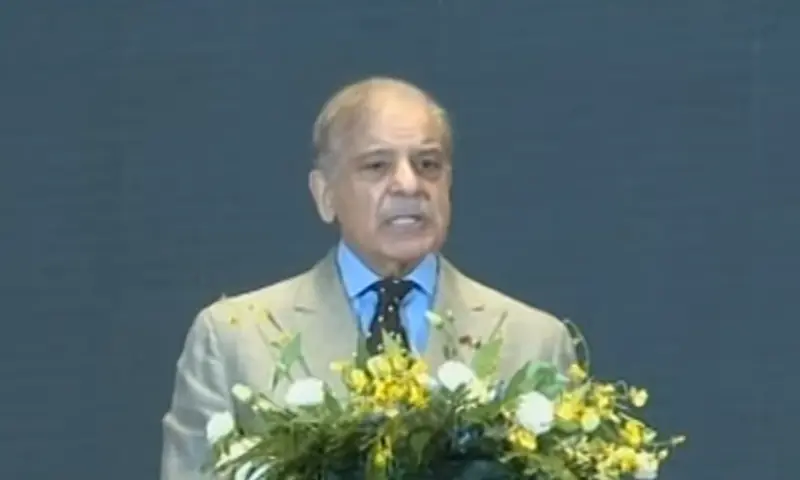
Prime Minister Shehbaz Sharif arrived in Beijing on Sunday, marking a pivotal phase in his four-day official visit to China. The visit, which began with engagements in Hangzhou on Saturday, is designed to bolster the long-standing strategic partnership between the two nations, with a heavy emphasis on the second phase of the China-Pakistan Economic Corridor (CPEC).
Upon his arrival in the Chinese capital, the Prime Minister was received by the Chinese Minister of Environment and Ecology, Huang Runqiu. According to a statement issued by the Prime Minister’s Office (PMO), the visit comes as both nations commemorate the 75th anniversary of their diplomatic relations. The agenda in Beijing includes high-level meetings with President Xi Jinping and Premier Li Qiang to discuss political, economic, and strategic cooperation, with a particular focus on trade, investment, industrial development, and agricultural modernization.
The Prime Minister’s trip follows a productive series of engagements in Hangzhou, where he chaired the opening ceremony of the third Pakistan-China Business-to-Business (B2B) Investment Conference. The conference served as a platform for strengthening economic ties, resulting in the signing of memoranda of understanding (MoUs) and agreements between Pakistani and Chinese enterprises valued at over $7 billion, according to the PMO. Among these, specific agreements worth $1.22 billion were finalized during the event to catalyze investment across multiple sectors.
Strategic Cooperation and Economic Priorities
During his address at the investment conference in Hangzhou, Prime Minister Shehbaz Sharif identified four core sectors essential for future cooperation: agriculture, information technology, special economic zones (SEZs), and the mining of minerals and gemstones. The Prime Minister emphasized that Pakistan, as an agrarian economy, is seeking to move beyond traditional trade models by fostering joint ventures that leverage China’s industrial expertise and technological advancements.
“We have signed MoUs worth billions of dollars, which now need to be converted into agreements,” the Prime Minister noted, highlighting that 30 percent of these initial MoUs had already been formalized. He expressed a target to increase agricultural trade with China by approximately $10 billion over the next five to seven years. He argued that by focusing on high-quality seeds, mechanized farming, and value-added exports, Pakistan could significantly enhance its economic output and provide extensive job opportunities for its rural population.
In addition to agriculture, the Prime Minister highlighted the potential of SEZs, specifically referencing a 6,000-acre project in Karachi. He pledged that the government would provide the necessary infrastructure to facilitate joint investments, promising a “red carpet treatment” for Chinese entrepreneurs. He also invited Chinese investors to explore partnerships in sectors where rising labor costs in China have necessitated industrial relocation, suggesting that joint ventures in textiles, leather, and other manufacturing areas could create a “win-win” situation for both nations.
Corporate Outreach and Technology Partnerships
The Prime Minister’s schedule included direct outreach to senior executives from leading Chinese corporations to discuss renewable energy, healthcare, and infrastructure. Meetings were held with representatives from Sheng Huo Neng Yuan Ke Ji Company, CATL, StarCharge, and the Xiuzheng Pharmaceutical Group. These discussions centered on the potential for establishing new manufacturing facilities and expanding existing operations within Pakistan.
A notable highlight of the visit was the Prime Minister’s tour of the Alibaba Group headquarters, where he was received by Executive Chairman Joe Tsai. During a televised ceremony, the two discussed five key areas for future collaboration: exports, artificial intelligence (AI), fintech, healthcare, and human capital development. The Prime Minister reaffirmed Pakistan’s commitment to leveraging Alibaba’s technological infrastructure to assist local small businesses and exporters in reaching a global market.
Political Alignment and CPEC 2.0
While the Prime Minister focused on economic and industrial cooperation, Deputy Prime Minister and Foreign Minister Ishaq Dar, accompanied by Planning Minister Ahsan Iqbal, led separate discussions in Beijing. They chaired the 2nd China-Pakistan Political Parties Forum and the 4th meeting of the CPEC Political Parties Joint Consultation Mechanism. These sessions were aimed at strengthening strategic mutual trust and advancing the framework of CPEC Phase-II.

According to Deputy Prime Minister Dar, the forum provided a platform for representatives from 12 Pakistani political parties to engage in dialogue with their Chinese counterparts. The discussions emphasized the necessity of political stability and shared commitment to the enduring friendship between the two countries. The Deputy Prime Minister and Minister Iqbal were received at the Beijing airport by Sun Haiyan, Vice Minister of the International Department of the CPC Central Committee.
Foreign Office Spokesperson Tahir Andrabi stated during a recent press briefing that the ongoing situation in the Middle East is also expected to be a subject of discussion during the Prime Minister’s meetings with the Chinese leadership. He noted that Pakistan and China maintain close coordination regarding regional peace efforts and follow a previously established five-point principle regarding the regional standoff.
Looking Ahead
The visit serves as a cornerstone for the 75th-anniversary celebrations of Pakistan-China diplomatic ties. As the delegation continues its high-level meetings in Beijing, the focus remains on transforming the signed MoUs into tangible industrial and economic outcomes. The government’s emphasis on attracting private sector expertise rather than traditional aid highlights a shift in policy aimed at fostering sustainable, long-term economic growth.
Further updates regarding the outcomes of the meetings with President Xi Jinping and Premier Li Qiang are expected to be released through official government channels as the visit concludes. We will continue to monitor these developments and provide verified reports as more information becomes available. We invite our readers to share their thoughts on the potential impact of these investments on Pakistan’s industrial sector in the comments section below.
Keep reading