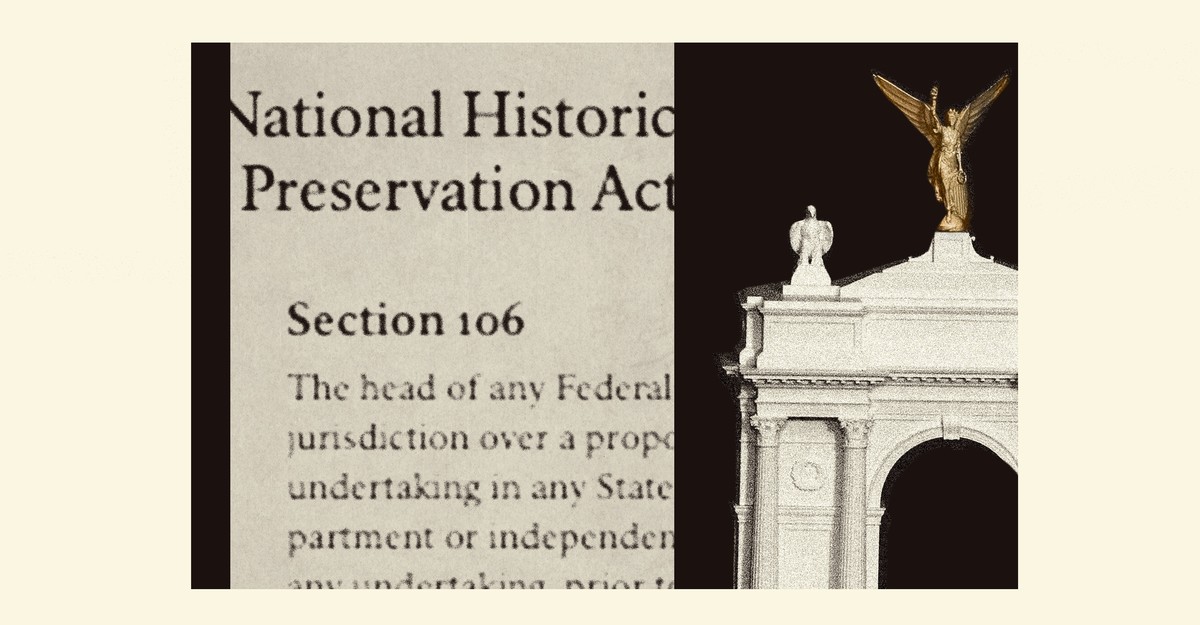
The Trump administration is attempting to accelerate the construction of the United States Triumphal Arch, a proposed 250-foot granite monument in Washington, D.C., by potentially altering federal historic preservation rules. According to internal documents and reports, the administration is seeking to bypass traditional procedural delays to complete the project before the end of Trump’s second term.
The project, estimated to cost $100 million, would place a massive structure with gilded winged statues at Memorial Circle on the western bank of the Potomac River. To achieve this, the administration is utilizing a combination of expedited reviews and proposed regulatory changes to Section 106 of the National Historic Preservation Act, which typically requires exhaustive consultation with historians, tribes, and the public before ground is broken.
The effort to build the United States Triumphal Arch has met significant resistance, including a lawsuit filed by preservationists and Vietnam War veterans. A recent poll indicated that approximately 52 percent of Americans oppose the project, with critics labeling the design a “monstrosity” and a “McMonument” due to its scale and cost.
Proposed Changes to Section 106 Preservation Rules
A July 17 email and draft amendments reveal that the Advisory Council on Historic Preservation (ACHP) is considering a vote to revise the rules governing Section 106 of the National Historic Preservation Act of 1966. If adopted, these changes would grant federal agencies broader discretion over preservation reviews and prioritize the mitigation of harm over the avoidance of harm to historic sites.

The draft Notice of Proposed Rulemaking describes the current interpretations of the law as creating “uncertainties, delays, and regulatory burdens.” Travis Voyles, the vice chair of the ACHP, instructed members in the acquired email to vote on the proposed rulemaking by July 24. Upon approval, the proposal would move to the Office of Management and Budget for further review.
Sara Bronin, a law professor at the George Washington University Law School and former chair of the ACHP, argues that these revisions would dramatically curtail public participation, weaken consultations with tribal nations, and narrow the types of historic properties eligible for protection. Bronin stated that if adopted, these regulations would likely be challenged in court and would probably not survive judicial scrutiny.
Bypassing Congressional Authorization and Height Limits
Under the Commemorative Works Act of 1986, new monuments in the civic core of Washington, D.C., generally require an act of Congress. However, the Department of the Interior (DOI) is proceeding without new congressional authorization, instead citing a 1925 plan for 166-foot-tall columns at Memorial Bridge that was never completed.
The administration has advanced the proposal through the Commission of Fine Arts, which gave final sign-off in May, and the NCPC. Both bodies are currently led by Trump appointees.
Impact on Arlington National Cemetery and Historic Vistas
To meet the administration’s deadline, the DOI has shared plans to have construction crews work 20 hours a day, year-round. This timeline is intended to ensure completion before the end of the president’s second term.

Controversies Over Public Comment and Consultation
The NPS has faced criticism for its handling of the Section 106 review process. The agency provided a 10-day window for the public to review a 277-page assessment of effects, a period Sara Bronin described as “exceedingly narrow” and “highly unusual.” While the NPS reopened the submission period until July 30, it previously claimed it had sufficient feedback after receiving over 100,000 public comments, which were analyzed using AI and found to be mostly in opposition.
Furthermore, six historic-preservation groups reported they were initially excluded from the consulting-party process. The National Trust for Historic Preservation characterized this as an “abuse of discretion” in a letter to the NPS. While invitations were eventually sent on July 10, only one consulting-party meeting has occurred to date.
Legal experts have also questioned the use of a “programmatic agreement” to handle adverse effects.
The National Capital Planning Commission is expected to cast a final vote on the project in September. This action will determine if the project moves toward immediate construction.
We invite readers to share their views on the balance between presidential legacies and historic preservation in the comments below.
Worth a look