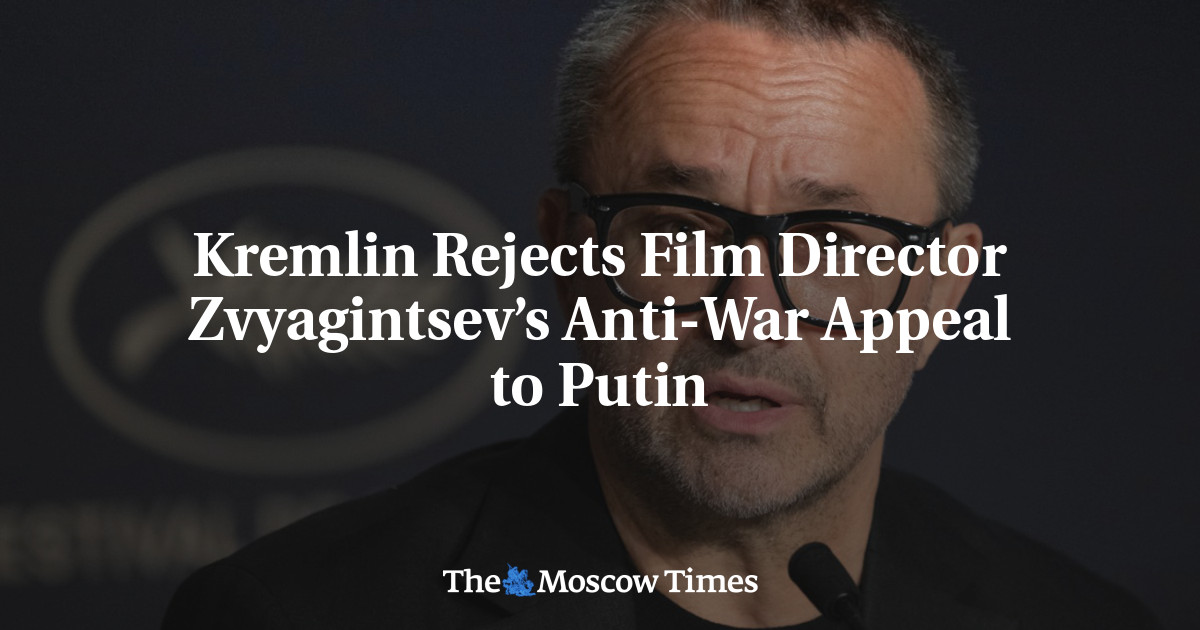
Moscow — In a sharp rebuke to one of Russia’s most prominent filmmakers, Kremlin spokesman Dmitry Peskov on Thursday dismissed an anti-war appeal from director Andrei Zvyagintsev as inappropriate, arguing that Zvyagintsev had not first condemned Ukrainian military operations in the Donbas region. The exchange underscores the Kremlin’s tightening control over public dissent amid Russia’s prolonged conflict in Ukraine, where even indirect criticism of the war effort now risks official backlash.
The latest confrontation comes as Zvyagintsev, whose films have earned international acclaim and domestic respect, has increasingly used his platform to question the human cost of the war. His latest statement—delivered in a rare public address—called for an end to hostilities and highlighted the suffering of civilians caught in the crossfire. While Zvyagintsev has long avoided overt political statements, his recent interventions have drawn scrutiny from authorities who view any deviation from state-backed narratives as a threat to national unity.
Peskov’s response, delivered during a routine press briefing, reflected the Kremlin’s evolving stance on dissent. “The director does not have the right to make anti-war statements,” Peskov stated, adding that such remarks were only permissible if accompanied by a condemnation of Ukrainian attacks in eastern Ukraine. The spokesman’s remarks suggest that Moscow now demands public figures align their critiques with the official narrative, even when discussing broader humanitarian concerns. This marks a significant escalation in the Kremlin’s efforts to police discourse, particularly among cultural figures who have historically enjoyed relative autonomy.
Who Is Andrei Zvyagintsev, and Why Does His Appeal Matter?
Andrei Zvyagintsev, 61, is a three-time recipient of the Palme d’Or at the Cannes Film Festival and a leading voice in contemporary Russian cinema. His films—such as Leviathan (2014) and The Return (2003)—often explore themes of moral ambiguity and societal decay, earning him both critical acclaim and occasional censure from Russian authorities. Unlike many of his peers, Zvyagintsev has avoided exile, remaining in Russia despite the country’s increasingly repressive climate. His decision to speak out publicly against the war represents a rare challenge to the Kremlin’s unified front on the conflict.
Zvyagintsev’s appeal is particularly notable because it arrives at a moment when Russian society is grappling with mounting economic strain, military setbacks, and a crackdown on independent journalism. While the Kremlin has long tolerated artistic dissent—as long as it did not directly threaten state interests—Zvyagintsev’s latest intervention tests the boundaries of acceptable criticism. His call for dialogue and de-escalation contrasts sharply with the official narrative, which frames the war as an existential struggle against “Nazism” and portrays any skepticism as treasonous.
Key Takeaway: Zvyagintsev’s appeal is not just a personal statement but a barometer for the broader climate of dissent in Russia. His ability to speak freely—without facing immediate repercussions—could set a precedent for other public figures, while his silence might embolden the Kremlin’s crackdown on free expression.
The Kremlin’s Double Standard: Criticism with Conditions
Peskov’s insistence that anti-war statements must include condemnations of Ukrainian actions in the Donbas reveals a strategic shift in how the Kremlin frames acceptable dissent. Historically, Russian authorities have allowed critics to voice concerns about corruption, inequality, or even the war’s economic toll—as long as those critiques did not undermine the broader justification for the conflict. However, the demand that opposition to the war itself must be paired with an endorsement of Russia’s military objectives in eastern Ukraine represents a new level of ideological policing.

This approach mirrors tactics used by authoritarian regimes worldwide, where dissent is permitted only within narrowly defined parameters. In Russia’s case, those parameters now appear to require public figures to adopt a “both sides” framing of the war—condemning Ukrainian actions while still supporting Russia’s presence in Donbas. For artists and intellectuals, this creates an impossible dilemma: either remain silent or risk being labeled as insufficiently patriotic.
Zvyagintsev’s refusal to meet this condition has already drawn attention from state media outlets, which have begun scrutinizing his past work for alleged “Western sympathies.” While there is no evidence he has ever openly supported Ukraine, the Kremlin’s move suggests that even neutral or humanitarian appeals for peace may now be treated as politically suspect.
What Happens Next? Zvyagintsev’s Legal and Professional Risks
As of now, there is no indication that Zvyagintsev faces immediate legal consequences for his remarks. However, the Kremlin’s history of targeting cultural figures—from the imprisonment of musician Pyotr Pavlensky to the exile of filmmaker Kirill Serebrennikov—serves as a warning. While Zvyagintsev’s international reputation may offer some protection, Russian authorities have increasingly used administrative charges, tax audits, and “extremism” designations to silence critics.
Legal experts suggest that Zvyagintsev could be vulnerable to accusations of “discrediting the Russian military” under Article 207.3 of the Russian Criminal Code, which carries penalties of up to three years in prison. Alternatively, authorities might pursue him under broader “foreign agent” laws, which have been expanded to include individuals who receive funding from abroad—even indirectly. Given Zvyagintsev’s global collaborations, this risk is not negligible.
Professionally, the fallout could be severe. State-funded film studios and cinemas—already under pressure to promote “patriotic” content—may distance themselves from his projects. International film festivals, which have increasingly faced pressure from Russian state media to boycott works critical of Moscow, could also reconsider invitations to his films. For a director whose career depends on both domestic and international recognition, these risks are substantial.
A Broader Pattern: The Shrinking Space for Dissent in Russia
Zvyagintsev’s case is part of a broader crackdown on free expression in Russia, where independent journalism, LGBTQ+ rights, and even academic freedom have all come under attack in recent years. The Kremlin’s response to his appeal aligns with a pattern of “managed dissent,” where criticism is tolerated only if it reinforces state narratives. This strategy has been particularly evident in the cultural sector, where artists who once enjoyed relative freedom are now expected to toe the line.
Recent examples include:
- The detention of anti-war Russian activist Roman Golikov by Finnish authorities, who rejected his asylum claim despite his donations to Alexei Navalny’s banned Anti-Corruption Foundation. Golikov’s case highlights the risks faced by Russians who publicly oppose the war, even from abroad (verified).
- The arrest of Russian disinformation operative Dmitry Novikov in Argentina, accused of leading a network linked to Russia’s Foreign Intelligence Service (SVR). His case underscores how the Kremlin deploys proxies to undermine foreign institutions, even as it tightens control at home (verified).
- The rare public appeals from Russian influencers like Viktoria Bonya, who directly challenged President Putin on economic and social issues. While her video drew millions of views, it also triggered speculation about foreign influence—a common tactic to discredit critics (verified).
These developments paint a picture of a society where the cost of dissent is rising, even for those who have long operated within the system. For Zvyagintsev, the question now is whether his international standing will shield him—or whether the Kremlin will find a way to silence him without triggering a broader backlash.
What to Watch: The Next Steps in Zvyagintsev’s Case
The immediate focus will be on whether Zvyagintsev faces any official repercussions in the coming weeks. Key developments to monitor include:
- State media coverage: Increased scrutiny of Zvyagintsev’s past work, collaborations, and public statements.
- Legal actions: Potential investigations under “discrediting the military” or “foreign agent” laws.
- Professional consequences: Withdrawals of state funding for his films or cancellations of international screenings.
- Public reactions: Statements from other Russian artists, who may either rally in support or distance themselves to avoid similar risks.
The next critical checkpoint will likely be the Kremlin’s annual United Russia party congress in September, where President Putin is expected to deliver a major address on the war’s progress. Any further restrictions on dissent—particularly in the cultural sector—could be announced during this event.
For now, Zvyagintsev’s appeal stands as a bold but precarious challenge to the Kremlin’s war narrative. Whether it emboldens others to speak out or serves as a cautionary tale remains to be seen.
This story is developing. What do you think? Should artists and public figures in Russia be allowed to criticize the war without facing legal consequences? Share your thoughts in the comments below.