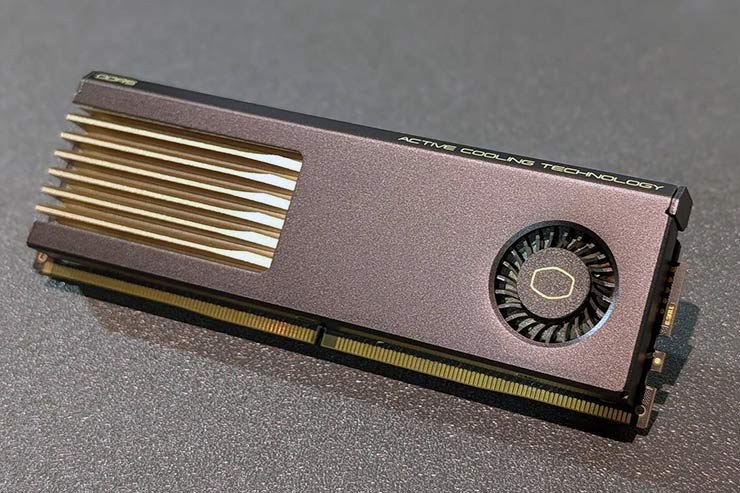
As the high-performance computing landscape shifts toward increasingly demanding workloads—ranging from professional-grade content creation to complex data simulations—the thermal management of high-capacity memory modules has become a critical bottleneck. While DDR5 technology offers significant bandwidth improvements over its predecessor, it also introduces higher power consumption, necessitating more robust cooling solutions to maintain system stability. Recent developments in active cooling for DDR5, spearheaded by industry leaders like Cooler Master, and G.SKILL, highlight a pivotal shift in how enthusiasts and professionals approach system architecture.
The move toward integrating active cooling—fans or specialized airflow solutions directly attached to DIMM modules—addresses a long-standing challenge in PC building: mitigating thermal throttling in dense memory configurations. When running kits such as 64GBx2 setups under intense, sustained workloads, heat dissipation becomes the primary factor in preventing system crashes and ensuring long-term hardware longevity. By managing these temperatures, users can maintain peak performance frequencies without risking the instability that often plagues high-density memory arrays.
The Evolution of Thermal Management in High-Density Memory
For years, passive heat spreaders were considered sufficient for most consumer applications. However, as DDR5 memory speeds climb past the 8000 MT/s threshold, the power management integrated circuit (PMIC) on each module generates significant heat. According to industry specifications, keeping these temperatures within an optimal operating range is essential for maintaining the integrity of data transfers during high-load tasks such as 4K video rendering or artificial intelligence model training, as noted in JEDEC solid-state technology standards.
G.SKILL has been at the forefront of this innovation, frequently demonstrating high-speed, high-capacity memory kits at major international technology showcases. Their approach often involves sophisticated heat sink designs paired with optional, purpose-built cooling fans designed to sit directly above the memory slots. This targeted airflow is particularly effective for users who occupy all four DIMM slots on a motherboard, a configuration that traditionally suffers from restricted airflow and heat accumulation.
Cooler Master, meanwhile, has focused on broader thermal ecosystem integration. By developing hardware that bridges the gap between case airflow and component-specific cooling, they allow builders to maintain stability in compact builds where traditional cooling might be obstructed. For those interested in the technical specifications of current-generation memory, the Intel resource guide on RAM selection provides a foundational look at why thermal headroom is vital for XMP and EXPO profile stability.
Why Active Cooling Matters for Professional Workstations
The demand for 128GB or higher memory capacities is no longer limited to server environments. Modern workstations, especially those utilized in professional creative suites or engineering software, rely on massive memory pools to keep applications responsive. When these systems are pushed to their limit, memory temperatures can spike rapidly. If the RAM exceeds its thermal threshold, the system may automatically down-clock the memory frequency, leading to perceptible performance degradation.
Active cooling solutions solve this by introducing a consistent stream of air that bypasses the “dead zones” often found between large CPU coolers and GPU backplates. What we have is especially relevant for professional users who cannot afford the downtime associated with system instability. By utilizing active cooling, these users can ensure that their hardware operates within the manufacturer’s recommended parameters, effectively extending the lifespan of the memory modules under heavy, 24/7-style duty cycles.
Technological Synergies: Integrating Cooling and Performance
The synergy between memory manufacturers and cooling solution providers is becoming increasingly apparent at industry events like CES. These collaborations often result in optimized kits that are “coolant-ready” or designed with airflow-optimized heat spreaders. This proves a transition from viewing RAM as a static component to treating it as a dynamic part of the system’s overall thermal architecture.

Beyond simple cooling, the integration of smart sensors into DDR5 modules allows for real-time temperature monitoring via software suites. This data-driven approach means that users can set custom fan curves, increasing airflow only when the memory reaches specific thermal targets. This level of granular control, supported by modern motherboard BIOS interfaces, represents the current gold standard in performance computing.
Key Considerations for System Builders
- Compatibility: Always verify that active cooling solutions do not interfere with your CPU air cooler’s clearance.
- Airflow Paths: Ensure your case has adequate intake and exhaust to prevent the active cooling fan from simply recirculating hot air.
- Monitoring: Utilize motherboard software to track DIMM temperatures under load to determine if active cooling is necessary for your specific workload.
- Capacity vs. Speed: Higher capacity kits (like 64GBx2) generally generate more heat; prioritize cooling if you are running these at high XMP/EXPO profiles.
As we look toward the future of computing, the necessity for active cooling in high-end systems will likely grow. With the continued refinement of DDR5 and the anticipation of future memory standards, the focus on thermal management is no longer an optional luxury for the enthusiast—it is a functional requirement for any serious workstation.
The industry continues to evolve, with new product announcements and thermal testing benchmarks expected throughout the coming fiscal quarters. For those looking to optimize their current builds, keeping an eye on official manufacturer forums and technical documentation remains the best way to stay informed. Have you integrated active cooling into your workstation, or are you considering a high-capacity memory upgrade? Share your experiences and system configurations in the comments below.
Keep reading