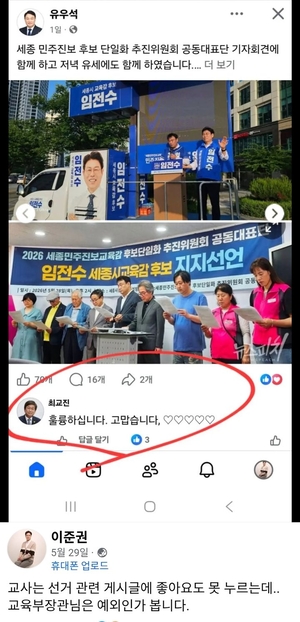
In the highly regulated landscape of South Korean public service, the line between personal expression and political bias is often razor-thin. This tension has reached a boiling point in Sejong City, where a recent controversy involving social media activity has ignited a fierce debate over the perceived double standards applied to educators versus high-ranking education officials.
At the heart of the dispute is a fundamental question of governance: how can a system maintain institutional trust when the rules governing the political neutrality of teachers appear significantly more stringent than those applied to the officials who oversee them? The controversy, centered on the selection and social media conduct surrounding a candidate identified as Im in Sejong, has become a lightning rod for critics of the current educational regulatory framework.
The outcry follows reports of “heart” emojis and “likes” on social media platforms by individuals in influential educational positions, signaling support for specific political directions or candidates. This behavior has been met with intense scrutiny, particularly because South Korean teachers are subject to some of the world’s strictest prohibitions against any form of political expression, even the most minor digital interactions.
The Sejong Controversy: Social Media and the Neutrality Mandate
The current friction in Sejong stems from the selection process of a candidate, referred to in local reports as Im, for a key role within the regional education hierarchy. Supporters of the selection have characterized the appointment as a “collective choice” by citizens seeking “new changes” and “better education” for the Sejong region. This defense, however, has done little to quell the criticism regarding the conduct of the officials involved.
The core of the grievance lies in the use of social media—specifically the act of “liking” posts or using emotive emojis—to signal political alignment. In a political culture where the “duty of neutrality” is a cornerstone of public administration, these digital footprints are viewed by many as more than mere social interactions; they are seen as implicit endorsements that can compromise the perceived impartiality of the education system.
Critics argue that when high-ranking education officials engage in such behavior, it undermines the very mandate of neutrality they are tasked with enforcing. This perceived inconsistency has led to accusations that the regulatory environment is being applied unevenly, creating a hierarchy of political freedom that favors administrators over the teaching staff they supervise.
A Regulatory Divide: Teachers vs. Education Officials
To understand why this controversy has resonated so deeply, one must examine the stark disparity in how political expression is policed within the South Korean educational sector. For teachers, the restrictions are comprehensive and often draconian. Under current interpretations of public service laws, a teacher who “likes” a politically charged post on social media can face disciplinary action, ranging from formal warnings to more severe administrative penalties.
This “zero-tolerance” approach is intended to protect the classroom from political indoctrination and to ensure that the school remains a sanctuary of objective learning. However, the Sejong incident has highlighted what many educators describe as a “regulatory paradox.” While teachers are held to a standard of near-total political silence, officials involved in the management and selection of educational leadership are perceived to navigate a much more permissive landscape.
This divide has significant implications for labor relations within the education sector. Teacher unions and professional associations have frequently pointed to this discrepancy as a source of profound frustration. The sentiment is that the “duty of neutrality” is being weaponized as a tool of discipline for subordinates, while being treated as a flexible guideline for superiors.
The Legal Framework of Educational Neutrality
The legal basis for these restrictions is rooted in several key pillars of South Korean law, designed to insulate the educational process from the volatility of partisan politics. The primary mechanisms include:
- The Public Official Election Act: Which prohibits certain classes of public employees from engaging in activities that could influence the outcome of an election.
- The State Public Officials Act: Which mandates that public servants maintain political neutrality in the performance of their duties.
- Specific Educational Mandates: Which provide additional layers of protection for the autonomy of the classroom and the impartiality of the instructor.
While these laws are designed to safeguard the integrity of the state, their application in the digital age has proven challenging. The definition of “political activity” has expanded to include passive actions such as “liking” a post or sharing an article. As social media becomes an inextricable part of professional and personal life, the legal system is struggling to distinguish between a private citizen’s digital engagement and a public official’s political endorsement.
Legal experts note that the ambiguity in how these laws are applied to digital interactions creates a climate of uncertainty. For educators, this uncertainty often leads to self-censorship, not only of political views but of broader social discourse, out of fear that a single digital misstep could jeopardize their career.
Implications for Governance and Institutional Trust
From a governance perspective, the Sejong controversy is a warning sign regarding the erosion of institutional trust. For an educational system to function effectively, both the public and the educators within the system must believe that its leadership is impartial. When the leadership is perceived to be playing by a different set of rules, the moral authority required to enforce discipline among teachers is significantly diminished.
This issue extends beyond the classroom and into the realm of regional policy. The Sejong City Office of Education, and by extension the broader educational administration in South Korea, faces the challenge of modernizing its code of conduct. There is a growing call for clearer, more consistent guidelines that account for the realities of social media use while maintaining the essential principle of political neutrality.
the economic and social costs of this instability should not be overlooked. A teaching force that feels unfairly targeted by regulatory inconsistencies is a workforce that may experience lower morale and increased turnover, potentially impacting the quality of education provided to students. In a competitive global economy, the stability and perceived integrity of a nation’s educational leadership are critical assets.
As the debate continues, the focus will likely shift toward whether legislative or administrative reforms can bridge the gap between the strictures placed on teachers and the conduct expected of the officials who lead them. The resolution of this controversy will serve as a litmus test for the future of political neutrality in the digital era of South Korean public service.
Next Steps: Observers are looking toward upcoming administrative reviews within the regional education boards to see if any formal investigations into social media conduct are initiated. Further updates on the Sejong selection process and any subsequent policy adjustments will be monitored closely.
We invite our readers to share their perspectives on the balance between political neutrality and digital expression in public service. Please leave your comments below and share this analysis with your network.
Related reading