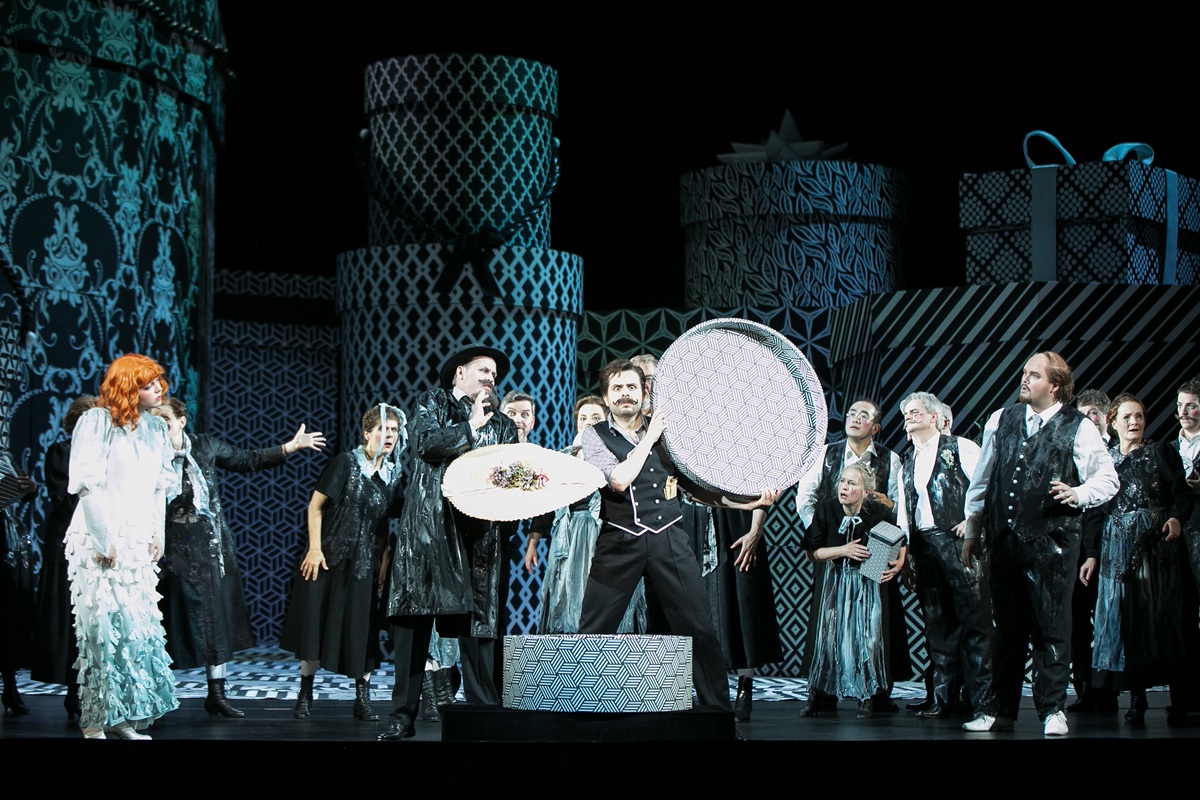
In the grand, storied history of the Semperoper Dresden, few works capture the frantic, lighthearted spirit of farce quite like Nino Rota’s Il cappello di paglia di Firenze, known in German as Der Florentiner Hut. While Rota is perhaps globally immortalized for his haunting, cinematic scores for Federico Fellini and Francis Ford Coppola, his operatic output reveals a composer of immense wit and structural precision. The Dresden production, directed by Bernd Mottl, has become a benchmark for how to balance the intricate demands of Italian comic opera with the sleek, modern sensibilities of a contemporary European stage.
For those unacquainted with the work, Der Florentiner Hut is based on the 1851 French vaudeville comedy by Eugène Labiche and Marc-Michel. The plot is a masterclass in escalating chaos: a horse eats a lady’s straw hat, and the protagonist, Fadinard, must find an identical replacement before his wedding day to avoid a social scandal. It is a premise that thrives on the “clockwork” nature of comedic timing, a rhythm that Nino Rota mastered with an almost mathematical grace. The Semperoper Dresden, renowned for its architectural beauty and acoustic excellence, provides an ideal setting for this operatic firework display.
A Master of Melodic Wit: Nino Rota’s Operatic Legacy
Nino Rota (1911–1979) was far more than a film composer, though his work on The Godfather and La Strada often overshadows his contributions to the world of opera and concert music. Born in Milan, Rota maintained a deep connection to the Italian musical tradition, yet he possessed a unique harmonic language that felt distinctly his own—playful, slightly melancholic, and deeply rooted in the traditions of the commedia dell’arte. Der Florentiner Hut, premiered in 1955 at the Teatro Massimo in Palermo, remains his most frequently performed opera, a testament to its enduring appeal.
The score is a brilliant pastiche that pays homage to Rossini and Donizetti, yet it is infused with the crisp, mid-century modernism that defined Rota’s compositional style. In the Dresden production, the orchestra navigates these shifts in tone with remarkable agility. The music does not merely accompany the action; it drives the farce forward, punctuating every misunderstanding and narrow escape with a sharp orchestral sting or a sweeping, lyrical melody. For the audience, the experience is akin to watching a high-speed chase choreographed to a symphony.
Bernd Mottl’s Vision for the Semperoper
Director Bernd Mottl is no stranger to the demands of musical comedy. His approach to Der Florentiner Hut in Dresden avoids the trap of excessive slapstick, opting instead for a staging that highlights the absurdity of the bourgeois social conventions the characters are so desperate to uphold. By centering the production on the relentless pressure of time—represented by the impending wedding—Mottl creates a visual landscape that feels both frantic and meticulously ordered.
The set design and costuming choices in this production reflect a keen understanding of the period’s aesthetics, bridging the gap between the 19th-century source material and the mid-20th-century composition. The interplay between the singers—who must act with the precision of silent film stars—and the orchestra creates a cohesive theatrical experience. It is this synergy that has garnered critical praise, positioning the Dresden performance as a definitive interpretation of Rota’s operatic masterpiece.
Why The Florentiner Hut Matters Today
In an era where opera houses are often tasked with balancing the heavy weight of the canon with the need to attract new audiences, Der Florentiner Hut serves as a perfect bridge. It possesses the sophistication required for opera veterans while remaining accessible and genuinely funny for newcomers. Rota’s ability to weave complex vocal lines into a lighthearted narrative ensures that the music remains challenging for the performers, even as it appears effortless to the listener.
the production highlights the importance of the Semperoper in preserving works that sit outside the standard “large five” of the operatic repertoire. By investing in the staging of Rota’s work, the institution demonstrates a commitment to variety and the celebration of 20th-century Italian composition. It serves as a reminder that opera can be, and often should be, a source of pure, unadulterated joy.
Key Takeaways: Understanding the Production
- Compositional Style: Nino Rota’s Der Florentiner Hut blends 19th-century French farce structures with his signature 20th-century melodic charm.
- The Plot: A classic comedy of errors centered on a missing hat, a frantic bridegroom, and the rigid social hierarchies of the 19th century.
- Dresden’s Role: The Semperoper’s commitment to this specific work highlights the house’s dedication to maintaining a diverse repertoire that includes mid-century comic masterpieces.
- Direction: Bernd Mottl’s production emphasizes the “clockwork” nature of the farce, ensuring that the comedic timing is as sharp as the orchestral performance.
Reflecting on the Dresden Experience
The success of this production speaks to the enduring nature of Rota’s vision. As an editor who has covered countless performances, I find that the most memorable nights in the theater are those where the audience leaves with a sense of genuine levity. The Semperoper Dresden has managed to capture that elusive spirit. Whether you are a devotee of Rota’s film scores or a newcomer to the opera, the frantic energy of Der Florentiner Hut is an experience worth seeking out.

For those planning to visit the Semperoper, it is essential to check the official performance calendar, as scheduling for specific productions changes seasonally. The visitor service portal provides the most accurate information regarding upcoming dates and ticket availability. As the cultural landscape of Dresden continues to evolve, the Semperoper remains a cornerstone of European musical life, constantly reminding us that the marriage of music and theater is, at its best, a transformative and joyful endeavor.
What are your thoughts on Nino Rota’s operatic contributions? Have you had the pleasure of attending a performance at the Semperoper? Share your experiences in the comments below, and join our global community of readers in celebrating the arts.
Related reading