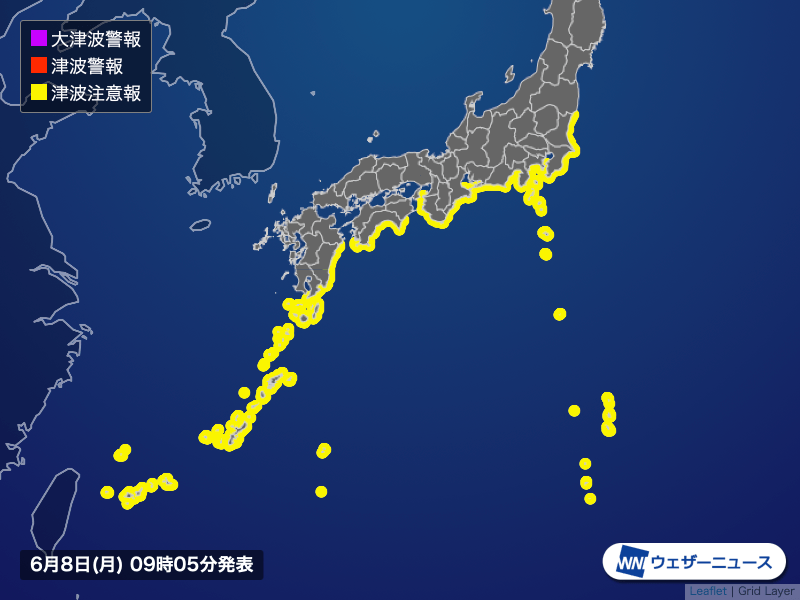
A powerful earthquake measuring magnitude 8.2 near the Philippines has prompted Japan’s meteorological authorities to issue tsunami advisories for its Pacific coastline. Residents in affected regions are being urged to evacuate immediately to higher ground as waves of up to 1 meter are possible, according to Japan’s Meteorological Agency (JMA) and confirmed by multiple official sources.
The quake struck at approximately 08:30 JST (Monday, June 8, 2026), with its epicenter located about 500 kilometers southeast of Manila. While the Philippines has not yet reported significant damage, Japan’s Pacific coast—including regions from Ibaraki Prefecture to Hokkaido—faces potential tsunami risks. Authorities have activated emergency response protocols, including evacuation orders for low-lying coastal areas.
This is the second major seismic event in the region this year, following a M6.9 quake off Aomori Prefecture in December 2025, which also triggered tsunami warnings that were later lifted. The current situation remains fluid, with ongoing assessments of wave heights and potential impacts.
Which Areas Are Under Tsunami Advisory?
The JMA has issued tsunami advisories for the following coastal regions in Japan:
- Ibaraki Prefecture (including Hitachi and Kitaibaraki)
- Chiba Prefecture (including Choshi and Kujukuri)
- Iwate Prefecture (including Miyako and Kamaishi)
- Miyagi Prefecture (including Sendai and Ishinomaki)
- Fukushima Prefecture (including Soma and Namie)
- Hokkaido’s Pacific Coast (including Hakodate and Muroran)
Residents in these areas are advised to move to designated evacuation zones at least 10 meters above sea level, according to local disaster management offices. The JMA has also warned that tsunami waves may arrive within 30 minutes to 3 hours after the earthquake, depending on the location.
Why Is This Earthquake Triggering Tsunami Risks in Japan?
The earthquake’s magnitude and shallow depth (approximately 20 kilometers) increase the likelihood of tsunami generation. While the epicenter is near the Philippines, the Pacific Plate’s tectonic activity in the region can send seismic waves across the ocean, affecting distant coastlines. Japan’s Pacific coast is particularly vulnerable due to its proximity to subduction zones.
Historical precedent includes the 2011 Tōhoku earthquake and tsunami, which measured M9.1 and caused catastrophic damage along Japan’s northeast coast. While today’s event is significantly smaller, authorities are taking precautions given the region’s seismic history.
What Should Residents Do Now?
Japan’s National Police Agency (NPA) and local governments are coordinating evacuation efforts. Key actions include:
- Evacuate immediately if you are in a coastal area under advisory.
- Follow official alerts via JMA’s official website or local emergency broadcasts.
- Avoid returning to evacuated areas until authorities confirm it is safe.
- Prepare for possible power outages and have emergency supplies ready.
The JMA will provide real-time updates on wave heights and advisories. Residents are advised to monitor NHK World or local disaster prevention websites for the latest information.
How Are Authorities Responding?
Japan’s disaster response agencies are on high alert:
- The Japan Coast Guard has deployed vessels to monitor tsunami activity.
- Local fire departments are conducting evacuation drills in high-risk zones.
- The Ministry of Land, Infrastructure, Transport and Tourism (MLIT) has issued travel advisories for coastal roads and railways.
Meanwhile, the Philippines’ Philippine Institute of Volcanology and Seismology (PHIVOLCS) has not yet reported significant damage, but authorities are assessing potential impacts on coastal communities.
What Happens Next?
The situation remains under close watch. Key developments to monitor include:
- Wave height updates from JMA’s tsunami monitoring stations.
- Potential advisory extensions if new seismic activity is detected.
- Evacuation center status for affected residents.
The next official update from the JMA is expected by 11:00 JST. Residents should remain vigilant and prepared for further instructions.
Frequently Asked Questions
Q: Is this tsunami expected to be as severe as the 2011 Tōhoku tsunami?
A: No. The 2011 event was a M9.1 quake with waves exceeding 10 meters in some areas. Today’s M8.2 quake is smaller, but authorities are taking precautions due to Japan’s high tsunami risk.
Q: Should I evacuate if I’m inland?
A: Only if you are in a designated evacuation zone. Inland areas are generally safer, but follow local advisories.
Q: How long will the tsunami advisory last?
A: Advisories typically remain in effect until wave heights stabilize. The JMA will provide updates every 30–60 minutes.
For real-time information, visit the Japan Meteorological Agency or your local disaster management office.
Stay safe. Share this information with others in affected areas.