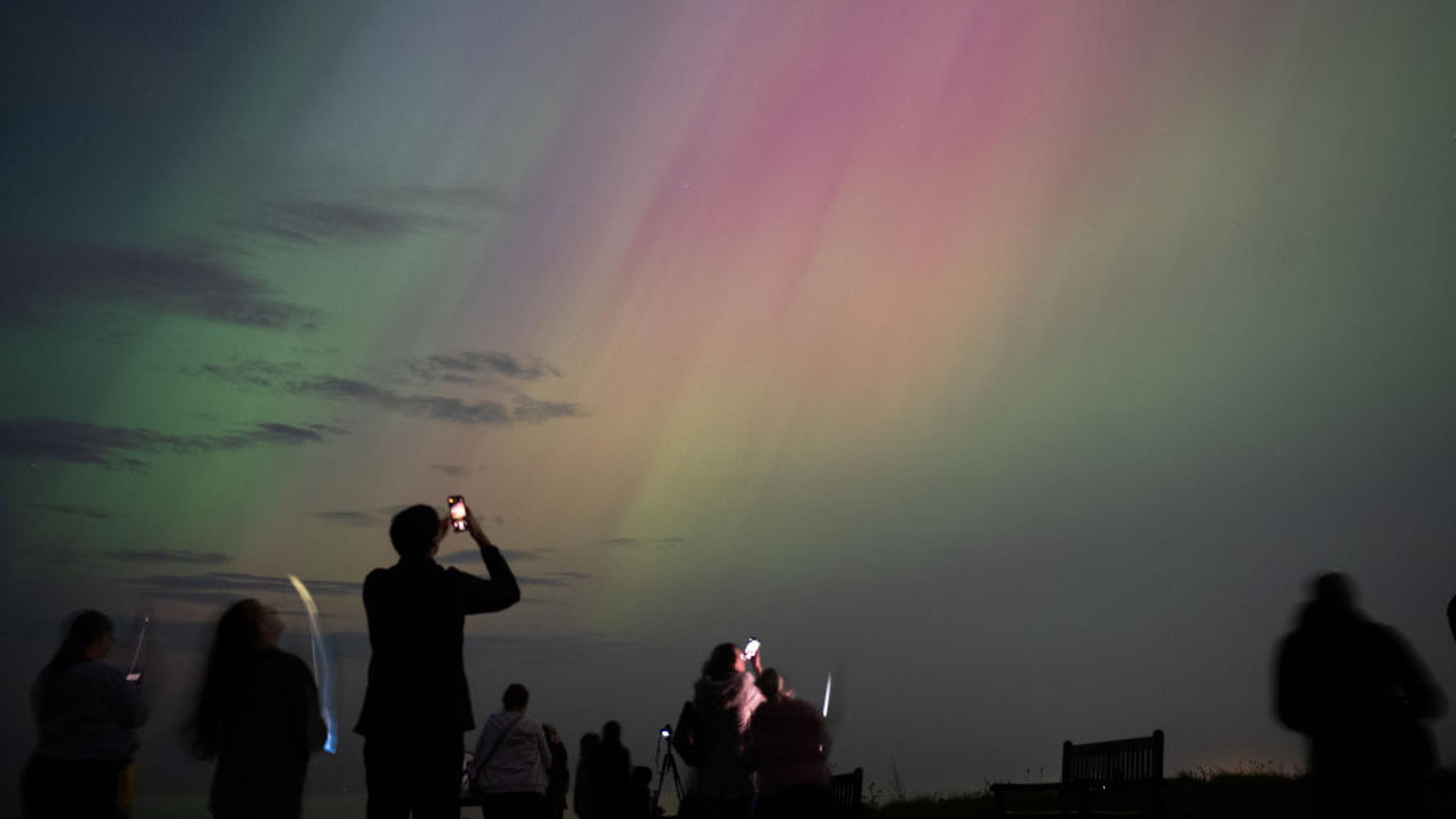
Skywatchers across large swaths of the United States may have a rare opportunity to view the aurora borealis, also known as the Northern Lights, on Monday night. The National Oceanic and Atmospheric Administration (NOAA) Space Weather Prediction Center has issued geomagnetic storm watches following a significant coronal mass ejection (CME) observed over the weekend, which sent a burst of plasma and magnetic fields into space toward Earth.
According to the NOAA Space Weather Prediction Center, geomagnetic storms are rated on a five-point scale, with G1 being “minor” and G5 classified as “extreme.” The agency has forecast a strong G3-level storm for Monday, with the potential for a moderate G2-level storm continuing into Tuesday. These atmospheric conditions significantly increase the likelihood that colorful auroras will be visible at lower latitudes than usual.
Understanding the Mechanics of the Aurora Borealis
The Northern Lights are a natural phenomenon occurring when charged particles from the sun collide with the Earth’s magnetosphere. This interaction, triggered by solar events like coronal mass ejections, excites gas molecules in our atmosphere, resulting in vibrant, shifting displays of light. The specific colors observed depend largely on the type of gas atoms involved and the altitude at which the collisions occur, according to NOAA’s educational resources on space weather.

While the storm was predicted to reach its peak intensity during daylight hours on Monday, NOAA analysts indicate that geomagnetic activity is expected to persist into the evening. Because the arrival of solar material can fluctuate by several hours, observers are encouraged to monitor real-time updates as nightfall approaches in their specific geographic region.
Viewing Potential and Geographic Reach
The intensity of the display is the primary factor determining how far south the lights may appear. Under a G2-level storm, the aurora may be visible as far south as New York and Idaho, according to the NOAA geomagnetic storm scale. If the intensity reaches the predicted G3-level, the visibility range could extend even further, potentially reaching latitudes consistent with Illinois and Oregon.
For those hoping to catch a glimpse, experts emphasize that location and environment are critical. The best viewing experiences occur in areas with minimal light pollution, away from the glow of city centers. Observers should also seek out locations with clear, unobstructed views of the northern horizon, as cloud cover can easily obscure the phenomenon.
Tips for Optimal Viewing and Photography
While the aurora may be visible to the naked eye, the human eye often struggles to perceive the full spectrum of colors during moderate storms. Cameras are generally more sensitive to the light emitted by auroras than human vision. To capture the best images, photographers are advised to use a long exposure setting, which allows the camera sensor to collect more light over time and reveal colors that might otherwise appear faint or gray to the observer.

For the most accurate and up-to-date guidance, the public is encouraged to consult the NOAA Space Weather Prediction Center dashboard, which provides real-time data on geomagnetic activity and updated forecasts as solar particles interact with Earth’s magnetic field. As the situation remains dynamic, keeping track of local weather reports for cloud cover remains an essential step for any planned viewing session.
We invite our readers to share their experiences or questions regarding this solar event in the comments section below. Stay tuned to World Today Journal for further updates on space weather developments as they occur.