
Researchers have identified that the distinctive vein architecture in the leaves of Pilea peperomioides, commonly known as the Chinese money plant, follows a mathematical Voronoi diagram pattern dictated by the distribution of water-secreting pores called hydathodes. These microscopic pores act as biological “seeds,” organizing the plant’s vascular network into a precise geometric tessellation that optimizes fluid transport across the leaf surface.
The discovery highlights a complex intersection between botanical morphogenesis and computational geometry. By observing the arrangement of major veins, scientists found that the leaf’s structural layout is not random but is instead a direct consequence of where hydathodes are positioned during the plant’s development. This spatial organization ensures that every area of the leaf remains within a specific distance of a vascular channel, facilitating efficient nutrient and water distribution.
The study of these patterns provides new insights into how plants solve complex engineering problems through biological growth. The Voronoi arrangement allows the plant to maximize surface area coverage while minimizing the metabolic cost of building an extensive vascular system. This geometric efficiency is a key component of how Pilea peperomioides maintains its characteristic circular leaf shape and structural integrity.
How hydathodes dictate leaf geometry
Hydathodes are specialized pores located primarily along the margins or specific points on plant leaves. Their primary biological function is guttation, the process by which plants excrete excess water through these pores. In the case of the Chinese money plant, these pores do more than manage water pressure; they serve as the primary architectural blueprints for the leaf’s internal plumbing.
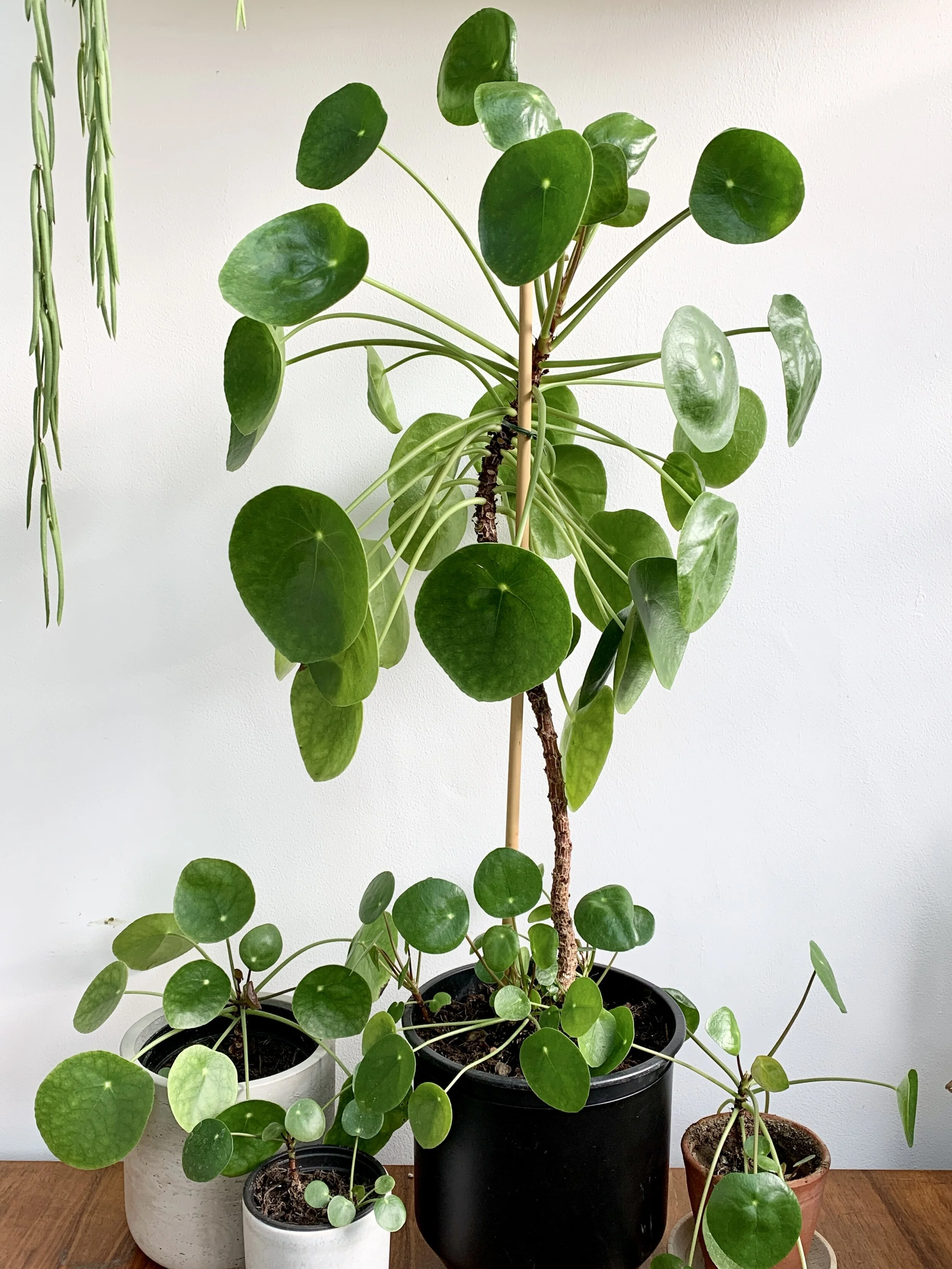
In biological terms, the placement of a hydathode serves as a focal point for the surrounding tissue. As the leaf grows, the vascular tissue—the veins—develops in response to the spatial constraints established by these pores. This process creates a Voronoi tessellation, a mathematical method of dividing space into regions based on the distance to a specific set of points. In this biological model, each hydathode acts as a point, and the veins form the boundaries of the cells created by those points.
This relationship suggests that the plant’s hydraulic system is “programmed” by the initial placement of these pores. By establishing a set of hydathodes at regular or mathematically optimized intervals, the plant ensures that the resulting vein network is both robust and evenly distributed. This prevents “dead zones” where nutrients might fail to reach the leaf edge, which is critical for a plant with large, flat leaves like the Pilea.
The mathematics of Voronoi diagrams in botany
A Voronoi diagram is a fundamental concept in computational geometry. It partitions a plane into several regions, known as Voronoi cells, such that any point within a given cell is closer to its corresponding “seed” than to any other seed in the set. While this concept is frequently used in computer science for pathfinding algorithms and in urban planning for service area mapping, its presence in Pilea peperomioides demonstrates a natural application of the same logic.

When applied to the Chinese money plant, the “seeds” are the hydathodes. The mathematical precision of the resulting veins allows the plant to achieve several biological objectives simultaneously:
- Uniformity: The Voronoi pattern ensures that no part of the leaf tissue is too far from a vein, maintaining consistent hydration.
- Structural Support: The network of veins acts as a skeletal framework, providing the necessary tension to keep the leaf flat and expanded for photosynthesis.
- Resource Efficiency: The pattern minimizes the total length of vein required to cover the leaf surface, reducing the energy the plant must expend on vascular development.
This mathematical regularity is not merely an aesthetic coincidence. It represents an evolutionary optimization. Plants that can more efficiently manage their hydraulic pressure and nutrient delivery through geometric precision have a selective advantage in diverse environmental conditions.
Why plant vein patterns matter for survival
The ability to organize vascular tissue into a Voronoi pattern is highly significant for plant survival, particularly regarding hydraulic conductivity and mechanical resilience. In many plant species, the failure of the vascular system can lead to localized tissue death or an inability to regulate transpiration, which is the process of water movement through a plant and its evaporation from leaves.

The Voronoi-style arrangement in Pilea peperomioides provides a safeguard against hydraulic failure. If one section of the leaf experiences damage, the highly organized and interconnected nature of the Voronoi cells allows the plant to reroute water and nutrients through adjacent vascular pathways. This redundancy is a hallmark of efficient biological design.
Furthermore, the geometric structure contributes to the plant’s ability to withstand environmental stressors. The vein pattern helps distribute mechanical stress caused by wind or gravity. By creating a predictable and mathematically sound lattice, the plant can maintain its shape without requiring the heavy, dense tissue that a less organized structure might necessitate.
Understanding these patterns is also aiding researchers in the field of biomimicry. Engineers and architects are increasingly looking to botanical structures to design more efficient irrigation systems, more resilient building materials, and optimized heat exchange networks. The way the Chinese money plant manages its internal fluids through geometric precision offers a scalable model for human-engineered systems.
Ongoing research into plant morphogenesis continues to investigate how other species utilize similar mathematical principles. Botanists are currently working to determine if this Voronoi organization is a common trait among various families of flowering plants or a specialized adaptation unique to specific leaf architectures. Future studies are expected to focus on the genetic signaling that triggers the initial placement of hydathodes, which effectively “sets the stage” for the mathematical growth that follows.
For more updates on botanical research and the intersection of mathematics and biology, please follow our science and health reporting sections. We encourage readers to share this discovery with fellow plant enthusiasts and science communicators.