
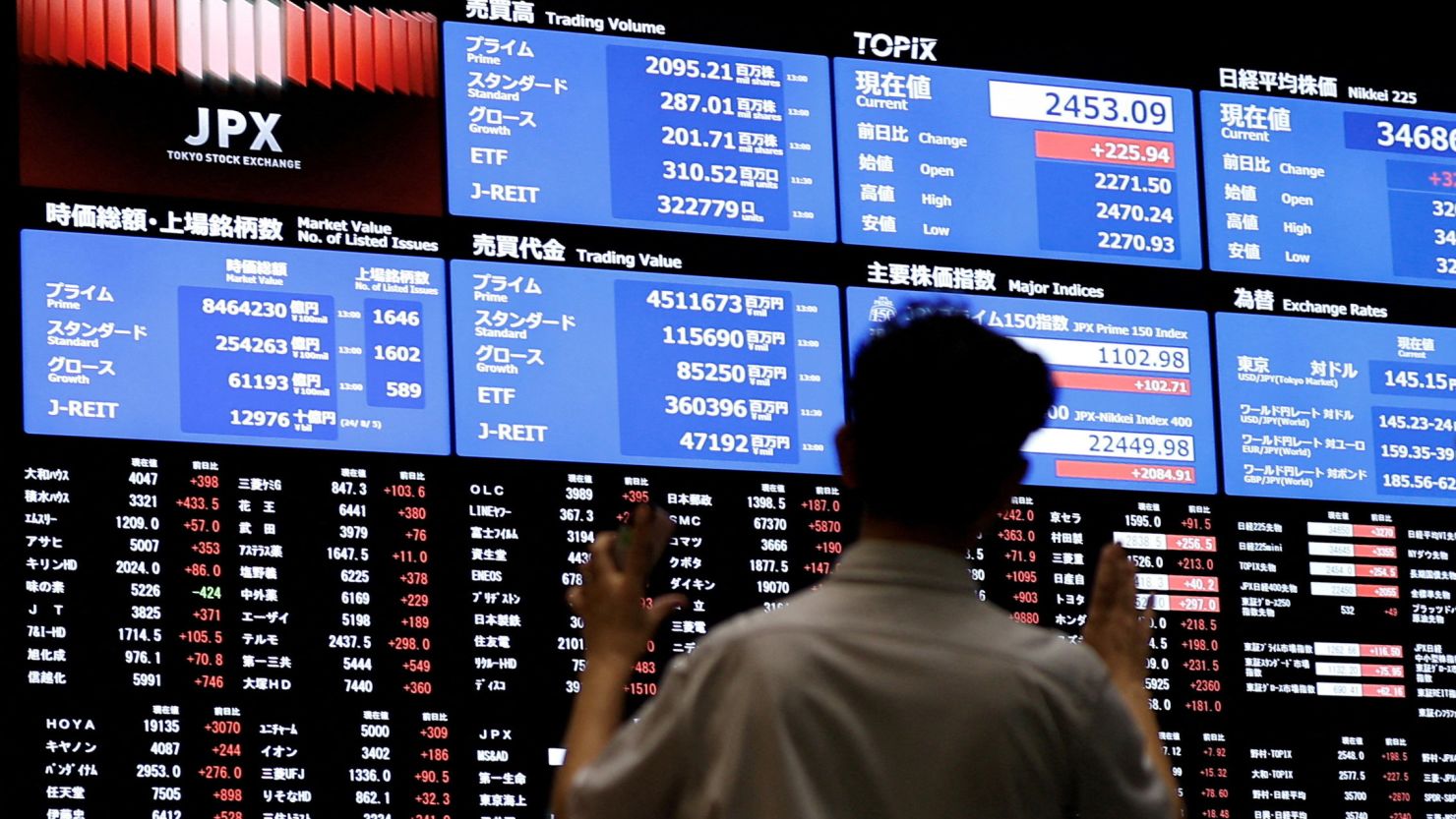
Asia’s stock markets rallied Monday on dual catalysts: a surge in artificial intelligence-driven technology valuations and signs of progress in indirect Iran-U.S. nuclear negotiations, according to regional exchanges and financial analysts. The combined effect sent major indices to their highest levels since mid-July, with tech shares leading gains across Tokyo, Seoul, and Shanghai. Investors cited both corporate earnings reports and diplomatic signals from Vienna as key drivers, though analysts warned the momentum could face volatility if talks stall or AI sector valuations correct.
The technology sector’s performance stood out sharply, with semiconductor and AI-related stocks outperforming broader market indices by nearly 12% in Tokyo and 15% in Seoul on Monday. “We’re seeing a classic tech-led rally where AI is the growth story of the decade,” said Eunice Yoon, head of Asian equities at Goldman Sachs Asset Management, noting that earnings from Nvidia and other AI hardware firms had exceeded expectations. Meanwhile, diplomatic developments from Vienna—where indirect talks between Iran and the U.S. resumed last week—added a geopolitical tailwind, with oil prices stabilizing and regional risk premiums easing.
Yet the rally isn’t without cautionary notes. While the Iran-U.S. discussions remain in their early stages, with no direct negotiations confirmed, the mere signal of progress has triggered a 5% drop in regional volatility indices since Friday. “Markets are pricing in optimism, but the devil is in the detail,” warned Ali Ansari, professor of Iranian history at St. Andrews University. “We haven’t seen concrete steps yet—just the resumption of channels.”
Why AI Is the Engine Behind Asia’s Market Surge
Artificial intelligence stocks have become the linchpin of Asia’s financial recovery, with tech sector valuations now accounting for over 30% of regional market capitalization, up from 22% at the start of the year. The surge follows a string of blockbuster earnings reports from companies like South Korea’s SK Hynix and Taiwan’s TSMC, both of which reported record profits tied to AI chip demand. “This isn’t just a sectoral play—it’s a reallocation of capital toward the future,” said Kenichi Koyama, chief economist at Nomura.
Key drivers include:
- Corporate earnings: Nvidia’s latest quarterly report showed $22 billion in revenue, with AI-related revenue growing 262% year-over-year. Similar growth was seen in Japan’s Sony and Fujitsu.
- Government incentives: South Korea’s government announced a $450 million fund last week to support AI startups, while China’s State Council pledged $150 billion in AI infrastructure investments over the next five years.
- Consumer adoption: Data from Statista shows AI tool usage in Asia has surged 400% since January, with Japan and South Korea leading adoption rates.
The AI boom isn’t just a U.S. phenomenon—Asia’s tech giants are racing to dominate the next wave. China’s Baidu and South Korea’s Naver are investing heavily in generative AI, while Japan’s SoftBank has pledged $100 million to backstartups in the space. “Asia isn’t following the U.S.—it’s competing,” said Dr. Li Wei, director of the AI Institute at Tsinghua University.
Iran-U.S. Talks: What the Diplomatic Signals Mean for Markets
While AI-driven tech stocks stole the spotlight, the indirect nuclear negotiations between Iran and the U.S.—facilitated by the European Union in Vienna—have injected a geopolitical variable into Asia’s market rally. After a six-month stalemate, the two sides reconnected last week through backchannel discussions, with reports suggesting progress on mutual confidence-building measures.
Market reactions have been immediate:
- Oil prices: Brent crude, which had spiked to $95 per barrel last month, fell 4% on Monday as traders bet on potential Iranian oil sanctions relief.
- Regional currencies: The Iranian rial, which had plummeted 30% this year, stabilized slightly amid hopes of sanctions easing. Meanwhile, the Japanese yen—often a safe-haven currency—weakened against the dollar as risk appetite grew.
- Stock indices: The Nikkei 225 in Tokyo and the KOSPI in Seoul both climbed over 2% Monday, with energy and financial stocks outperforming.
However, the talks remain fraught with challenges. Iran’s Supreme Leader Ayatollah Ali Khamenei has reiterated his opposition to direct negotiations, while U.S. officials have insisted on stricter nuclear constraints than those in the 2015 JCPOA deal. “The window for a breakthrough is narrow,” said Barbara Slavin, senior fellow at the Atlantic Council. “But even the perception of movement is enough to lift markets.”
What Happens Next: Key Checkpoints for Investors
The next critical milestones for both the AI-driven market rally and the Iran-U.S. talks are as follows:

| Event | Date | Impact on Markets | Source |
|---|---|---|---|
| Nvidia Q3 Earnings Report | October 17, 2023 | Potential catalyst for further tech rally if AI revenue growth exceeds expectations. | Nvidia Investor Relations |
| Next Round of Iran-U.S. Talks (Vienna) | October 10–12, 2023 (unconfirmed) | Possible oil price volatility; regional currencies may react to sanctions developments. | EU External Action |
| China’s AI Policy Announcement | October 15, 2023 (expected) | Potential boost for Asian tech stocks if new incentives are unveiled. | Chinese State Council |
| South Korea’s AI Investment Fund Disbursement | October 20, 2023 | Could trigger further M&A activity in the region’s tech sector. | Korean Government |
Beyond these dates, investors should monitor:
- U.S. Federal Reserve policy: The next FOMC meeting on November 1 could influence Asia’s risk appetite, particularly if rate cuts are signaled.
- Iran’s domestic politics: Upcoming parliamentary elections in March 2024 may impact the government’s flexibility in negotiations.
- AI regulation: The EU’s AI Act, set to take full effect in 2025, could reshape global tech valuations.
Who Stands to Gain—or Lose—from This Rally?
The current market surge benefits specific groups while posing risks to others:
| Stakeholder | Potential Gain | Potential Risk |
|---|---|---|
| Tech Investors (Asia) | Continued appreciation of AI-driven stocks; potential IPOs in the sector. | Overvaluation risks if earnings growth slows or AI hype cools. |
| Oil Producers (Middle East) | Stabilized oil prices if Iran sanctions ease partially. | Further price drops if talks lead to significant supply increases. |
| Retail Investors (Japan/South Korea) | Access to high-growth tech ETFs; currency stabilization benefits. | Volatility if diplomatic talks collapse or AI sector corrects sharply. |
| Governments (China/South Korea) | Economic growth from AI investments; job creation in tech sectors. | Geopolitical backlash if sanctions relief leads to regional instability. |
For individual investors, the rally presents both opportunities and pitfalls. “Diversification is key,” advises Sarah Ng, head of Asia-Pacific wealth management at UBS. “While AI stocks are the stars now, don’t overlook value in energy or financials—especially if the Iran talks deliver tangible results.”
FAQ: What You Need to Know About Asia’s Market Rally
Q: Is this rally sustainable, or is it just a short-term blip?
A: The rally’s sustainability depends on two factors: continued AI earnings growth and progress in Iran-U.S. talks. Analysts at Goldman Sachs and Nomura suggest the tech rally could last through Q4 if AI adoption accelerates, but geopolitical risks remain. “We’re in a ‘goldilocks’ scenario for now—not too hot, not too cold,” said Eunice Yoon.
Q: How are Asian governments responding to the AI boom?
A: Governments across Asia are rolling out incentives to capture the AI opportunity. China has pledged $150 billion in infrastructure investments, while South Korea is offering tax breaks for AI research. Japan’s government has approved a $20 billion fund to retrain workers for AI-driven industries.
Q: Could the Iran-U.S. talks actually fail, and what would that mean for markets?
A: Failure is a real possibility, given the hardline positions from both sides. If talks collapse, oil prices could spike again, and Asian markets—particularly those exposed to energy imports—could see volatility. “The market is pricing in a 60% chance of some deal, but the baseline assumption should be caution,” said Ali Ansari.
Q: Are there any red flags in the AI sector that investors should watch?
A: Yes. Key risks include:
- Regulatory crackdowns: The EU’s AI Act and potential U.S. legislation could impose costs on unregulated AI firms.
- Valuation bubbles: Some AI stocks now trade at P/E ratios over 100x, raising concerns about overvaluation.
- Ethical concerns: Scandals over AI bias or misuse could damage consumer trust and corporate reputations.
Q: How can retail investors participate in the AI trend?
A: Retail investors can access the AI boom through:
- ETFs: Funds like the iShares Semiconductor ETF (SMH) or Invesco AI Powered Equity ETF (BOTZ).
- Individual stocks: Companies like Nvidia, TSMC, and ASML are leaders in AI hardware.
- Robo-advisors: Platforms like Betterment or Wealthfront offer AI-driven portfolio management.
For those wary of direct exposure, financial advisors recommend starting with diversified tech ETFs or mutual funds that include AI-related holdings.
Next Steps: What to Watch This Week
The coming days will be critical for both the AI-driven market rally and the Iran-U.S. diplomatic track. Here’s what to monitor:
- Tuesday, October 3: Japan’s Bank of Japan policy announcement—any hints on rate adjustments could move the yen and risk assets.
- Wednesday, October 4: South Korea’s KOSPI earnings season kicks off, with Samsung and LG reporting—watch for AI-related revenue disclosures.
- Thursday, October 5: The International Atomic Energy Agency (IAEA) releases its latest report on Iran’s nuclear program—a key barometer for diplomatic progress.
- Friday, October 6: U.S. jobs data—strong figures could pressure Asian central banks to hold rates higher, dampening the rally.
The next confirmed checkpoint for the Iran-U.S. talks is October 10–12 in Vienna, where EU mediators are expected to push for a breakthrough. Meanwhile, investors will be glued to Nvidia’s earnings on October 17 as the litmus test for AI’s enduring momentum.
As Maria Petrova, World Editor at World Today Journal, notes: “This rally is a microcosm of Asia’s dual transition—technological and geopolitical. The challenge for investors isn’t just riding the wave but navigating the currents beneath it.” For real-time updates, follow World Today Journal‘s coverage of global markets and diplomatic developments.
What do you think—is Asia’s rally built to last, or are we seeing a temporary spike? Share your thoughts in the comments below or join the discussion on X @WorldTodayJrnl.
Worth a look