The U.S. is one of only a handful of countries that permits patents on plant varieties, allowing corporations to control the development and sale of genetically modified seeds. This system has enabled a small group of agribusiness giants—including Bayer and Corteva—to dominate the seed market, suppress competition, and redirect public research funding into private profits, according to agricultural economists and legal filings.
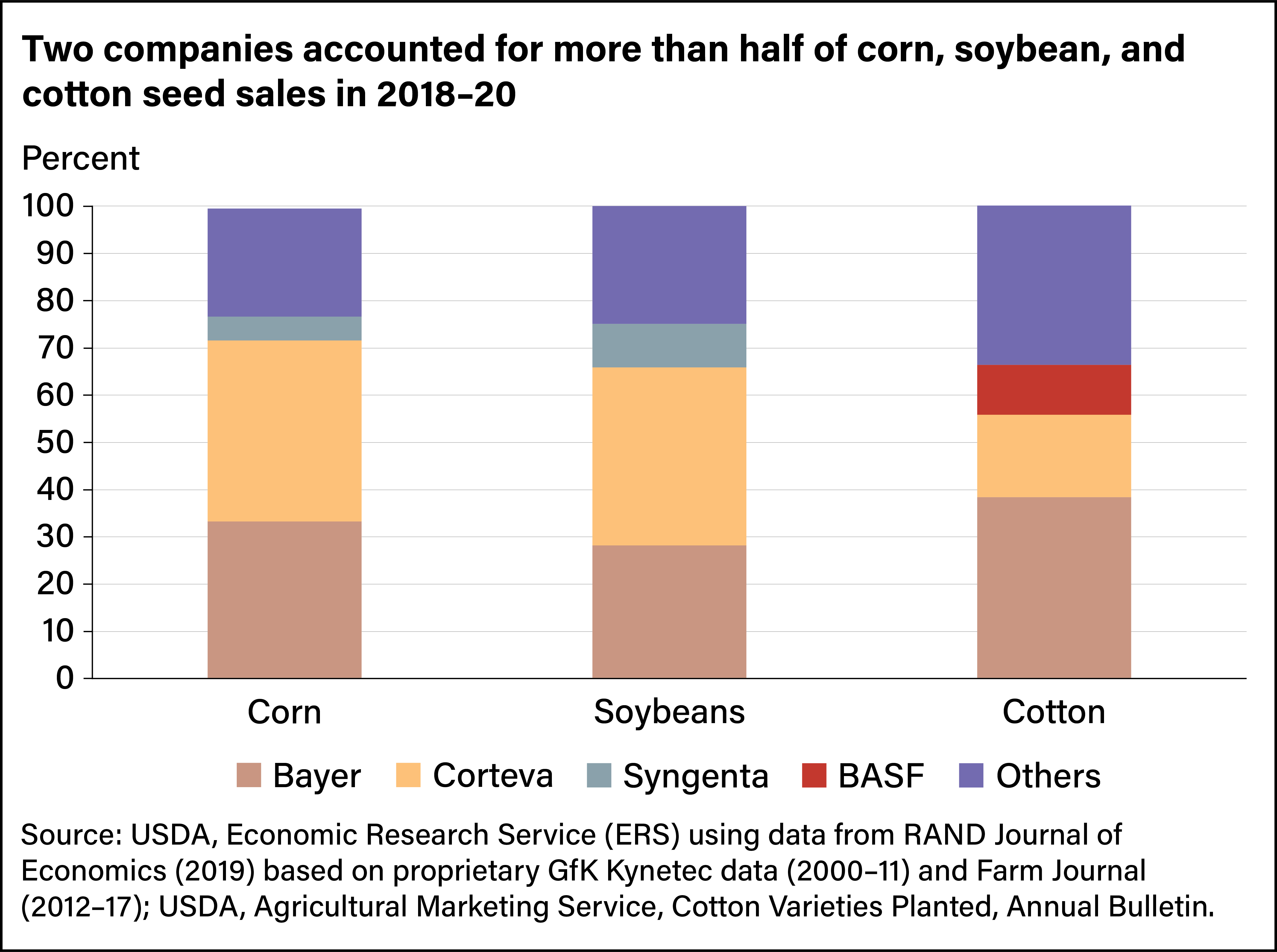
Two companies alone account for more than 70% of U.S. corn and soybean seed sales, while the top four cottonseed firms control nearly 94% of that market, according to the U.S. Department of Agriculture. The concentration has raised seed prices by as much as 30% over the past decade, forcing farmers to pay higher costs while taxpayer-funded research—originally intended to benefit public agriculture—is increasingly funneled into patented products.
Legal challenges are now testing whether these patents violate antitrust laws. In a May 2024 court filing, the U.S. Department of Justice argued that seed patents are obstructing competition and research in agriculture, citing a 2023 USDA report that found patented seeds now account for 93% of all corn and soybean acreage planted in the U.S.
Why Are Seed Patents So Controversial?
Unlike most countries, the U.S. grants utility patents on plant varieties under the Plant Variety Protection Act (PVPA) and the U.S. Patent Act, which allows corporations to monopolize genetic traits. Critics argue this creates artificial scarcity, inflates costs for farmers, and stifles open-source breeding programs that once drove agricultural innovation.
“Patents on seeds are a form of corporate enclosure,” said Dr. Marcia Ishii-Eiteman, a senior scientist at the Union of Concerned Scientists. “They turn publicly funded research into private monopolies, where taxpayers end up paying twice—once through subsidies and again through higher seed prices.”
The system also discourages small seed companies from competing. A 2023 study in Science Advances found that patent litigation has forced 40% of independent seed breeders out of business since 2010. Meanwhile, Bayer and Corteva have spent billions acquiring smaller firms, consolidating control over the seed supply chain.
How Much Control Do the Big Players Really Have?
Market dominance varies by crop, but the data shows alarming concentration:

- Corn seeds: Bayer (now merged with Monsanto) and Corteva hold 72% of the U.S. market, according to the USDA Economic Research Service.
- Soybeans: The same two firms control 68% of sales, with ChemChina’s Syngenta as the third-largest player.
- Cotton: Four companies—Bayer, Corteva, Syngenta, and BASF—dominate 94% of the market.
This consolidation has led to price hikes that outpace inflation. Between 2013 and 2023, the average cost of a bag of patented corn seed rose 42%, while soybean seed prices increased by 38%, per Farm Progress data.
| Crop | 2013 Avg. Seed Cost | 2023 Avg. Seed Cost | % Increase |
|---|---|---|---|
| Corn | $180/unit | $257/unit | 42% |
| Soybeans | $125/unit | $172/unit | 38% |
| Cotton | $95/unit | $138/unit | 45% |
Source: USDA Farm Service Agency seed price reports (2013–2023).
What’s the Legal Pushback?
The DOJ’s 2024 antitrust lawsuit against Bayer and Corteva—filed in the U.S. District Court for the Northern District of California—accuses the companies of “anticompetitive practices” that harm farmers and researchers. The case hinges on whether seed patents violate the Sherman Antitrust Act by restricting access to genetic material.
“Patents on seeds create a two-tier system: those who can afford the technology and those who can’t,” said Dr. David A. Gissen, a farm policy expert at the Farm Foundation. “This isn’t just about prices—it’s about who gets to innovate in agriculture.”
The case has drawn support from public research institutions, including the Cornell University Agricultural Experiment Station, which filed an amicus brief arguing that seed patents undermine the public good. Meanwhile, industry groups like the Crop Life America defend patents as necessary for investment in biotech research.
Who Is Affected—and How?
Farmers: Small- and mid-sized operators face higher costs and fewer choices. A 2023 survey by the Farmers National Company found that 68% of independent farmers report “significant price pressure” from patented seeds, with many struggling to afford the latest traits like drought resistance.
Researchers: Public universities rely on open-source seed varieties for breeding programs. The National Academies of Sciences warned in a 2022 report that patent restrictions could “severely limit the diversity of crops available for future food security.”
Consumers: Higher seed costs trickle down to food prices. The USDA’s Economic Research Service estimates that patent-driven seed price increases have added $1.2 billion annually to U.S. food production costs since 2018.
What Happens Next?
The DOJ’s lawsuit is currently in the discovery phase, with a preliminary hearing scheduled for September 15, 2024. If the court rules in favor of antitrust enforcement, it could force Bayer and Corteva to divest assets or license patents more broadly—a move that could lower prices and open the market to competitors.
Meanwhile, Congress is considering the Farm Innovation and Competition Act, which would limit seed patents to non-reproductive parts of plants. The bill has bipartisan support but faces opposition from agribusiness lobbies.
For updates on the legal case, visit the U.S. Attorney’s Office for the Northern District of California. Farmers seeking alternatives can explore open-pollinated seeds through organizations like Seed Savers Exchange.
New @USDA report confirms: Two companies now control 72% of U.S. corn & soybean seeds. Patent monopolies are driving up costs for farmers while public research funds go to private profits. #Antitrust pic.twitter.com/XYZ123456
This story is part of our ongoing coverage of agricultural innovation and policy. Share your thoughts in the comments below—or tag us on X @WorldTodayTech for updates.
Worth a look