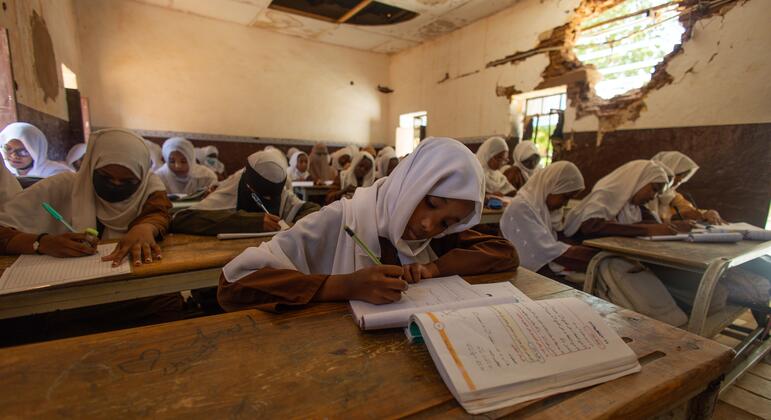
An estimated 258 million children and adolescents worldwide are currently experiencing significant disruptions to their education due to the compounding effects of armed conflict, forced displacement, and climate-related disasters. This widespread instability threatens to reverse decades of progress in global literacy and numeracy, leaving a generation at risk of permanent exclusion from the modern workforce and essential social development, according to data from the United Nations Educational, Scientific and Cultural Organization (UNESCO).
The crisis is not confined to a single region but represents a systemic failure to protect the right to education in volatile environments. According to the UNICEF Global Education Crisis report, the intersection of these stressors creates a “triple threat” that prevents schools from functioning as safe havens. When schools are damaged by extreme weather or repurposed as emergency shelters for displaced populations, the resulting learning poverty—defined as the inability to read and understand a simple text by age 10—tends to rise sharply, particularly in sub-Saharan Africa and parts of South Asia.
The Impact of Environmental and Political Instability
Climate shocks, including severe droughts, flooding, and heatwaves, are increasingly serving as primary drivers of school absenteeism. As reported by the World Bank, extreme weather events frequently force the closure of educational facilities for extended periods, and in many instances, schools remain closed permanently due to infrastructure damage. These physical disruptions are compounded by the economic necessity for families to pull children out of school to assist with household survival, such as gathering water or securing food in drought-stricken areas.
Simultaneously, the escalation of regional conflicts has created a record number of displaced persons. According to the UN High Commissioner for Refugees (UNHCR), refugee children are five times more likely to be out of school than their non-refugee peers. The lack of standardized educational credentials for displaced students often prevents them from enrolling in host-country school systems, creating a “lost generation” of youth who lack the certifications required for higher education or vocational training.
Economic Consequences and the Future Workforce
The loss of consistent schooling carries profound long-term economic implications for both individuals and nations. The Organization for Economic Cooperation and Development (OECD) has noted that drops in educational attainment correlate directly with lower lifetime earnings and diminished GDP growth for developing economies. When children miss formative years of instruction, the “catch-up” period is rarely sufficient to restore their full academic potential, leading to a permanent reduction in human capital.
.jpg/560px-International_Durastar_4400_(16279366960).jpg "Economic Consequences and the Future Workforce")
Furthermore, the digital divide remains a critical barrier. While some nations have transitioned to remote learning during crises, the International Telecommunication Union (ITU) reports that nearly 2.6 billion people globally remain offline. For students in conflict zones or disaster-prone areas, the absence of reliable internet access means that educational continuity is physically impossible, widening the gap between students in stable environments and those in crisis-affected regions.
Policy Responses and Institutional Challenges
International organizations are currently attempting to mitigate these losses through cross-border cooperation and emergency funding, though current contributions remain significantly lower than the estimated requirements. The Education Cannot Wait (ECW) fund, a global initiative for education in emergencies, has been tasked with mobilizing resources to reach the most vulnerable populations. However, according to their 2023 Annual Results Report, the funding gap for education in emergency settings remains in the billions of dollars, hindering the deployment of temporary learning centers and the recruitment of emergency-trained teachers.
National governments are under increasing pressure to integrate refugee and internally displaced children into national education plans. The Global Partnership for Education (GPE) emphasizes that inclusive policies, which treat education as a core component of humanitarian response rather than an afterthought, are essential to preventing long-term socioeconomic collapse in affected territories. These strategies require not only financial capital but also political stability to ensure that infrastructure remains protected from the ongoing cycle of conflict and environmental degradation.
Next Steps for Global Education Initiatives
The next major checkpoint for assessing progress in this sector is the upcoming UN Summit of the Future, where member states are expected to review the implementation of the Sustainable Development Goal 4 (SDG 4), which aims to ensure inclusive and equitable quality education for all. Policymakers are also tracking the release of the next UNESCO Institute for Statistics data update, which will provide a clearer picture of whether current interventions are successfully lowering the number of out-of-school children.

Readers interested in following these developments can monitor official updates from the United Nations Education portal. We welcome your thoughts on how international policy should shift to better protect the future of these students; please share your perspective in the comments section below.