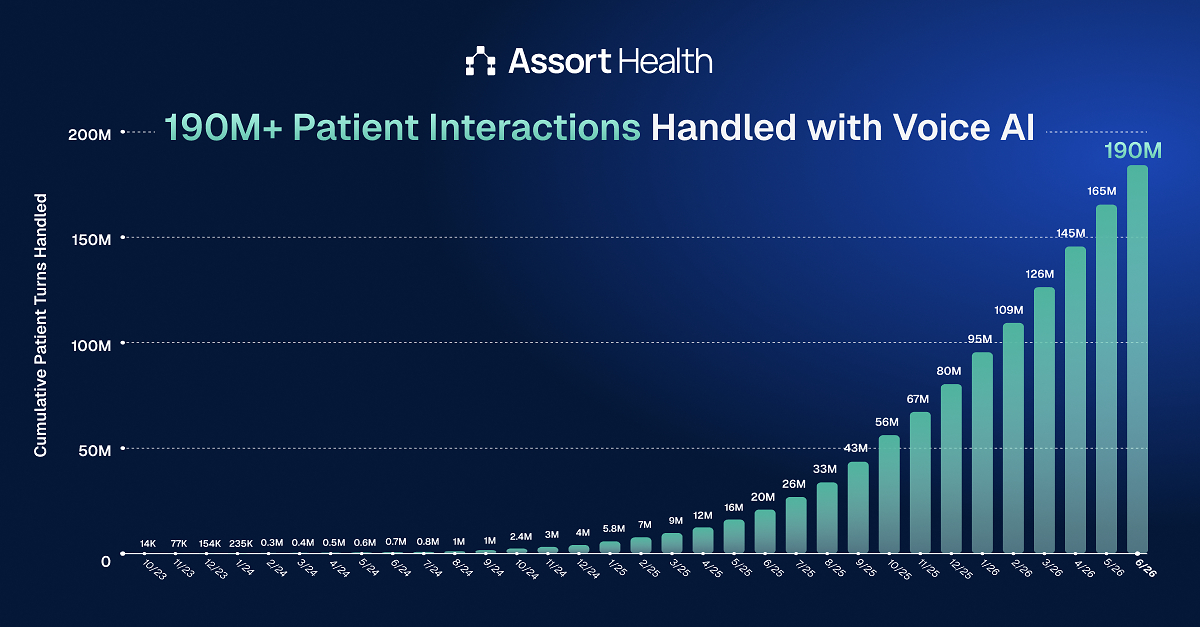
Assort Health, a developer of patient access automation software, has secured $120 million in Series C funding, reaching a $1.2 billion valuation. The investment, led by Menlo Ventures, brings the company’s total external financing to over $222 million, according to company disclosures. This capital infusion supports the firm’s transition from providing specialized voice-automation tools to deploying a comprehensive, AI-driven administrative platform for large-scale health systems.
The company’s platform, which integrates with electronic health record (EHR) systems like Epic and Athenahealth, is designed to automate complex ambulatory workflows including patient scheduling, intake, and insurance verification. By utilizing a proprietary AI model named Synapse, the platform aims to reduce the administrative burden on clinical staff, with reported gains in operational capacity for early adopters such as John Muir Health.
Scaling AI for Complex Ambulatory Environments
The core challenge in ambulatory care, particularly within high-acuity specialties like orthopedics or neurology, is the complexity of routing patients to the correct care pathway. Unlike general-purpose language models, Assort Health’s Synapse model is trained on a specific dataset comprising 190 million patient voice interactions, 62,000 clinical care protocols, and 1.6 million distinct decision pathways. This specialized training allows the system to manage nuanced requests without requiring constant human intervention, according to technical documentation provided by the firm.
The system operates through four primary modules that function as an integrated administrative layer:

- Concierge: Manages inbound patient communications, including multi-lingual scheduling and clinical triage requests.
- Activate: Automates proactive outreach to address referral loops, no-shows, and outstanding patient balances.
- Orchestrate: Handles backend documentation, writing encounter details directly into the EHR system.
- Empower: Functions as a decision-support tool for human staff, offering performance analytics and custom agent deployment capabilities.
By automating these tasks, health systems aim to address labor shortages and rising administrative costs. For example, John Muir Health has utilized these agents to manage patient traffic, with the provider reporting a 115% increase in administrative labor capacity and a 5% rise in net appointment volume, according to data shared during the funding announcement.
The Role of Patient Journey Memory
A significant differentiator for the platform is its “Patient Journey Memory” architecture. Traditional automation tools often treat every patient interaction—whether a phone call, a text message, or an online form—as a standalone event. In contrast, Assort Health’s system maintains a continuous, longitudinal record of a patient’s history, preferences, and insurance status across all communication channels.

This persistent data layer allows the AI to recognize a returning patient’s context instantly, which can reduce the need for patients to repeat information. “They’ve built not just another point solution, but a unified platform of AI agents that elevates the entire patient journey,” said JP Sanday, a partner at Menlo Ventures who has joined the Assort Health board of directors. This approach is intended to improve patient retention and reduce the friction that leads to care gaps.
Market Growth and Future Outlook
Assort Health has reported a 20x increase in revenue over the last 15 months, a period marked by its expansion from smaller provider groups into larger academic medical centers and enterprise health networks. This growth trajectory reflects a broader trend in healthcare technology, where providers are increasingly seeking to integrate AI agents directly into their existing EHR infrastructure to avoid fragmented software ecosystems.
The current expansion phase focuses on standardizing these AI workflows across diverse clinical environments. As the company scales, the efficacy of its “Synapse” model in maintaining high resolution rates during “edge case” scenarios—such as complex medical scheduling conflicts—will remain a primary metric for health system administrators evaluating the platform’s safety and reliability.
While the firm has secured significant backing, its long-term success depends on consistent performance metrics across varied health systems and the integration of evolving clinical protocols. As of the latest update, the company continues its commercial rollout, with further deployments expected throughout the coming fiscal year. Readers interested in the implementation of these technologies in clinical settings can monitor official updates from participating health systems or the company’s own portal for ongoing case studies.
- Why Resistance Training Is the ‘Fountain of Youth’ for Healthy Aging
- AI-Generated Synthetic Viruses Created From Scratch to Fight Superbugs
- FBI Joins Investigation Into Series of Murders in Roswell, New Mexico (news-usa.today)
- FDA Approves Groundbreaking mRNA Vaccine Booster for Adults 50+, Boosting Immunity and Protecting Against Chronic Health Risks (archyworldys.com)