
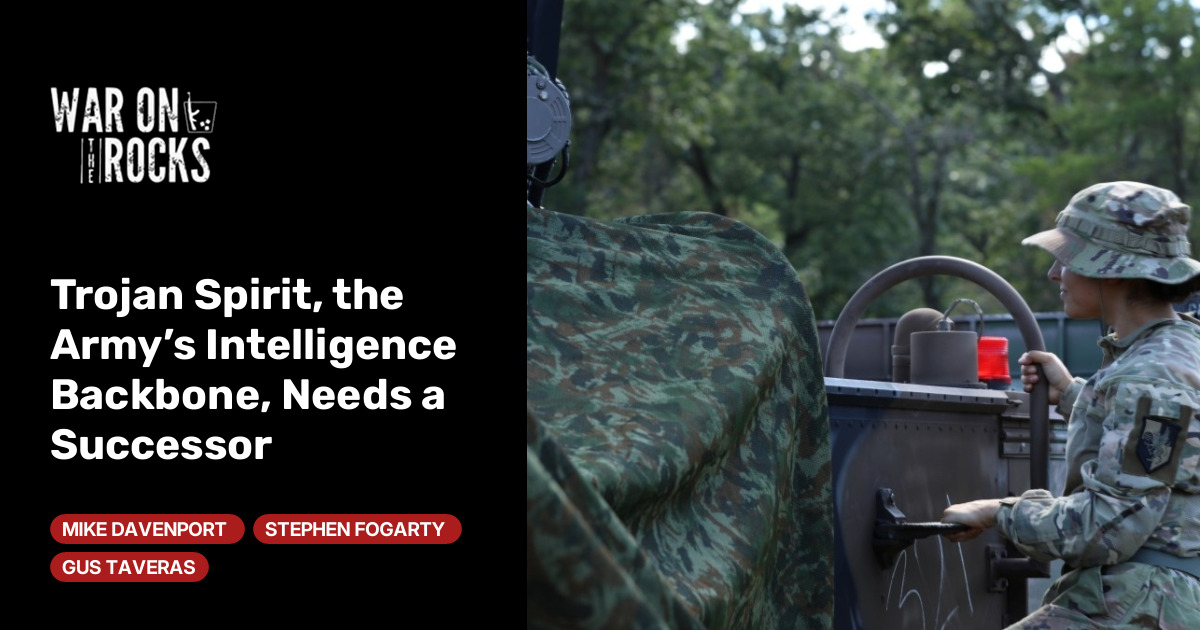
The U.S. Army is seeking a successor to the Trojan Spirit system, a program that served as the Army’s Intelligence Backbone. Originally developed to solve the problem of too many systems and databases for intelligence collection and analysis, the system is now being evaluated for a successor. The Army must prioritize a more integrated replacement to ensure warfighters maintain access to actionable intelligence.
Trojan Spirit, which transitioned out of development and into operational deployment during Operation Desert Storm, represented a significant shift in military communications. By allowing deployed commanders to access the latest intelligence from three-letter agencies through a mobile, satellite-linked platform, the system effectively bridged the gap between national-level collection and the tactical edge. The program’s ability to move data across disparate networks fundamentally changed the battlefield.
The Evolution of Tactical Intelligence
The strategic barrier that birthed Trojan Spirit in the late 1980s and early 1990s remains a challenge: there were too many systems and databases for intelligence collection and analysis, some centralized and some forward deployed, and little access to practical insights. In 1990, the challenge was getting intelligence from three-letter agencies to deployed commanders in the middle of nowhere.
During the Gulf War, Trojan Spirit introduced the concept of the “reach-back” capability, enabling units to request and receive intelligence that would have otherwise been inaccessible. This capability fundamentally changed the battlefield. It transformed the commander’s view of the battlespace, moving from localized awareness to a broader intelligence picture.
Defining the Need for a Successor
The current push to replace Trojan Spirit is driven by the necessity to address the strategic barrier of too many systems and databases. The goal for a successor system is to move to a data-centric environment where intelligence is automatically processed and pushed to the relevant user.
A modern successor is expected to be software-defined and network-agnostic. This ensures that intelligence can be accessed through any secure terminal, reducing the logistical footprint and increasing the resilience of the communications network.
Operational Challenges and Modernization
Transitioning from a legacy system presents significant logistical hurdles. The Army’s intelligence community must maintain operational continuity while upgrading to new platforms. These challenges underscore the complexity of replacing a system that has been the primary conduit for intelligence.

Furthermore, the threat landscape has evolved. While the original Trojan Spirit was designed to operate in an environment where the U.S. maintained electromagnetic superiority, a successor must function in an environment where communications and satellite links are subject to electronic warfare and jamming. Future systems must prioritize signal security and anti-jamming capabilities, moving away from the vulnerability inherent in centralized, high-power satellite transmissions.
Future Outlook
The Army has not yet announced a singular replacement for the entirety of the Trojan Spirit mission. The service continues to conduct field trials and modernization exercises to test how these new technologies perform under simulated combat conditions.
As the military moves forward with these upgrades, the focus remains on ensuring that the tactical edge never loses its window into the broader intelligence network. The transition will likely be incremental, replacing specific nodes of the Trojan Spirit network with new, cloud-integrated terminals before moving to a fully modernized architecture.
What are your thoughts on the transition from legacy intelligence systems to cloud-based architectures? Join the conversation by sharing this article or leaving a comment below.