
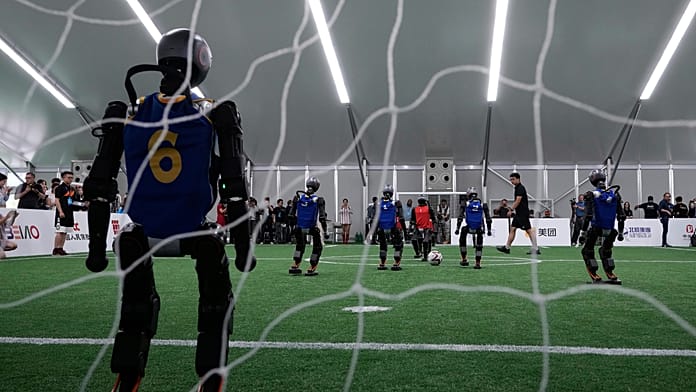
Humanoid robots recently demonstrated advanced mobility and coordination skills during the RoboCup 2024 competition held in Incheon, South Korea. The event, which serves as a global testing ground for autonomous robotics, featured teams of bipedal machines navigating a football pitch, executing complex maneuvers, and responding to dynamic environmental changes in real-time. According to the RoboCup Federation, the tournament aims to promote research in artificial intelligence and robotics, with the ultimate goal of developing a team of humanoid robots capable of defeating the winners of the FIFA World Cup by 2050.
The competition in Incheon highlighted significant technical strides in humanoid stability, vision processing, and collaborative decision-making. Unlike remote-controlled devices, these robots operate autonomously, relying on onboard sensors and localized computing to interpret the game state and execute movements. This year’s matches underscored the transition from simple, pre-programmed motions to fluid, adaptive behaviors that mimic human-like agility on the field.
The Evolution of Autonomous Robotics in Sport
RoboCup has evolved from its inception in 1997 into a comprehensive scientific initiative involving thousands of researchers globally. The humanoid league is widely considered the most technically challenging division due to the constraints of maintaining balance while performing high-speed physical tasks. As reported by the Institute of Electrical and Electronics Engineers (IEEE), the primary challenge remains the latency between sensor input—such as detecting the ball’s trajectory—and the motor output required to strike it accurately.

In recent years, the integration of machine learning has allowed robots to improve their gait patterns and obstacle avoidance strategies through iterative simulations. The robots seen in Incheon utilize sophisticated camera arrays to map the playing field, identifying teammates, opponents, and the ball without human intervention. This autonomy is critical for the long-term objective of the competition, as it forces developers to solve problems related to real-time energy management and mechanical durability under stress.
Technical Challenges and Engineering Milestones
The performance of humanoid robots on the football pitch serves as a proxy for their potential utility in disaster response, elderly care, and manufacturing. The mechanical engineering required for a robot to recover from a fall or navigate uneven turf is directly applicable to search-and-rescue scenarios. According to Nature, research presented at international robotics forums often cites the “Humanoid League” as a vital benchmark for testing how machines interact with unstructured environments.
Spectators at the Incheon event observed notable improvements in the robots’ ability to maintain a center of gravity while accelerating. These developments are supported by advancements in actuator technology and lightweight, high-strength materials. The ability of these units to communicate with one another to coordinate defensive formations demonstrates a shift toward multi-agent systems, where individual units function as a cohesive, intelligent network rather than isolated machines.
Why RoboCup Matters for Future Technology
Beyond the competition, the data gathered during these matches provides a foundation for developing robots that can operate safely alongside humans. The focus on “social robotics” and human-robot interaction is a core component of the RoboCup roadmap. By standardizing the environment—the football pitch—researchers can isolate variables and measure progress against a consistent set of rules and physical conditions, as outlined in the official documentation for the 2024 event.
The impact of this research extends to the commercial sector, where companies are increasingly looking for ways to deploy humanoid robots in logistics and warehouse environments. The lessons learned in Incheon—specifically regarding energy efficiency and sensor fusion—are already influencing the design of next-generation robotic platforms intended for industrial use. As these machines become more adept at navigating complex social and physical spaces, the distinction between research projects and practical applications continues to narrow.
Looking Ahead: The Path to 2050
The RoboCup Federation maintains a rigorous schedule of regional and international events to ensure continuous development. The next major milestones will be determined by the technical committees, which adjust the competition rules annually to increase the difficulty level and push the boundaries of current hardware capabilities. Updates regarding future tournament locations and rule amendments are published periodically on the organization’s official portal.

As the field of robotics moves toward more generalized intelligence, the football pitch remains a definitive arena for testing the limits of bipedal locomotion. Whether the 2050 goal is met remains a subject of debate within the engineering community, but the steady progress displayed in South Korea suggests that the gap between human and machine performance is closing. Readers interested in the specific technical papers or match results from the Incheon event can access the archives maintained by the RoboCup Federation. Comments and discussions regarding the future of humanoid robotics are encouraged in the section below.