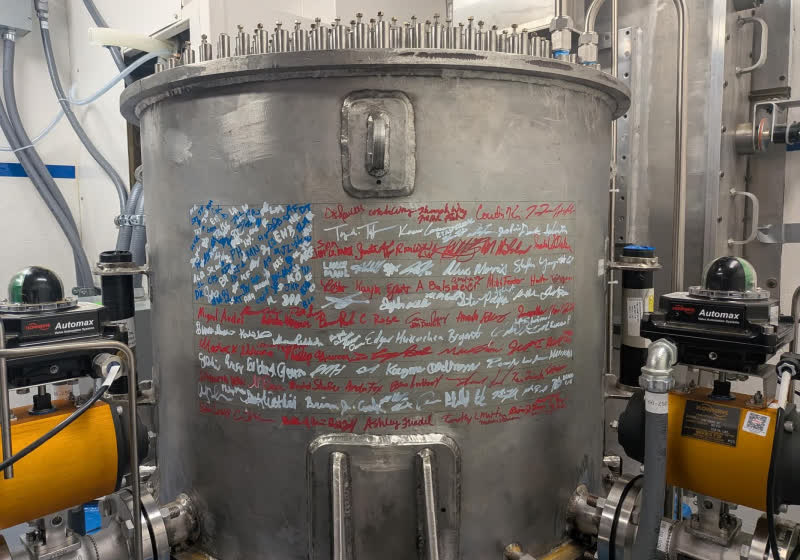
Three U.S.-based microreactors have reached criticality, marking a significant milestone in the Department of Energy’s effort to accelerate advanced nuclear demonstrations. The Unity reactor, developed by Houston-based Deployable Energy, is the latest to achieve this state, following similar achievements in June by reactors from Torrance-based Antares and El Segundo-based Valar Atomics.
Criticality occurs when a nuclear reactor achieves a self-sustaining chain reaction, a prerequisite for generating power. These developments come as hyperscale data center operators seek carbon-free, baseload power sources to meet the surging electricity demands of artificial intelligence workloads.
The U.S. Department of Energy (DOE) is coordinating these demonstrations to reduce the time and cost associated with bringing advanced nuclear designs to market. By supporting a diverse portfolio of microreactor technologies, the agency aims to create decentralized power grids capable of supporting remote industrial sites and high-density computing hubs.
How Microreactors Differ From Traditional Nuclear Plants
Microreactors are a subset of Small Modular Reactors (SMRs), typically defined as producing fewer than 10 megawatts of electricity. Unlike traditional large-scale nuclear power plants, which require massive cooling infrastructures and years of on-site construction, microreactors are designed for factory fabrication and rapid deployment.
According to the U.S. Department of Energy, these systems often utilize advanced fuels and coolants—such as molten salts or liquid metals—instead of the pressurized water used in conventional reactors. This allows them to operate at higher temperatures and lower pressures, which can enhance safety by reducing the risk of coolant loss accidents.
The “modular” nature of these reactors means they can be transported via truck or shipping container and installed in a “plug-and-play” fashion. For data center operators, this eliminates the need to wait for utility companies to expand the existing electrical grid, which currently faces significant bottlenecks in many U.S. markets.
Why AI Data Centers Are Targeting Micro-Nuclear Power
The rapid adoption of Large Language Models (LLMs) has shifted the energy profile of data centers. AI chips, such as the Nvidia H100 and Blackwell series, require significantly more power per rack than traditional CPUs, leading to a spike in electricity consumption that traditional renewable sources cannot always meet due to intermittency.

Data centers require “five-nines” reliability (99.999% uptime). While solar and wind provide clean energy, they require massive battery storage or natural gas backups to maintain stability. Microreactors provide a constant, carbon-free baseload that can be situated directly on-site, effectively creating a “behind-the-meter” power solution.
This trend is already visible among the largest cloud providers. Microsoft recently signed a power purchase agreement with Constellation Energy to restart a reactor at Three Mile Island, while Amazon Web Services (AWS) has invested in SMR technology through its partnership with X-energy. The success of the Unity, Antares, and Valar reactors suggests that even smaller, more agile nuclear options are becoming technically viable.
The Role of the Department of Energy in Nuclear Acceleration
The achievement of criticality for these three reactors is part of a broader federal strategy to maintain U.S. leadership in nuclear technology. The DOE has focused on “accelerated demonstrations,” providing funding and regulatory guidance to help private firms move from theoretical designs to physical prototypes.
A primary hurdle for these companies is the U.S. Nuclear Regulatory Commission (NRC). The NRC’s traditional licensing framework was built for giant light-water reactors, not transportable micro-units. The DOE is working with regulators to streamline this process, focusing on “risk-informed” licensing that accounts for the inherently safer designs of advanced reactors.
By funding multiple competing designs—including those from Deployable Energy, Antares, and Valar Atomics—the government is avoiding “single-technology risk.” This competitive approach allows the market to determine which coolant or fuel type is most efficient for specific use cases, such as military bases or urban data clusters.
Comparing the Three Recent Milestones
While all three reactors reached criticality, they represent different approaches to the micro-nuclear challenge. The Unity reactor from Deployable Energy focuses on high-density energy deployment, while Antares and Valar Atomics have focused on different thermal efficiencies and fuel cycles.
The timing of these events is notable. Antares and Valar Atomics both cleared the criticality hurdle in June, creating a momentum shift that Deployable Energy joined with the Unity reactor. This cluster of successes indicates that the engineering challenges of maintaining a controlled chain reaction in a miniaturized environment are being solved more rapidly than previously projected.
Industry analysts note that the transition from “criticality” to “commercial power” is the next major hurdle. Reaching criticality proves the physics of the reactor works; the next step is proving the reactor can operate reliably for years without refueling and that the heat-to-electricity conversion is economically viable.
Potential Challenges and Regulatory Hurdles
Despite the technical success of these three reactors, several non-technical barriers remain. Fuel procurement is a primary concern. Many advanced reactors require High-Assay Low-Enriched Uranium (HALEU), a fuel type that has historically been supplied largely by Russia.

The U.S. government is currently investing in domestic HALEU production to ensure that companies like Deployable Energy and Valar Atomics are not dependent on foreign adversaries for their fuel supply. Without a steady domestic pipeline of HALEU, the scaling of microreactors will remain limited to small-scale demonstrations.
Public perception and siting also remain volatile. Even though microreactors are smaller and designed with passive safety features—meaning they can shut down without human intervention or external power—local opposition to “nuclear in the backyard” continues to be a risk for data center developers.
What Happens Next for Advanced Nuclear
The immediate focus for Unity, Antares, and Valar Atomics will be long-term stability testing. These reactors must demonstrate that they can modulate power output to match the fluctuating loads of a data center without compromising safety or fuel integrity.
The industry is now watching for the first “commercial-scale” deployment. While these three reactors are demonstrations, the goal is to move toward “fleet deployment,” where hundreds of identical microreactors are manufactured in factories and shipped to sites across the country.
The next confirmed checkpoint for the industry will be the upcoming NRC reviews of advanced reactor applications, which will determine if the current “demonstration” successes can be translated into permitted commercial operations. Updates on these filings are typically made available through the Nuclear Regulatory Commission’s public document system.
Readers interested in the intersection of AI and energy can follow official DOE announcements regarding the Advanced Reactor Demonstration Program (ARDP) for further updates on deployment timelines.
Do you think micro-nuclear is the way to sustain the AI boom, or should the focus remain on grid expansion and storage? Share your thoughts in the comments below.