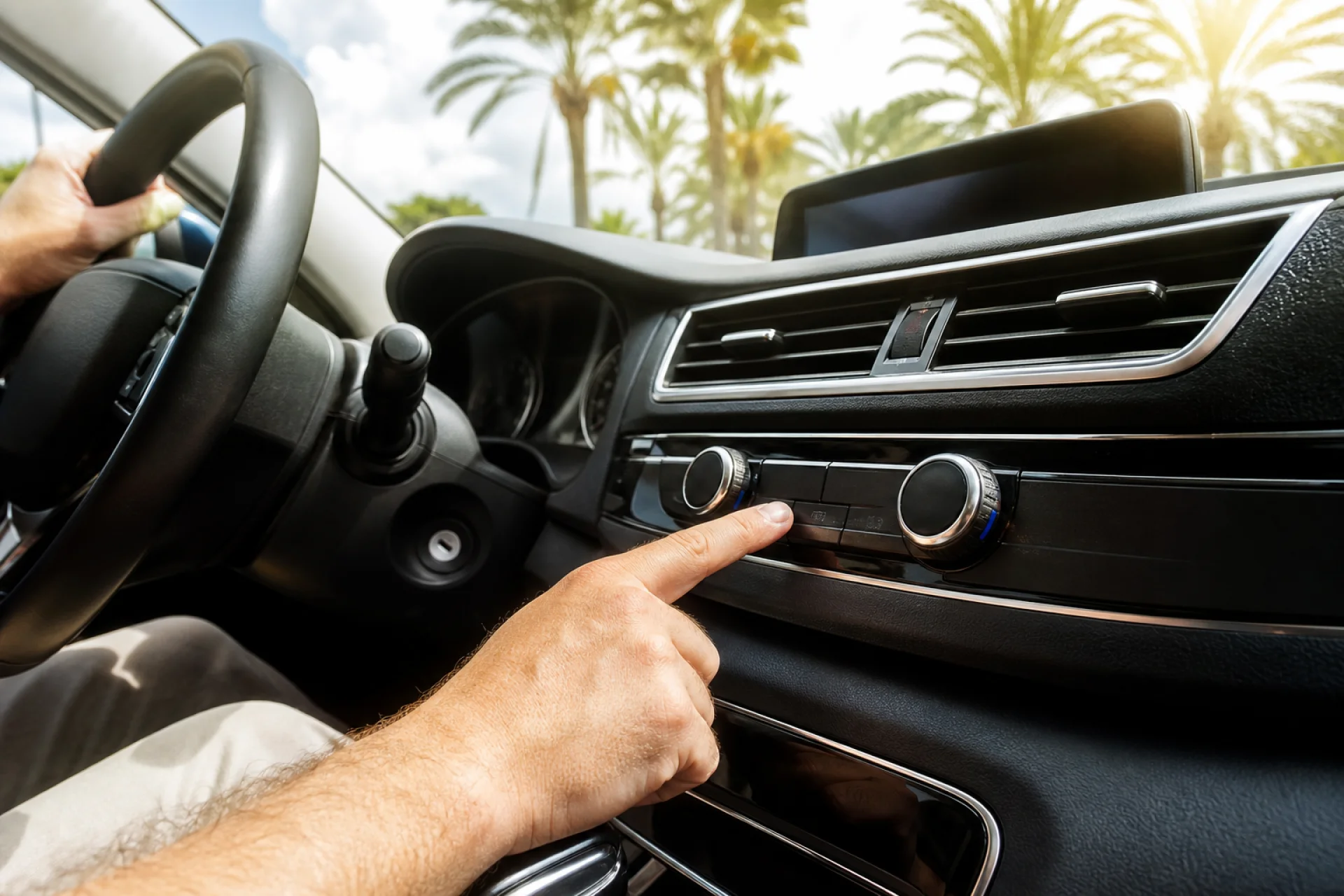
Drivers can reduce fuel consumption by up to 10% during heatwaves by using the interior air recirculation button on their dashboard, according to Selectra. This feature prevents the air conditioning system from constantly cooling hot outside air, instead recycling and chilling the air already inside the cabin, which lowers the load on the engine.
The use of air conditioning (AC) significantly increases a vehicle’s fuel consumption because the AC compressor is powered by the engine. According to Boursorama, this energy draw forces the engine to work harder, leading to a measurable spike in fuel usage.
How does the air recirculation button reduce fuel use?
The interior recirculation button changes where the HVAC system pulls air from. When deactivated, the system pulls fresh air from outside. During a heatwave, this means the AC must cool air that could be 35°C (95°F) or higher before it reaches the passengers.

When the recirculation button is active, the system closes the external intake and pulls air from within the cabin. Since this air has already been cooled, the compressor does not need to run at maximum capacity to maintain the set temperature. Selectra reports that this reduction in mechanical effort can lead to fuel savings of up to 10% in specific high-heat conditions.
However, this setting is not intended for permanent use. L’Auto-Journal notes that the button is a tool to “relieve” the air conditioning system rather than a permanent replacement for fresh air intake.
What is the actual cost of running car air conditioning?
The financial impact of AC usage varies based on the vehicle’s engine size and the external temperature. Boursorama indicates that AC usage causes fuel consumption to “jump.”
For most internal combustion engine (ICE) vehicles, the AC compressor is belt-driven. This creates a direct parasitic load on the engine. In electric vehicles (EVs), the AC is powered by the high-voltage battery, which reduces the overall driving range.
Why did air conditioning adoption differ between Europe and the USA?
The prevalence of factory-installed air conditioning in cars developed at different rates across the Atlantic. Frandroid reports that Europe took approximately 50 years longer than the United States to adopt air conditioning on a massive scale. This discrepancy was driven by both geography and economic priorities.
The United States faced extreme heat in the “Sun Belt” regions, making AC a necessity for mobility and commerce. In contrast, European climates were historically milder, and the higher cost of fuel—combined with smaller engine sizes—made the fuel penalty of AC less attractive to consumers and manufacturers.
Best practices for cooling a car efficiently
Comparing AC strategies and their impact
| Strategy | Fuel/Energy Impact | Primary Benefit | Primary Drawback |
|---|---|---|---|
| AC (Recirculation Mode) | Reduced (up to 10%) | Faster cooling/Lower fuel use | CO2 buildup over time |
The transition toward electric vehicles is further changing this dynamic. Because EVs do not have a combustion engine to power a belt-driven compressor, they use electric compressors. The energy still comes from the battery, meaning that extreme AC use in an EV directly reduces the distance the car can travel on a single charge.
The “hidden” recirculation button remains one of the simplest tools for achieving this balance.