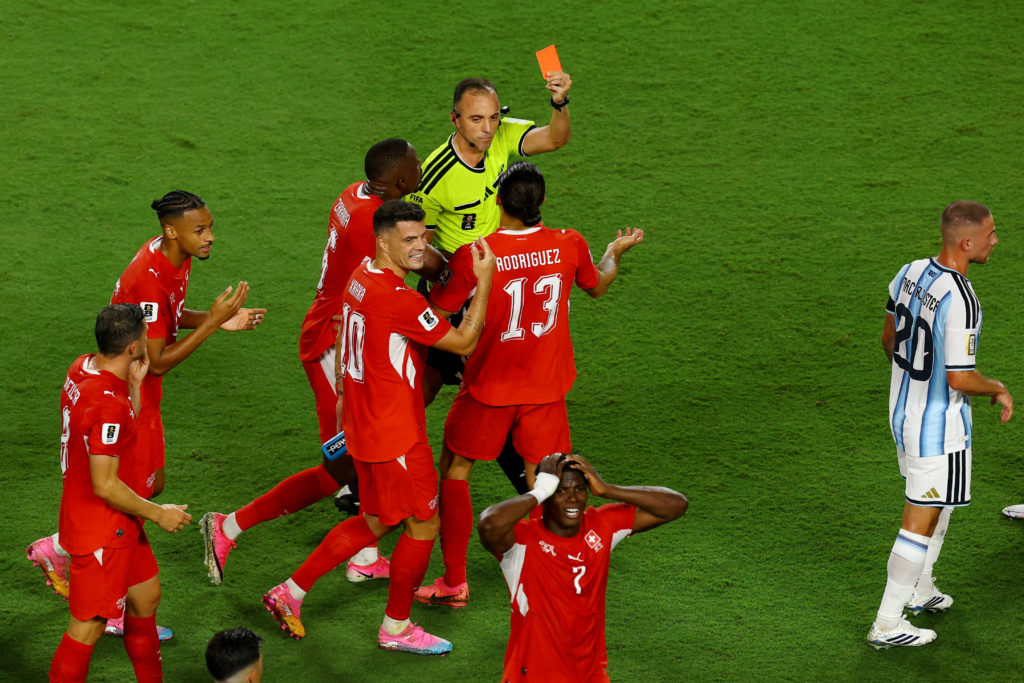
The implementation of Semi-Automated Offside Technology (SAOT) and refined Video Assistant Referee (VAR) protocols remains at the center of international football debates following recent high-profile officiating decisions. As governing bodies like FIFA and regional confederations continue to adjust the threshold for technological intervention, the application of these tools during tournament play, including matches involving teams like Switzerland and Argentina, highlights the ongoing friction between precision technology and the subjective nature of on-field disciplinary calls.
According to the FIFA Laws of the Game, VAR is restricted to four specific categories: goal/no-goal decisions, penalty decisions, direct red card incidents, and mistaken identity. The controversy often arises not from the technology itself, but from the interpretation of “clear and obvious” errors by the Video Assistant Referee and the match official’s reliance on the On-Field Review (OFR) monitor.
Refining the Precision of Offside Decisions
The introduction of Semi-Automated Offside Technology (SAOT) was designed to reduce the time spent on complex, frame-by-frame reviews. By utilizing dedicated optical tracking cameras mounted under the stadium roof, the system tracks up to 29 data points on each player’s body 50 times per second, according to FIFA’s official technology documentation. This data allows for the automated generation of an offside line, which is then verified by the video match officials before being communicated to the on-field referee.

While the technology provides high-fidelity spatial data, the human element remains a requirement for determining “active play.” The International Football Association Board (IFAB) continues to oversee the protocols that dictate when a player in an offside position is considered to be interfering with an opponent. This nuance often leaves spectators and players confused when a goal is disallowed for a marginal offside that is not immediately visible to the naked eye.
Disciplinary Thresholds and Red Card Reviews
Disciplinary decisions, such as the sending off of a player for violent conduct or serious foul play, represent the most contentious application of VAR. Unlike objective offside lines, determining the “intensity” or “intent” of a tackle requires a qualitative judgment by the referee. Per the IFAB VAR Protocol, the referee is encouraged to use the pitch-side monitor to review footage when the decision involves a subjective assessment of a foul.
Recent criticism from fans often centers on the disparity between slow-motion replays—which can make any contact appear more severe—and the real-time speed of the match. Officials are trained to view incidents at full speed to gauge the nature of the contact, but the pressure to reach a definitive conclusion often leads to lengthy stoppages. The governing bodies maintain that the current protocol is necessary to ensure fairness, though they acknowledge that the “clear and obvious” standard remains a point of constant internal review.
Transparency and Communication Improvements
To address fan confusion, FIFA and various continental leagues have begun implementing live audio announcements for VAR decisions. This initiative, which allows the referee to explain the final ruling to the stadium and television audience, is intended to provide immediate context for why a decision was made. According to reporting from BBC Sport, this transparency measure is part of a broader push to bring the decision-making process into the public domain.
Despite these efforts, the gap between the speed of technology and the complexity of the rules remains a challenge. The reliance on frame-by-frame analysis continues to spark debate over whether the “spirit of the game” is being sidelined in favor of mathematical perfection. As the technology matures, the focus of regulatory bodies like IFAB remains on balancing the need for accuracy with the flow of the game.
The next major update regarding officiating standards and potential rule adjustments is expected to follow the conclusion of the current tournament cycle, with IFAB’s annual general meeting serving as the primary forum for discussing potential modifications to the Laws of the Game. Further updates on match officiating policies will be provided via the official IFAB website as they are finalized by the panel. We invite readers to share their thoughts on the current state of match officiating in the comments section below.
Related reading